
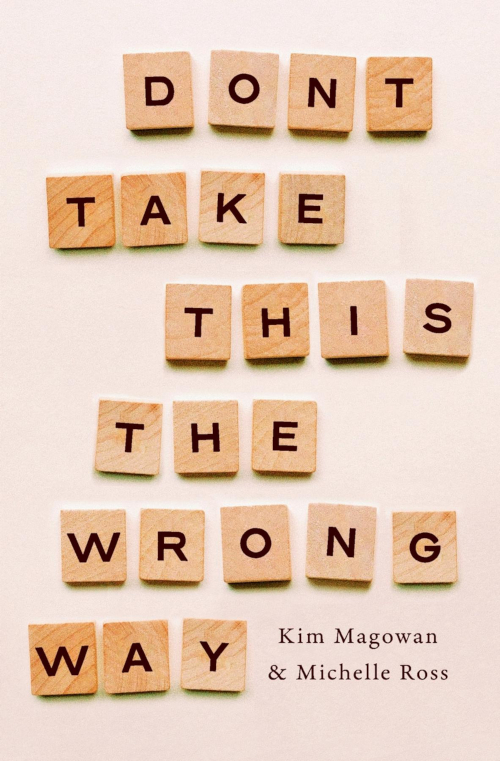
In Kim Magowan & Michelle Ross’ short story collection Don’t Take This the Wrong Way characters teeter on the edge of an epiphany. But they stumble before they can access any greater understanding of their lives.
Some stories feature parents who can’t connect to their children, refusing to see how their own behavior is alienating. Others showcase naïve, desperate people who idealize troubled families or condescending partners. Despite their limited self-awareness, these characters are compelling, and they allow Magowan & Ross to explore the comforting appeal of inertia.
Across their twenty-five, co-written stories, the authors make clear that they are most interested in avoidance. More particularly, how people deflect and deny the need to change. The protagonist in “The Cucumber in the Front Office,” for instance, rants about the decaying cucumber in her office’s fridge, a symbol, she thinks, of her degrading work and home environments. Rather address these issues, however, the protagonist merely complains about these things, unable to bring herself to trash “that damn cucumber,” or face the enormity of bettering her life.
Similarly, in “Oh-Oh-It’s-Cruel,” a brother and sister trade petty insults when their father gathers his family to discuss his will. The story is conveyed through alternating perspectives, and the only commonality that emerges from both characters’ accounts is that their mother’s death, which occurred when they were young, was harrowing. Thus, it’s easier to focus on what they dislike about each other rather than to dwell on their father’s inevitable death. While the siblings come across as clueless and self-involved, there is enough tragic backstory to make us feel compassion for characters that otherwise might be too flawed to be likeable.
When Magowan & Ross’ characters are capable of insight, however, the results are astonishing. One of the strongest stories, “Family Reunions: Inventories,” illuminates the reward of triumphing over one’s assumptions. The story is presented as a list of ethnographic observations that a protagonist makes when she returns home for a reunion. These observations are tinged with anger, as is the case when she reads the bottles of shampoo in her shower and rearranges the words on them into “use, rage, wager, sweat, pervert, trap.” Part of her frustration arises from her belief that she’s superior to her family, but Magowan & Ross play with notions of distance to undermine their character’s haughtiness. The last observation in the story is the character’s realization that she has something “in common with Aunt Birdie, after all: they both love the word ‘potpourri,’” and the abrupt tonal shift between annoyance and joy unexpectedly reframes the character: deep down, she wanted to feel like she belonged.
Because nearly all these stories revolve around characters who struggle to interpret situations and behaviors clearly, they are best read slowly, rather than in quick succession. This is a book that demands some reflection after each story ends, especially given the authors’ interest in their characters’ psychological states.
The most memorable stories combine psychological exploration with mundane settings and characters. One such story “It Was Stapled to the Chicken,” charts a young man’s belief that his girlfriend has switched places with her friend. The details that distinguish her, like her “lips, which are puffy and remind [him] of knuckles,” are seemingly transferred to her friend, who acts as if the protagonist has been her boyfriend all along. While the story captures how men can never truly see the women they objectify, the protagonist reflects on his own mother who, after remarrying, calls her new husband the “‘love of [her] life,’” despite once saying the same about his dad. As this story suggests, we learn to live with, and reconcile, paradoxes in our everyday lives.
Formally playful at times, but always approachable, Magowan & Ross’ collection will appeal to anyone who has felt stifled by their circumstances or misunderstood by their loved ones. To truly know someone is rare, this collection posits. When characters finally do realize their own limitations prevented them from reading others accurately, they can only understand this because of hindsight or intense reflection, like the protagonist in “Twenty-three Safety Manuals,” who breaks off a relationship with a kind man because she feels he was not forthright enough about his past relationship. Six years later, however, she acknowledges that most people withhold information from those they love, a realization that is humbling despite being tragically late. Achingly bittersweet, the stories in Don’t Take This the Wrong Way succeed because they invite us to see our own flaws not as damning, but as ordinary.
Don’t Take This the Wrong Way, by Kim Magowan & Michelle Ross. EastOver Press, March 2025. 258 pages. $19.99, paper.
Emily Hall has a PhD in contemporary Anglophone fiction from the University of North Carolina at Greensboro. Her creative prose has appeared in places such as 100 Word Story, Cherry Tree, and Flying South, where she was a finalist for their 2024 creative nonfiction contest. Her academic criticism has appeared in places such as South Atlantic Review, The Journal of Medical Humanities, and Reception. She lives in North Carolina with her husband and two pets.
Check out HFR’s book catalog, publicity list, submission manager, and buy merch from our Spring store. Follow us on Instagram and YouTube. Disclosure: HFR is an affiliate of Bookshop.org and we will earn a commission if you click through and make a purchase. Sales from Bookshop.org help support independent bookstores and small presses.
 Heavy Feather Review