

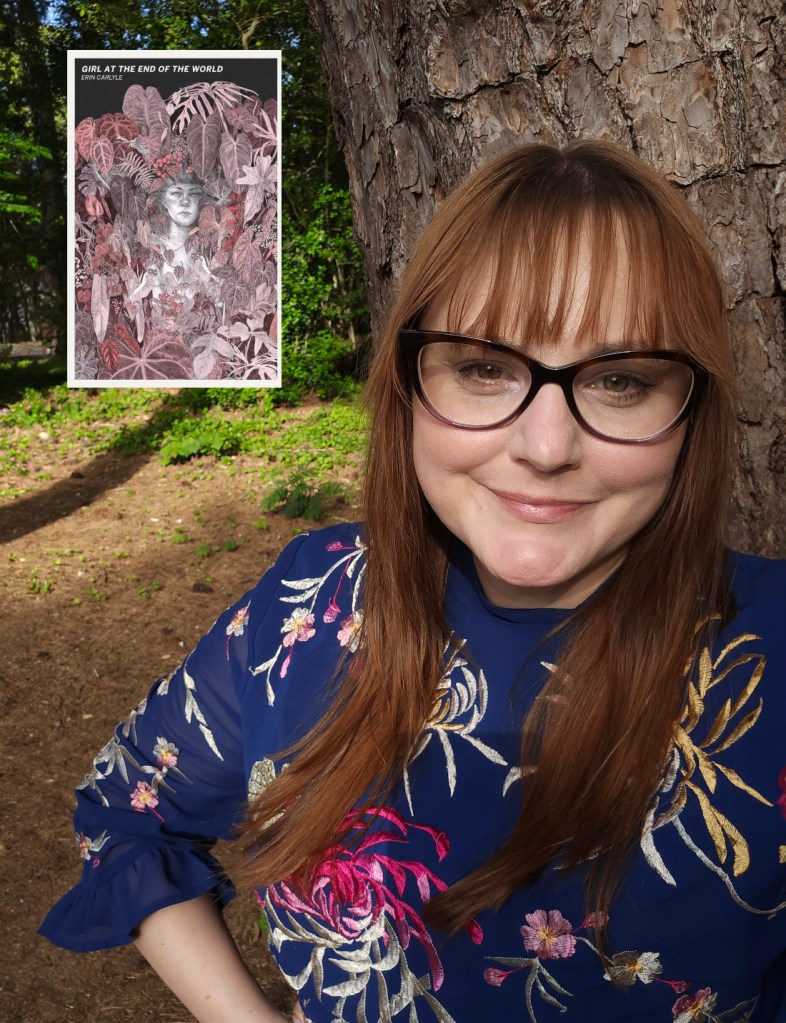
I’ve known Erin Carlyle for twelve years. We shared living spaces for ten of them—first as partners, then as spouses—and in that time we struggled together. Struggled to find a place to settle. A place of stability. A place we could call home. It was a depressingly mundane American story defined by movement, money, and death. We moved between corporate-controlled, high-rent dungeon apartments. We traveled the country on a limited budget to begin employment gigs that paid so little we lived paycheck-to-paycheck. And during it all, our dads died only one year apart, felled by different self-inflicted illnesses.
Language can hardly capture the dislocating traumas of a parent’s death, even when it’s a slow, years-in-the-making, expected event. But in the immediate aftermath of her father’s lost battle with opioid addiction, Carlyle dealt with the trauma of his loss in the only way she knew how. She expressed the inexpressible in language and form. Poetry became her method of recontextualizing a difficult childhood both lived and not lived with a complicated man who, struggling with addiction and a dying body, failed to support his children. A man who placed Erin in compromising situations, who abdicated his responsibilities as a father, but one who also exhibited moments of tenderness and emotional availability.
Erin’s poetry also directs its ire at the institutions that killed her father. For decades, the pharmaceutical industry, aided and abetted by doctors and health insurers, shilled opioids to unsuspecting patients on the promise of their low addiction potential. Erin’s life was defined, in large part, by the greed that fueled this false promise and relegated her parents and others like them to tragic lives of poverty and addiction. It is only natural that, after he died and we moved to California during the height of COVID, Erin couldn’t help but relate his loss with the death and destruction caused by the distant California fires that polluted the Sacramento air. As smog blanketed the skies, Erin could only think of the death and destruction of the homes and trees and wildlife further south.
Knowing a person intimately means coming to terms with knowing that you’ll never know everything about them. This interview, which I conducted alongside Olivia Ivings, emerged from a desire to understand what remains both enigmatic and confounding about Carlyle and her work. It provides fresh insight into her creative process, her poetic inspirations, the trauma that animated Girl at the End of the World, and the political and social upheavals that necessitated it.
Olivia Ivings & Shane Snyder: In what ways has your poetry evolved since your debut collection? What kind of relationship do you see between the two books? How do you imagine your work will change with your next collection (if you have any feeling for it yet)?
Erin Carlyle: In a way, I do see these two books as sisters. My first book, Magnolia Canopy Otherworld, was largely about growing up poor in The South, and in that book, I touched on a few of the same topics as I do in my second book such as girlhood, poverty, and the Opioid Crisis. But my new book is about the grief I endured from losing my father to his opioid and Xanax addiction. It still deals with girlhood, place, and poverty by looking at specific memories and impressions of this very complicated relationship.
Girl at the End of the World is a stronger and more cohesive book, and it not only takes on the death of my father and this personal tragedy that I have been healing from, but it also links that tragedy with ecological issues. I started writing this book in 2020 as my first book was being published, and when the US was deep into the pandemic lock down. I had lost my job, and my husband and I moved across the country to California to live with his father, so I had time to slow down and consider my work.
When we moved there, we were met with a particularly bad fire season, and so much so that many days the sky was orange, and you could smell fire all around. I was frightened and fascinated with the idea of fire season in California. I had visited California many times by this point, but this was my first time there during the fires. In the South we have tornados and, in some places, hurricanes, but the idea of fire completely decimating cities and forests, and that the air could be poison, was a very new fear for me. While fire season is not a new thing, human usage of the land in California has significantly exacerbated the problem. In my mind, I linked this environmental disaster with the death of my father and the opioid crisis. These became two manmade tragedies, and I was experiencing these deaths at the same time. I was processing them at the same time. This is why there is so much fire imagery in the poems as well as a series in the last section called “End of the World.”
My work with line and enjambment, which are the two areas of craft that interest me the most, has also matured. I’ve managed in recent years to create lines that can stand out on their own, but then move into enjambed breaks that are surprising or even shocking. In my first book, my interest in the line was just blossoming, and in this book that interest is much more apparent.
OI&SS: How did you choose the collection’s first poem? What does it represent to you, and how does it set up the themes and tone of the book?
EC: I think of the first poem in a collection as an introduction to the book’s themes. It creates the first impression. This is also the first impression a reader gets of my father. I chose a poem about my father siphoning gas in the night from neighborhood cars because I felt this glimpse of him accurately depicted a man who was tender, tragic, and, at times, irresponsible. While I loved him, he was a complex man who made decisions that had adversely impacted me and my brothers for our whole lives. The memory also confuses the speaker, and she asks several times if this was real or a dream of her father? For the speaker her father feels more myth than real. This first poem is invested in the contradiction and equivocation between myth and reality because grief forces a person to place an entire life into context.
As far as the craft of the book is concerned, I just wanted to set the tone. This is not a father who always protected his children, and this relationship was not easy to endure, but I still feel like this first poem empathizes with him. I hope the rest of the poems where he appears are also empathetic and loving. I hope that this book isn’t a reckoning, and it isn’t angry. These are love poems in a way, and this particular poem is a way of honoring a complex person honestly.
OI&SS: I’m interested in the weightiness of the collection compared to the tight, clean lines and frequent minimalist-leaning poems, particularly in the poems that span several pages, including the poem that spans the collection’s second section. How do you perceive the connection between form and content?
EC: When I write, I tend to consider the relationship between the poem’s themes and its look on the page. This likely stems from my background in visual art (although I don’t get to do it much anymore), and specifically in printmaking where the artist layers colors and images to create a new image. I see myself as building a poem through layers. I want each line to be almost a poem on its own, and then each of these poems build upon one another to create the whole of the poem.
I approach longer poems similarly. I’m building the whole with a series of images. It’s like those sections in science coffee table books with transparent images that reveal the body’s many systems—the nervous system, the circulatory system, the muscles and ligaments and tendons. You could look at the body as a whole, and you could turn the individual pages to read about specific parts of the body.
For instance, there is a poem in the middle of the book that acts as the second section. It’s a strange journey into the underworld, except this is through the books the speaker read as a child. Each of the little scenes in this poem builds this book-world, or they layer one book world on top of another to build a larger underworld that the speaker travels through to get to the other side of her grief and to literally get to the next section of the book.
OI&SS: The collection centers grief, particularly the loss of the speaker’s father. Has writing about grief changed your understanding of it?
EC: Yes, it did in that I got to sit with my feelings and translate them into art. I don’t mind confessing that I based this book on my experiences. Unfortunately, death is something that touches us all—there is no escape from it—but for me, knowing that logically and experiencing it emotionally didn’t match up. There was a complicated interaction between logic and emotion for me as the human experiencing grief, and I wanted to translate that into poetry. I’m sure it’s like that for many people, but I really couldn’t make his absence make sense. There have been so many times after he died when I will just have the thought to call him to argue about politics or just see what he was up to, and then I’d feel terribly empty because that was impossible. Writing this helped me figure all of that out.
The book also explores different aspects of grief. For example, I was really thinking about humanmade disasters. For example, some of the poems draw affective relationships between two humanmade disasters: the opioid crisis affecting the whole country and the worsening summer fire season along the west coast, where I was living while working on this book. I grieved the loss of wildlife and identified with people whose homes and, in some cases, loved ones didn’t make it. I felt grief for the people affected by these disasters, and it’s very painful and frightening to get sucked into something you have no control over. People have lost so much. People have lost their lives. Writing this book helped me make this connection. I could zoom out of my personal experience and feel a collective grief.
OI&SS: The collection feels Southern Gothic in the way it renders nature, childhood/adolescence, and the occult. How do you see the South in your poetry?
EC: This is not the first time that my work has been described as Southern Gothic. I think that makes sense in the way that I think about place in my work. My life in the South was a mixed bag. On the one hand, The South is an environmentally varied, beautiful place with people I love and care about. But on the other hand, it instilled feelings of fear and danger in me.
I guess you could say I was a latchkey kid, and I didn’t have a lot of supervision. I spent time in the beautiful woods, but in those woods were other people, some who lived there. I remember many times finding ripped up porno magazines strewn around the trees, and I would look at these images as a 6- or 7-year-old child. That’s just an example of how strange this space could be for a young girl. Also, there was always some old wives tales or stories passed on by other children about ghosts in the woods or even devil worshipers in the corn fields. There was a sense that a girl shouldn’t be out on her own. And I’d be remise if I didn’t mention the terrible history of slavery and oppression in The South as well. It’s a haunted place. This is how I see the South because this is how I experienced the land. That makes my version of the South feel dark and dangerous. American Gothic and specifically Southern Gothic heightens the monstrous nature of the land in the same way that English Gothic uses ruined manors or old homes. Southern Gothic highlights the dark and dangerous ways in which people have inhabited the land, and I feel that I am contributing to the genre through examining my own life.
OI&SS: The poems often reference childhood as a space of magic, trauma, and complexity. How do you approach writing about memory and the blurred lines between what is remembered, dreamed, or imagined? I am interested in how you balance reality with dream, fairytale, and horror.
EC: This is where poetry is the best! I’m not writing memoir even though I do admit these poems come directly from my life experiences, but poetry can inhabit a space where reality, dream, and horror collide. For instance, in the first poem in this book, my father takes me out with him while he looks around for neighbor’s cars that he can siphon gas from. The poem continuously asks if this is a dream or is this a memory. A poem can interrogate that liminal space between dream and memory or real and imagined. What is remembered and what is imagined have equal weight and both become true.
I have always been a daydreamer. I was just recently diagnosed with ADHD which answered so many questions for me about my life. One of the reasons my parents and teachers overlooked this in me is because it can often manifest as daydreaming or spacing out rather than hyperactivity. This is my general mode of being. I’m always in my head where what is remembered and/or dreamed is blurry. It’s a place of comfort to me, and I can see that this comes out in my writing. This is why poetry has always made sense to me as well. Poetry allows me to connect the many thoughts my brain naturally makes, and the revision process helps me focus in on these connections by cutting away the excess and layering the poem as I mentioned above. It’s a way I can make use of daydreaming.
OI&SS: The latter part of your collection reflects feminine energy embodied in the witch and the idea of magic power. Can you elaborate on how you see this energy functioning with grief and renewal?
EC: I see this section as a place where the speakers hold on to magical thinking, but however magical thinking doesn’t provide safety. I am not a magical thinker in my real life at all. I don’t practice magic and I’m not religious, but when I was a teenager, like so many young girls, I liked the idea of conjuring. I liked to read about witches, and when I was a teenager, about 15 or 16, I was undergoing an uncomfortable transition from childhood to adulthood, and the leftover vestiges of my childhood imagination let me accept magic. The speaker in the middle sections goes through an underworld of sorts through the books she read as child and emerges in a space where she could still accept magic. It’s not that this is a safe space because there is so much danger still in this section, but it’s a space of nostalgia for something that is lost.
This is a time when her dad was still alive, but even so, this section isn’t sentimental. The complex parental relationship is still there haunting the poems. This is why the last poem in the book isn’t a resolution. This speaker is back to her adult reality, and she’s back in the house after her father has died trying to help her mother through the first steps after his death. In this way my book is saying that there isn’t a magical solution to death and grief. I don’t know that I’m thinking about renewal at all. At the end of this book there is a Xanax and a glass of water and just the first steps forward.
OI&SS: The collection has a tension between having (stealing, borrowing, renting, owning) and not having (lack, loss, and the grief it produces). In what ways (other than topic) do you see this surfacing in the collection?
EC: Some of my earliest memories of my family have to do with lacking resources. Well before my dad had his first heart attack and started taking opioids, he had a hard time keeping work. We would learn later in his life that he had ADHD and undiagnosed bipolar disorder, which I’m sure worsened his impulsive behavior. He made a lot of desperate and irresponsible decisions in the moment to make quick money, and, as children, we would often go without the things we needed. Or sometimes, we’d have a lot of the things we needed and even extra, and then nothing a few months later. I learned to expect that things would not last. My father often pawned our electronics when he was out of work. One morning, for instance, I woke up and my collection of Disney VHS tapes had vanished, and he was gone. I learned later that day that he had sold them at a flea market for a few bucks a piece.
My early experience of life was always a push and pull between having and lacking. I am a middle-aged woman now, but that early part of my life is always with me. My first impulse isn’t always “oh, I can just go get the thing I need.” I’ll sometimes still deny myself something until it actually dawns on me to just go buy it. In telling the story of my dad and my grief through poetry, that push and pull had to be there. I’m not trying to paint my dad in a totally negative light, but these things shaped our relationship and shaped me for the rest of my life. One poem in the first section is about all of the houses we lived in because even our living situation was precarious and changed frequently. In this poem I imagine a shapeshifting home made up of all the homes we lived in over the years, and my adult-self floats through the changing rooms gathering whatever memories of the events that took place in those spaces that she can before it crumbles.
OI&SS: Your first collection made crucial connections between small-scale, individual experiences (your upbringing in The South, feelings of danger, girlhood and womanhood) and bigger picture social and political tragedies (the Opioid Crisis). Do you see this collection as making similar connections between the personal and the political?
EC: Absolutely. Actually, I wouldn’t mind if people saw this book as a sister book to my first collection. This book examines grief resulting from my father’s death from an overdose to opioids, which is something he struggled with for decades. The personal is political (an idea coined by feminist Carol Hanish in a 1969 essay) means that our very existence is political. For example, regulations on the rampant over prescribing of these pills came way too late for my father. His first heart attack happened during a time, in the early 1990s, when pharmaceutical companies had little oversight, and frankly, not enough has changed since.
The book opens with a scene where my father steals gas from neighbors, and while the speaker isn’t sure if this is a dream or reality, this act was something she was familiar with because of the poverty she grew up in. It may feel like a dream to the more privileged, but in fact, this is very real to this speaker. A lack of resources forced her father’s hand. All of this is political. This book may not confront those issues as directly as its predecessor because grief directs the action, but the trauma of the Opioid Crisis and a childhood spent in poverty still wade around in the speaker’s head. These traumas inform how she sees her father and his parental missteps, and even how she grieves his loss. There is a sense of bitterness, but there is also a sense of forgiveness in this book.
Grief is also a political subject. For instance, the way you honor your dead depends on how much money you have and the resources you have to help you though the pain. The act of writing as a woman comes from a legacy of women before me who paved the way for me to be able to share my voice about grief. That, too, is political. The personal is political.
OI&SS: Which writers and/or artists working in different media inspired you while you worked on this manuscript? What are you reading now?
EC: Two books that also touch on the Opioid crisis that I loved are I Know Your Kind by William Brewer and Hillbilly Madonna by Sara Moore Wagner. Both books also use either dreamlike language or fairytale structures to discuss family and community.
I also loved Donika Kelly’s work as well as anything by Karyna McGlynn. I have so many favorites that I keep going back to read.
The musician, Tori Amos, is also one of my biggest inspirations. Otherwise, I love reading horror, especially folk horror. The novel Lost in the Garden Adam Leslie is very witchy and strange.
I am also a huge Bruce Springsteen fan, and one of my poems in this collection cites his 1982 album, Nebraska. A couple of the songs on this album think though a strained father-son relationship. Specifically, I have always felt drawn to the song “My Father’s House” which is a song about a dream where Springsteen runs to his father’s house only to find that someone else lives there. Because of this, he has no way to make amends with his father. He cannot fix the rift between them. Springsteen’s lifelong project of highlighting working-class stories will always be an inspiration to my own work.
Olivia Ivings is a graduate of the MFA program in poetry at University of Florida. Her work appears or is forthcoming in Passengers Journal, FOLIO, Door=Jar, and Bellevue Literary Review. She is currently pursuing her PhD at Georgia State University.
Shane Snyder received his PhD in American Culture Studies from Bowling Green State University, where he also completed his Master of Arts degree in Literary and Textual Studies. His academic work has appeared in the Journal of Popular Culture, the Journal of Gaming and Virtual Worlds, and the Social Science Journal. Currently, he is a Visiting Lecturer of Writing and Communication at the Georgia Institute of Technology.
Check out HFR’s book catalog, publicity list, submission manager, and buy merch from our Spring store. Follow us on Instagram and YouTube. Disclosure: HFR is an affiliate of Bookshop.org and we will earn a commission if you click through and make a purchase. Sales from Bookshop.org help support independent bookstores and small presses.
 Heavy Feather Review