
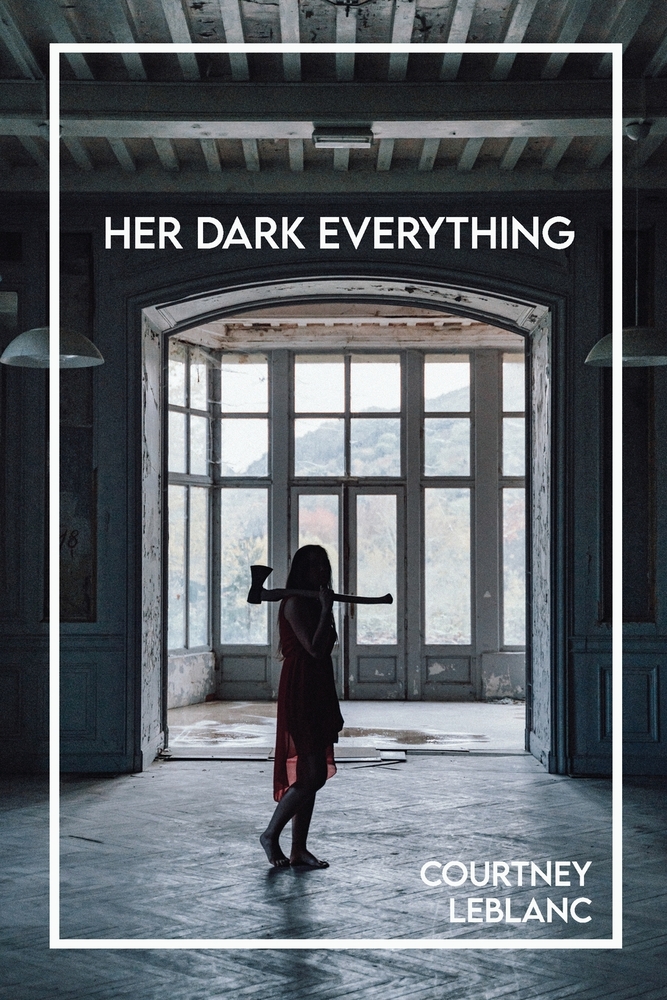
Deeply personal threads shine through this collection, concerning the deaths of LeBlanc’s father and best friend—yet these narratives are not linear, but always wrapped in further messages, not strictly elegiac, but more a passing through of notes, as we see in music. Sometimes we are unable to assess the poem’s stakes, but the structure brings us back to what matters most; making sense of what cannot be understood, finding joy in life, in spite of everything. From “I Try to Write a Poem While My Best Friend Gets a Ketamine Infusion for Her Depression”:
waiting
for the drug to work its magic, to make
the right connections, to stop the dark
sadness from winning.
As a title, Her Dark Everything strikes a chord as a retrograde feminist collection, presenting a more complex picture of the relationships between gender, loved-ones, meaning, and power. LeBlanc says in her first poem, “All At Once”: “A conflict—or is it a full-fledged war? Is there a difference?” From that beginning point we know, this is a collection of questions and furies, set at times at a slight ironic distance, whilst some infuse, up-close-and-personal; shifting from sardonic tone to intimate with lines like: “You take a muscle relaxer most nights and worry you’re taking it too often.”
LeBlanc’s magical-realism isn’t overt, it’s in the precision of her phantasmic-reflections, reflected through glass, one step removed. When dealing with pain, she utilizes poetry’s medium to hold pain at arm’s length, whilst still acknowledging its brutality. She’s done this with her father’s death, and the suicide of close friends; witnessed and related unbearable things. From this suffocating suffering, LeBlanc is unpredictably optimistic, in her refusal to succumb to constant despair, though honest in her assessment this doesn’t render her healed. From “I Have Always Known”:
Most of us discover we are the antagonist
long after the epilogue. But I have always
known the truth: I am disaster.
If, as so many like to bemoan, only poets read poetry, the questions provoked by this collection, such as an individual’s ability to effect meaningful change, are ones we who still read and still seek change, will recognize. When we talk of change, Her Dark Everything is seized with a desire to undo death, and awareness of this futility. Poems settle instead on begging questions of situations, both imagined and real. In relation to a friend who threatens to kill themselves, LeBlanc writes: “I don’t google your name ten times a day / for two weeks hoping.” The simple act of wish-fulfillment is artily juxtaposed against her own living. The myriad questions of what makes a life worthwhile, set-against a tension that she may lose another friend to suicide, is tautly stretched throughout. From “I Take a Break at Work to Sit in the Courtyard and Am Attacked by Insects”:
They haven’t
found your body yet but I know you’re dead.
You gave me the exact date, told me, I have to
move out in six weeks and five days and so I plan
to be dead before then.
Reading about suicide and actually being directly affected by it, are different, and an author can summon that immediacy through their own rendition of it, but only if they’ve really gotten in the trench with the idea of dying and seen it themselves. If we are surprised at the novelty of this subject in poetry, it speaks volumes about what is and isn’t considered important in contemporary literature. It’s like rape, you cannot truly describe what you haven’t gone through or been directly impacted by. LeBlanc’s grief over losing a close friend to suicide is repeated mantra-like, for us to fully realize this unfolding loss and its strange ying and yang. The relief someone you love isn’t suffering, the horror that death was the only way to end it. LeBlanc’s observations are espying the capture of suicidality without being (suicidal) herself. From “Duplex for When She Died”: “She always wore her sadness, couldn’t picture her life without it.”
The female body is a raging constant in many of these poems, its feminist heart never far away. In the brilliantly titled poem “We Live In America, Here’s How We Survive,” which should win an award for its timeliness and truth, LeBlanc throws off any residue filter and speaks for us all who are terrified and outraged at the direction the country is going for everyone, but especially for females:
We put on lipstick even if it’s hidden
behind a mask. We text our friends and meet
in front of the Supreme Court in supportive
shoes and comfortable bras.
These intense moments heighten the poems’ tensions, not letting us process before going on to the next outrage, building almost like you would a musical piece, to an unbearable point of tension that acts for us, in the fabrication of a Golem for our outrage. LeBlanc’s use of the female body is particularly effective, as it acts not just as reference point for the poet’s gender, but becomes positioned as the subject of political and physical experience when she says, “and our bones becoming fossils / some future generation digs up.” It is the fragmenting of rights combined with the physicality of oppression that is so deftly woven here, as she finishes with naked facts, juxtaposed with lived experience:
Every time
dividing cells are protected instead
of women, our civilization dies
a little.
There is no sidelong approach in addressing feminism here. These poems are unapologetically direct even if they’re not irony-free. They address the experience of being female via feminist theory and frank depictions of the female body and its strange dance between erasure and exposure. From “To the Man at the Gym Who Tried to ‘Help’ Me with My Form”:
After an hour I wipe down
the equipment, leave with my back
as straight as the stick up my ass—
according to the man who didn’t
get my number, despite his ability
to bench twice my body weight
Her Dark Everything isn’t a didacticism or heavy theory, so much as a roar most of us have within us, but do not express, when mansplained, or gaslit or judged for our physicality rather than our existence as equals. LeBlanc reminds us, women aren’t safe when they go jogging alone, they’re not inviolate at a gym, they’re so often unable to let their guard down for these very reasons. The lines in “Poem Where I Apologize For Being A Woman,” are one such example of wry-humor turned furious; both audacious and poignant in its unguarded truism:
And you’re right, if we aren’t careful
it’ll swing the other way and women will be the majority—
lawyers and doctors and dentists—and we wouldn’t want
that.
In the poem “What the Living Do,” LeBlanc pulls out her finest love poetry, speaking to her best friend who is dead, the poem’s super-power grows from one statement building on another. The sibilance and assonance complement the aching retrospective, where LeBlanc’s language is a wild bouquet of musicality and artful longing. Some lines are prose-like declaratives, others euphonic; there is a beauty here in sadness that cannot be described, only felt. It is exquisitely rendered, as you imagine the writer aching in loss, but finding such beauty in life. That juxtaposed irony isn’t lost, but shared with us, in a believable, profoundly real way:
We layer against the cold
and against the hurt. We write poems
to dead friends to keep them alive
There is not simply subjectivity here, but the glorious scathing survivor and her passions, entering a world and reflecting it back to us. There’s real pleasure in witnessing LeBlanc pull down and repeatedly rebuild our expectations until we become her captive, willing to enter her memory palace and walk alongside her. From “Ode to My Best Friend”:
Surgeries and starving.
Madeleines and marathons. Recovery and replaying the last
message. Birth and babies. Ketamine infusions and calorie
counting. Massages and mass shootings. Lockdowns and breakdowns.
Her Dark Everything, by Courtney LeBlanc. Riot in Your Throat Press, April 2025. 78 pages. $17.00, paper.
Candice Louisa Daquin is of Egyptian/French heritage, an immigrant to America she currently works with Raw Earth Ink and Tint Journal among other publishing houses, as an editor and consultant. She is a trauma psychotherapist by training and an advocate of immigration reform and LGBTQ equality.
Check out HFR’s book catalog, publicity list, submission manager, and buy merch from our Spring store. Follow us on Instagram and YouTube. Disclosure: HFR is an affiliate of Bookshop.org and we will earn a commission if you click through and make a purchase. Sales from Bookshop.org help support independent bookstores and small presses.
 Heavy Feather Review