
Paranoia is a tricky beast to capture. I think we can all recognize and relate to it from the outside easily enough, whether in the wild-eyed monologuing of Macbeth and Raskolnikov or the slow-burn panic of classic alienation thrillers like The Conversation and The Parallax View, or the countless ongoing explorations of our evolving surveillance state with all the real-time compromise and lived-in dread it entails. The paranoid protagonist as cautionary tale is as old as the interminable ticking of time. But to depict paranoia as an internal state—as not just a response to our mad, mad, mad, mad world, but an ingrained, systematized way of seeing it—is a much taller literary order. Whether it’s the result of mental health issues, or heavy drug use (or in the case of Stefan O. Rak’s staggering New Roses, both), it’s nowhere near as simple as just thinking that everything and everyone is out to get you. It’s much closer to what we see with modern-day adherents to simulation theory or QAnon (or, if you want to get right down to it, religious fundamentalism)—the genuine belief that everything and everyone are somehow a lie, and that you alone see through to the truth.
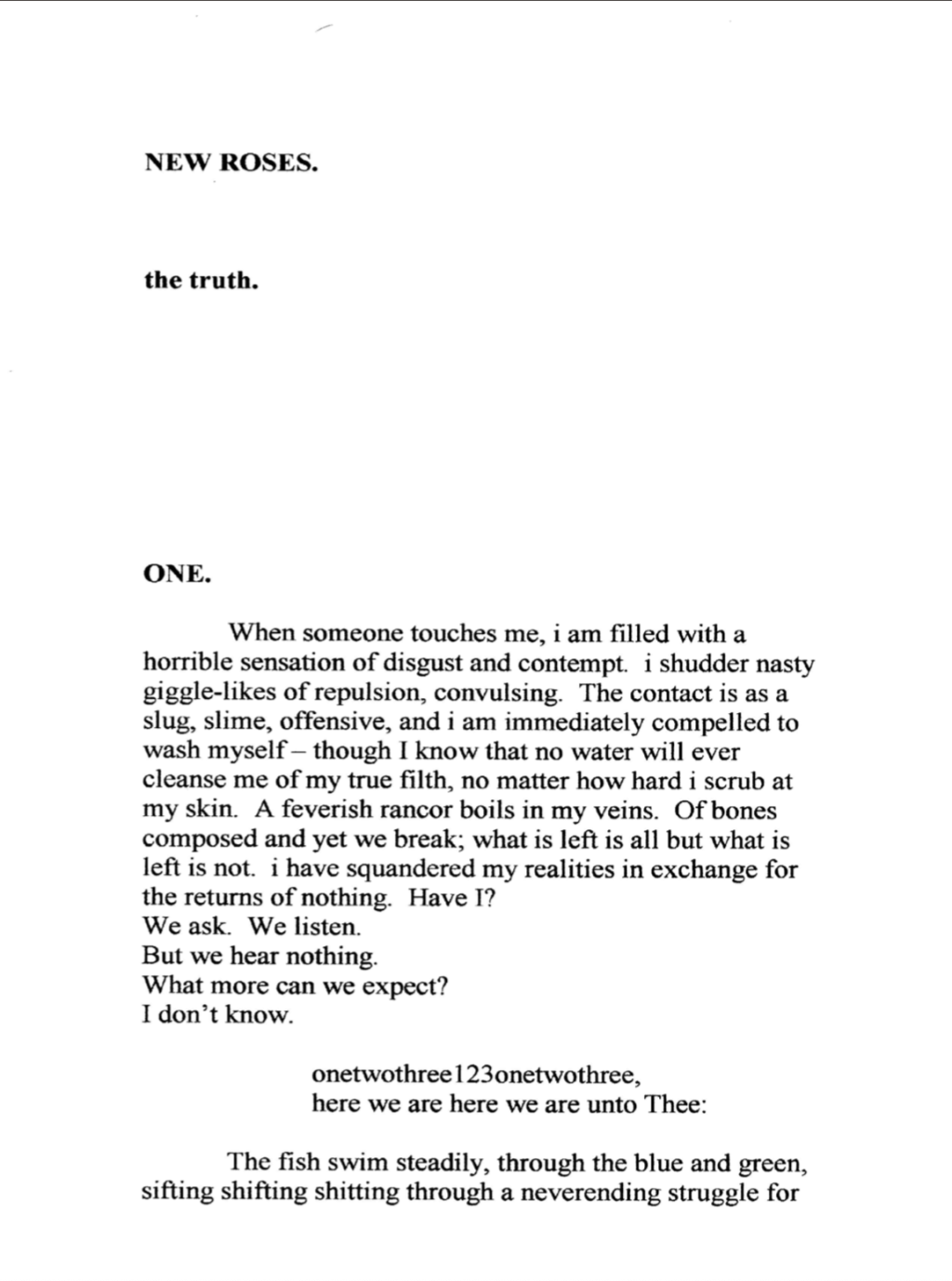
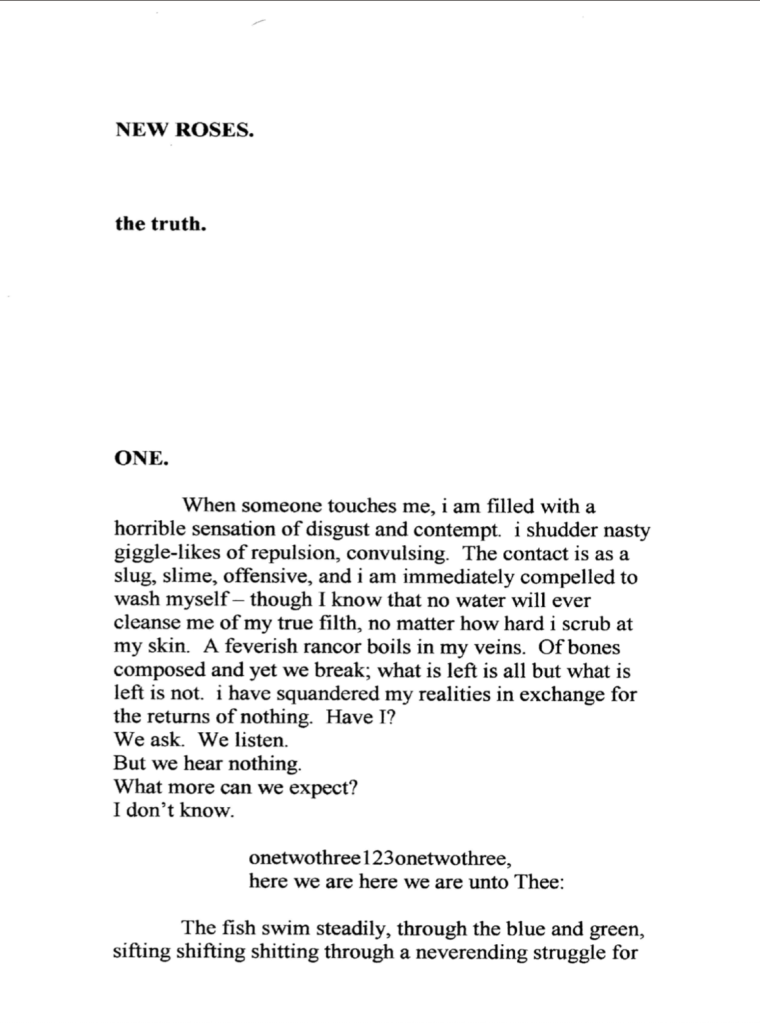
“the truth,” incidentally, is also the title of the first of New Roses’ three distinct sections, and functions as something of a phraseological canary in the labyrinthine coalmine we as readers are about to descend. For “the truth,” such as it is presented, is in fact among the most convincingly constructed depictions of a clinically paranoid mind I’ve ever encountered in literature. Operating from the fringes of his high-functioning “exile”, displaying aspects of, at the very least, schizophrenia, megalomania, and aphasia, Rak’s narrator presents us with his meticulously strung-out evidence board for the whole vast conspiracy to which he, and presumably we, are all currently beholden; a feudal cabal of tormentors with names like “Godperson” and “Hismen” and “Elite Conspirators of the Magisterial Order.”
For the first few pages, these sinister monikers give the impression you might be wading into some near-future sci-fi dystopia, but soon enough they reveal themselves as simply the protagonist’s own elaborate argot for our class-based, bureaucratic society, from the ultrawealthy global puppetmasters and all-seeing technocrat oligarchs, to the three-branched circle-jerk of the U.S. government, to the education, religious, and medical communities crosswired into some malefic, tripodal bloc entity, to celebrities as the true, complicit opiate of the masses, to shadowy domestic military presences and garden-variety cops on the beat. It’s all connected! He’s sure of it. And by the time he’s tossed in a prison cell, still raving against the “Magistrates” who’ve sentenced him to nearly four years, you just might believe it a little bit too. One of New Roses’ most brilliant and haunting effects is just how much its panoptic funhouse mirror world makes perfect sense.
Adding profoundly to that effect is Rak’s dizzying deployment of every incendiary gadget in his typographical utility belt. An incomplete accounting would include things like the book’s text starting on its front cover, the odd footnotes and scrambled words that reappear like time-release jokes in later sections, the disorienting absence of page numbers and gleeful resistance to uniform chapter delineations, and the quadruple-dutch caroming between I, i, Ii, and | for narratorial identification. But it’s so much more than that. At the sentence level, Rak’s prose feels downright animate; sentient; possessed. Words repeat and rearrange themselves in strange and unpredictable ways until they’re skittering across the gutter like centipedes. Poetic stanzas lattice through the crumbling brickwork of a hyperliterate mind, grown vinous with blooming bolds and invasive italics. Lines bunch in and billow out to their own strange, squeezebox rhythms, pumping paragraphs up into polyphonetic balloon spheres before funneling them back down into monosyllabic death drops.
And all that’s before you even reach “the garden,” the book’s second part, in which Rak applies a “reprocessing” technique called “Reductionism” to the text of the first until it resembles little more than a cryptic cuneiform of words and punctuation. Rak doesn’t fully explain “Reductionism” until New Roses’ postscript, and I think it’s worth preserving that particular mystery for potential readers, but I was reminded, throughout parts one and two, of a Word doc somewhere deep in the recesses of my hard drive, wherein I attempted to sit down and write something amid an overwhelming psychedelic drug experience; the way the words wouldn’t stay still—in my brain, or on the screen—and how I kept trying and failing to outmaneuver my own racing, cyclonic thoughts. It’s rare to see this level of kinetic, visual playfulness outside of experimental presses like 11:11 or Inside the Castle, and no exaggeration to say it takes a measure of artistic genius to evoke this, or any kind of subjective, altered condition with paper and ink alone. But Rak pulls out all the stops in service of depicting, via the physical page, both his narrator’s profoundly dissociative time behind bars, and his progressively disintegrating mental state.
It comes as something of a relief then, when at last, with your brain thoroughly scrambled, you wash up on the shores of part three, the by-and-large traditionally formatted and grammaticized “the flowers bloom.” Here we find our protagonist a newly free man, off the wrong drugs, on the (quote unquote) right ones, and attempting a gingerly reintegration into both his writing practice and (quote unquote) normal life. Alas, though these diaristic entries are certainly easier to parse, our relief proves short-lived, as we quickly realize he is miserable, and in no way convinced he’s any better or worse off than he was before—he’s simply traded one form of manifest clarity for another. Sure, he’s no longer hounded by Magistrates and Hismen (or, at least, has a better grasp on their basic banality), but the sense of purpose he displays throughout part one—that singular focus that comes with knowing your enemy and believing wholeheartedly in your fight—has been fully displaced by the one-workaday-at-a-time drudge of recovery and the 9-5.
As immersively as “the truth” recreates the frenetic, bouncy castle interior of a drug-addled mind, “the flowers bloom” is equally rigorous in its depiction of sobriety’s grayscale malaise. The former’s mad theorizing about the immateriality of time as a concept, the necessities of unemployment and criminality within the macrocapitalist design, and the literal and technological narcotization of the sheep herd masses, give way to the latter’s all-too-relatable descriptions of self-deceptive clockwatching, the grind of the hustle economy, and the pervasive sense of mortality that haunts a routine divested of all escape. “i love life, I just hate having to live it” he admits at one point, coming to harsh terms with his plight—realizing that, whether he returns to the freedom of unmedicated psychological abandon, or remains caged in his fragile new sanity, there’s no getting away from himself; no unknowing the things he knows. “My problem with reality” he quips, in another diamond-perfect sentiment, “is that I do not care about it. At all.”
He begins to dream of his own murder, and subsequently to fantasize about that dream becoming reality; to close the galloping livewire loops between waking and sleeping, life and death; to actually outthink himself, once and for all. He goes off his prescribed meds. He quits his job. He relapses. His choice and trajectory are clear. And yet, as the book comes to a close, he seems to arrive at some kind of peace. Having booked his own proverbial appointment in Samarra, his mind grows quiet and still. His fate remains open-ended, but his power over it, at long last, feels secure.
So yes. True paranoia, by its very nature, is different for everyone; as different as every human brain. Understanding and isolating it within one’s own mind is difficult enough. Transposing it onto a character, and keeping that character’s warped vision of reality separate from your own (presumably) more accurate conception, is an endeavor not unlike playing pin the tail on the donkey at the neurocellular level. I don’t know Stefan O. Rak well, and will not make any assumptions here with regards to his personal experience or how it might have contributed to this book. But what I will say, as someone who spent the better part of nine years in a near-permanent altered state, obsessively domino-effecting every meaningful moment from my past into the rubbled collapse of my present, and growing mistrustful (and untrustworthy) toward nearly everyone I’d ever known, is that he fucking nailed it.
When you commit to that kind of lifestyle—whether by mainlining the wrong drugs, avoiding the right ones, or both—you really do start to exist in a shadow world of your own design, and you really will find yourself questioning everything and everyone. And while I emerged from my own self-imposed exile nearly a decade ago, I don’t fool myself into believing my cerebral cortex escaped unscathed; that I wouldn’t be a very different person, living a very different life, if I’d just kept on the straight and narrow. Not necessarily better or worse. Just different. And with all those unrealized possibilities squatting under the floorboards of my memory, I don’t mind admitting that I felt a great deal of comfort upon finishing the psychic and morphological gauntlet that is New Roses. I don’t know Rak’s personal experience, but whatever it is, I’m so grateful it led him to write it, and I hope this review helps others find it too. Because just as with his narrator, it’s those lonely, multiversal choices—those unknowably snaking roads not taken—that will drive you maddest of all.
New Roses, by Stefan O. Rak. Whiskey Tit, December 2019. 230 pages. $16.00, paper.
Dave Fitzgerald is a writer living and working in Athens, Georgia. He contributes sporadic film criticism to DailyGrindhouse.com and Cinedump.com, and his first novel, Troll, was published in May 2023 by Whiskey Tit Books. He tweets @DFitzgerraldo.
Check out HFR’s book catalog, publicity list, submission manager, and buy merch from our Spring store. Follow us on Instagram and YouTube. Disclosure: HFR is an affiliate of Bookshop.org and we will earn a commission if you click through and make a purchase. Sales from Bookshop.org help support independent bookstores and small presses.
 Heavy Feather Review