
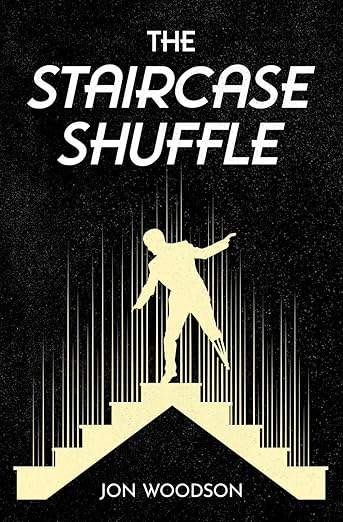

Jon Woodson, professor emeritus of Howard University, most notably author of To Make a New Race: Gurdjieff, Toomer, and the Harlem Renaissance, has of late been self-publishing both his recent scholarship as well as a few novels, collections of poetry, and translations of African writers of merit. I’m a fan of all categories of his work, and his 2016 novel Summer Games, is among a handful of my favorite books of the past couple of decades.
His specialty, as scholar, is the influence of a particular school of mysticism, the Fourth Way, initiated by the ever-elusive G. I. Gurdjieff, has had on the development of the Harlem Renaissance, and American modernism in general. In his most recent fiction, The Staircase Shuffle, we follow poet Melvin Tolson, in a first-person narrative that’s both a dramatic satire, as well as a lesson in Fourth Way teachings. We never quite get to know whether Woodson is trying to further the reach of Fourth Way knowledge, because he believes it is of some value, or whether he is simply pulling our leg.
Either way, one can obviously see the benefit of some of the teaching, since self-observation, as taught by the school, is essentially in parallel to the recently oft-practiced mindfulness meditation. And so we follow Tolson in his attempts at maintain an awareness of his thoughts and kinesthetic experience through a number of adventures and tribulations.
Tolson had come to New York, from East Texas, to further his education and to better himself as a teacher. He was on scholarship to Columbia University, which sits in the midst of Harlem, pursuing a masters degree in English, to help ensure his continued working in his profession, and perhaps even gain an increase in salary when he returned. He was also perfectly situated to meet with and study icons of the Harlem Renaissance, for whom he had great enthusiasm.
On visiting a Harlem library, he shared a sonnet he wrote with a librarian who assisted him in his research. The librarian just happened to be Dorothy Porter, the first African American to receive a library science degree from Columbia University. Porter happened to have connections, not only with the writers Tolson was interested in studying, but also to the Fourth Way School. Impressed with the poem Tolson had written, she insisted that he meet with Wallace Thurmond, one of the core writers of the Harlem Renaissance, but also the person who would begin him on his way toward Fourth Way studies.
There was an event the Fourth Way School had wanted to use for a kind of consciousness raising, and that was the plight of the Scottsboro Boys, who were nine young men falsely accused of rape, and were headed for execution. The school believed they needed an epic poet to help spread the word in such a way as to gain the sympathies of the entire community and the country as a whole. Tolson would be chosen for that role.
But first, he had to be initiated into the Fourth Way School methods. This involved certain types of self-observation, and an approach to coded writing borrowed from medieval alchemists, called Cabala. In short, it involved strategies such as placing purposeful typos in the texts, and the sprinkling in of the letters of names and ideas in ways that were barely decipherable, but with the aim of helping us wake up from the mechanical sleep Gurdjeiff had claimed was the state in which nearly all human beings lived until they died. In order to best learn the methods of Cabala, he attended classes taught by none other than Zora Neel Hurston, who turned out to be a senior member of the school.
Throughout the novel, Woodson teases us with the idea that he was writing with a form of Cabala as well, and that we should catch him with his typos and associations to mysteries embedded in the text. This becomes part of the charm of the work, since it provides another ironic level to its noirish intrigue, one that involves attempts on Tolson’s life, a gun battle over the theft of bookie payroll, and the competition between the school—which had disguised itself as the Communist Party—with the NAACP, for control of messaging regarding the Scottsboro Boys’ plight. In one scene, Tolson even meets with W. E. DeBois, who ends up being a bit of a villain in the context of this conflict.
One chapter tells of Tolson’s needing to use a gun to protect Ada Wright, a mother of one of the Scottsboro Boys, from being kidnapped by the NAACP, when thugs showed up with clubs ready to pursue their own violence. Woodson takes this opportunity to weave in Tolson’s Fourth Way training as he faces his adversaries:
1. Place the organism in strange or unpleasant circumstances.
There was a knock on the door. One of the men from the Party asked the other one if anyone is expected …
2. The effort to realize. I have a body.
The intruder wasn’t a big man … He was holding some sort of club but so far, he wasn’t forcing me to admit anything …
…
4. The attempt to realize the organism’s mechanicality. I had survived two recent attempts to take my life …
The entirety of chapter 17 goes through 31 steps of the school’s training method while the action unfolds. It is one of the most challenging, but also exhilarating, sections of the book. It is here as well we see Woodson’s powers as an word-artist on full display, as he is a superlative maker of sentences and various concoctions of original language.
A later section describes how Tolson tricks Langston Hughes to do some of the work for them unawares:
It meant that Hughes had been induced to write a poem without any of its occult meaning …
We are led to wonder if we are in a like relation to the present work. Is Woodson an outside observer and critic, or mere historian of the Fourth Way, or an exemplar, propagandist and teacher of the school’s method? One gets the feeling he wants us to ask these questions, as a kind of meta-strategy, because that’s part of what the novel is about as well, just as the crowd noise is an essential part of John Cage’s 4’33”. Woodson is speaking through a fictionalized version of the historical figure, but because of what we learn about sleep and identification, we might surmise that the author, Woodson, is also a fiction in that it is a made-up identity that another Woodson has taken on, and on, and on, and so forth. And of course, we ask as well, who are we who saddles up and pretends to be “the reader?”
The Staircase Shuffle, by Jon Woodson. September 2024. 270 pages. $9.99, paper.
John Schertzer is the author of the novel Bellamonia and a poetry collection, Second Nature. His poems, fictions, and hybrids have been published in Big Other, Inverted Syntax, The Germ, American Letters & Commentary, 1913 Journal, The Cortland Review, La Petite Zine, Danse Macabre, LIT, and other journals.
Check out HFR’s book catalog, publicity list, submission manager, and buy merch from our Spring store. Follow us on Instagram and YouTube. Disclosure: HFR is an affiliate of Bookshop.org and we will earn a commission if you click through and make a purchase. Sales from Bookshop.org help support independent bookstores and small presses.
 Heavy Feather Review