
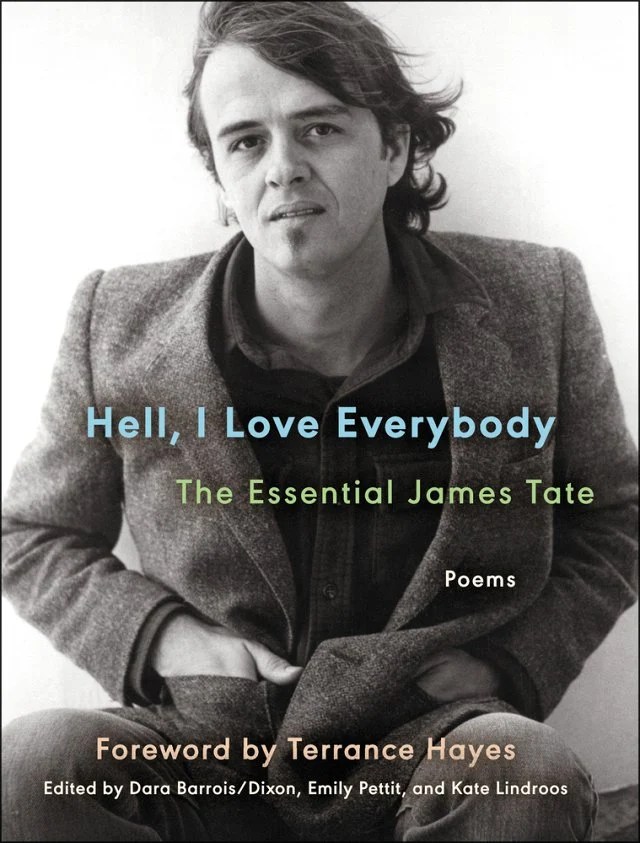
Hell, I Love Everybody is a collection of 52 poems edited by Dara Barrois/Dixon, Emily Pettit, & Kate Lindroos; they call it “the essential James Tate” and the editor’s note says they thought of it as a “book of beloved favorites.” It’s a slim volume, and every poem in it will give readers the Monty Python-esque sensation we should look for when reading one of Tate’s many poems, published during his seven decades of life—the sensation of meeting the strangeness of the world anew.
The poem from which the title is taken, “Goodtime Jesus,” is a prose poem, and reading it again after November 2024 gave it new meaning for me—the divine speaker’s nightmare and his refusal to let that color the small events of the day or the love the speaker feels for the world. Tate humanizes his speaker in a way that makes the love he summons up feel raw, new, and exceedingly human.
Many of these most-beloved poems feel new again. In “Read the Great Poets,” we hear:
People read poem like newspapers, look at paintings as though they were excavations in the City Center, listen to music as if it were rush hour condensed. They don’t even know who’s invaded whom, what’s going to be built there (when, if ever). They get home. That’s all that matters to them. They get home. They get home alive.
And then the surprise: “so what it’s been burgled.” We’re left with “The Masters. The Thieves.”
In the days when a popular movie called Conclave focuses on choosing a pope, it’s still amusing to read that “after a poodle dies / all the cardinals flock to the nearest 7-Eleven. / They drink Slurpees until one of them throws up / and then he’s the new Pope” and it still seems significant that
Fathers tell them over and over again not to lean out of windows,
but the sky is full of them.
It looks as if they are just taking it easy,
but they are learning something else.
What, we don’t know, because we are not like them.
“Neighbors” certainly seems new again, in our post-pandemic era, heading for a second Trump presidency; it shows us people who “lunge backward, / back into our own deep root systems, darkness and lust / strangling any living thing to quench our thirst and nourish / our helplessly solitary lives.”
Poems like “The Cowboy,” “The War Next Door,” and “Everything but Thomas” are timeless. The details in the story of an alien who wants to meet a cowboy, with the speaker admitting “I tried / not to think of the cosmic meaning of all this,” add up to a sadness impossible to predict or explain.
The impossible necromancy of the dog in “Roscoe’s Farewell” and the victims in “The War Next Door” offers a new way to see why “we were all so sad we didn’t know what to do” and “who the enemy was.”
The turn in “Everything but Thomas” is built on small details like hot dogs for lunch and happens so matter-of-factly that the title, which is the last three words of the poem, still comes as a surprise.
More than one poem in this small volume is about the rules, how to see them and then how to think about them once you’re freshly aware of them. The first poem titled “The Rules” in this volume is about a candy store with such strictly imagined rules that when faced with armed robbery, the clerk replies “I’m / sorry, this is a candy store. We don’t do hold ups.” The sweet story of the would-be robbers happy with their candy is undercut by the story of a woman who wants a “large, red hat with a feather in it” and not only expects to find it in a candy store but feels entitled to snatch it when she does. The second poem called “The Rules” creates a picture of some kind of military spy who must “follow orders” and “contact Central once a week,” although some of the rules the spy is given are out of the purview of his job, like “don’t wear plaid” and “stay off gondolas,” which the speaker says he does “instinctively.”
This little volume of favorites offers a fine introduction to the poems of James Tate and a handy collection of some of the best. Even the most casual reader of poetry will probably recognize one or two of the poems included, like “Teaching the Ape to Write Poems,” which is frequently anthologized. Even those of us who haven’t loved a Tate poem before will be unexpectedly seduced and knocked off balance, addressed directly in poems like “Dear Reader” and told “I’ll give up my sleep for you.” Anyone reading this volume late at night will be tempted to respond in kind.
Tate said, in his “Art of Poetry” interview for The Paris Review, that “we all know that we’re enshrouded in tragedy, lies, and all kinds of evil. Torture, for God’s sake! And heaps of evil beyond what we can contemplate, and yet life is wonderful for those of us who haven’t been directly affected. So we walk around balancing the two all the time. I, for one, am not giving in. I am not going to walk around in tears all day long. I still want to have a good day if I can.” That attitude is clear in this collection and makes it essential reading for anyone trying to achieve a daily balance in today’s world.
Hell, I Love Everybody, by James Tate. Edited by by Dara Barrois/Dixon, Emily Pettit, & Kate Lindroos. New York, New York: Ecco, November 2023. 112 pages. $17.99, paper.
Jeanne Griggs is a reader, writer, traveler, ailurophile, and violinist in the Knox County Symphony. She directed the writing center at Kenyon College from 1991-2022. Jeanne earned her BA at Hendrix College in Conway, Arkansas, and her doctorate at the University of Maryland, College Park. Her conference papers include “A Survey of Reanimation, Resurrection, and Necromancy in Fiction since Frankenstein,” and “Climate Change Predictions in Octavia E. Butler’s Parable of the Sower and Parable of the Talents.” Published by Broadstone Books in 2021, Jeanne’s volume of poetry is entitled Postcard Poems. Jeanne reviews poetry and fiction at Necromancyneverpays.com.
Check out HFR’s book catalog, publicity list, submission manager, and buy merch from our Spring store. Follow us on Instagram and YouTube. Disclosure: HFR is an affiliate of Bookshop.org and we will earn a commission if you click through and make a purchase. Sales from Bookshop.org help support independent bookstores and small presses.
 Heavy Feather Review