
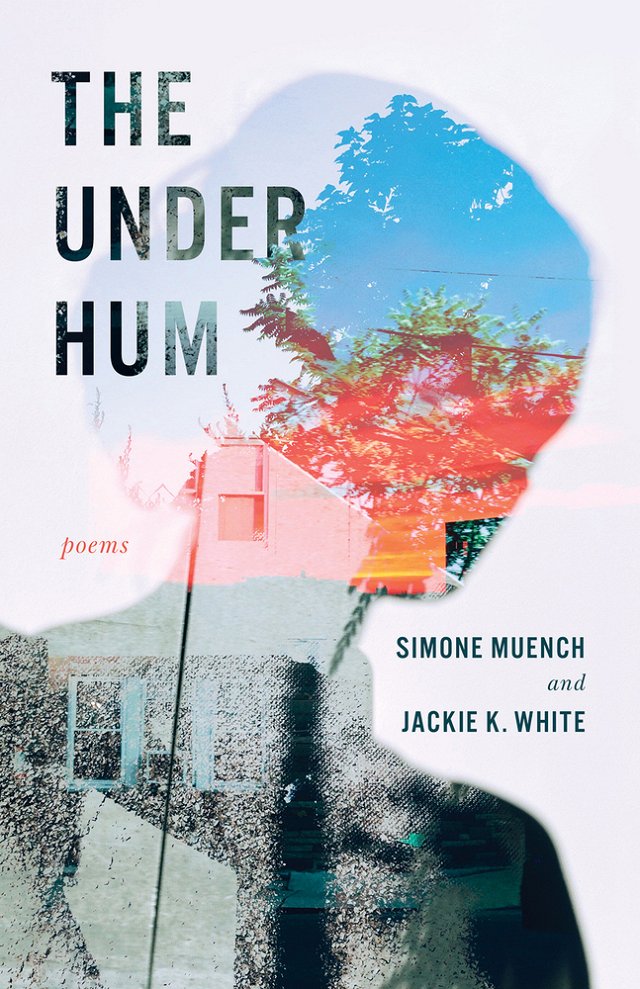
The Under Hum is a small book that is large and generous in so many ways: double the usual number of authors, and full of lines by modern working poets that “seed” the invented poetic forms and linguistic experiments of this collaboration. The Surrealist feminists have arrived and they come with ghostly memories and scars, loud and dancing.
The prologue poem “Scorch” introduces the theme of being silenced in girlhood, and the moment the speaker’s words “Like smoke … can’t be / contained.” The imagery of polite suburbs and their hidden gnarly woods are a backdrop of this lyrical journey of the feminine self from “wronged” to “riling” in sonnets, golden shovels, centos and abecedarians.
“sound / is a muscle” a line from “Rebuttal,” alludes to the fearless music that drives the book along. It celebrates the power of voice over the silence that hurt can drive a girl to, or the silence of the dead. The poetic structures create space for the risks of that muscular sound. “Portrait as Landscape: Dear Dark Garden” offers elegy for the dead girls of serial killer headlines:
Outside, lining the hushed front yard.
dogwood and cherry blossoms peak
to petal cascades, hiding more basement
girl-held horrors. The pastoral says nothing
of rot. The suburban silent about ruin …
The embodied feminine is represented by the natural world, full of life and fight, decorated with moss and bone. The authors vindicate the voiceless in linguistically delightful ways. The poem that follows, “Self-portrait Lined by Mina Loy” takes a line from a poem by Loy to launch an exploration of night and its dualities, “On my tongue,/a blaze cleaves my voice into bellow/and witchgrass.”
Outright or explicit violence against women is largely hidden from view. In “Slow Dive” the authors allude to this method of “telling it slant,” “It’s venom’s/ slow dive, a rockbound flight/ we can’t ever name.” The point is not to retraumatize us, but to allow us to feel heard after years of repression.
In “Portrait as Landscape: not the Fox” they take metaphor further. The play of “portrait” and “landscape,” those mundane the choices for page layout of documents, is another clever wordplay in the midst of these mysterious ghost story settings:
She was wronged, flung from childhood
into a vista of fox bones under forest moss
Was she a blue aura or a gold one—a myth
of the river, a silhouette in the mirror?
The mirror is an apt image, as two authors mirror each other in language, in a singular goal, to achieve the lyric, freed by its boundaries, from dark material to a hive-like hum:
… I’ll creep
quieter than a birdwatcher beyond
this body’s bruised cartography, its
broken tongue, toward the tender hum.
The line from Alejandra Pizarnik that begins the portrait, “I am sad in the night of wolf fangs” is profound in of itself in its simplicity, and also profoundly fitting. It is part of the landscape of this book as if the authors had conjured it themselves. The act of curation is also the act of creation, with many other poets’ works embraced, jazzing in the centos.
The two authors, that “silhouette in the mirror” is a mystery, too. Where does one mind, one voice end, and the other begin? I read several recent interviews, but they never outright reveal their process. There is the unscripted delight of an “exquisite corpse,” that surrealist parlor game that can lead to some surprising sonic repetitions. Image bounces off image, and a tone is secretly agreed upon. Considering all of the things collaboration can be this feels delight as a feedback loop, or a hive mind. It made me ponder in a bemused way why on earth anyone would ever write alone again.
Ownership and ego dashed, the poems are freed to have a life of their own. And they launch surprisingly light for such dark subject matter. In “Elegy lined by Vicente Huidobro,” Huidobro’s line evokes “a séance” and Muench & White respond using the words “jumper cable” as a verb, again that playfulness and delight.
Yes, something extra is going on here, that twinkle when the random is invited to the party. Well sure enough, according to an interview with Franchesca Viaud in The Massachusetts Review, these two poets are collaborating once again, on a book inspired by the women of the Surrealist movement. Aware and self-aware, they drop hints here and there, as in “Portrait as Landscape: Scale”:
We’re the space between coil & strike, snaking
free of doublespeak …
An additional gift this book offers is the massive reading list it compiles from the many poets whose lines appear in it. I truly love all of the things that The Under Hum does with language, the healing intention of giving voice to the wounded quiet girl that lives inside each of us, and the many new poets it has introduced me to.
The Under Hum, by Simon Muench & Jackie K. White. Black Lawrence Press, May 2024. 70 pages. $17.95, paper.
Karin Falcone Krieger’s recent writing and visual art have been published in The Decadent Review, Tupelo Quarterly, Tofu Ink, Viewless Wings, Hunger Mountain, The Literary Review, and in the anthology, “A physical book which compiles conceptual books” (Partial Press, 2022). In 2022 she was awarded a Multi-Disciplinary Artist Residency at Bethany Arts Community. She served as an adjunct English instructor for 20 years and earned an MFA from The Jack Kerouac School of Disembodied Poetics at Naropa. She can be found writing poems for strangers at fairs and festivals on her antique typewriters. These and other projects can be seen at karinfalconekrieger.com.
Check out HFR’s book catalog, publicity list, submission manager, and buy merch from our Spring store. Follow us on Instagram and YouTube. Disclosure: HFR is an affiliate of Bookshop.org and we will earn a commission if you click through and make a purchase. Sales from Bookshop.org help support independent bookstores and small presses.
 Heavy Feather Review