
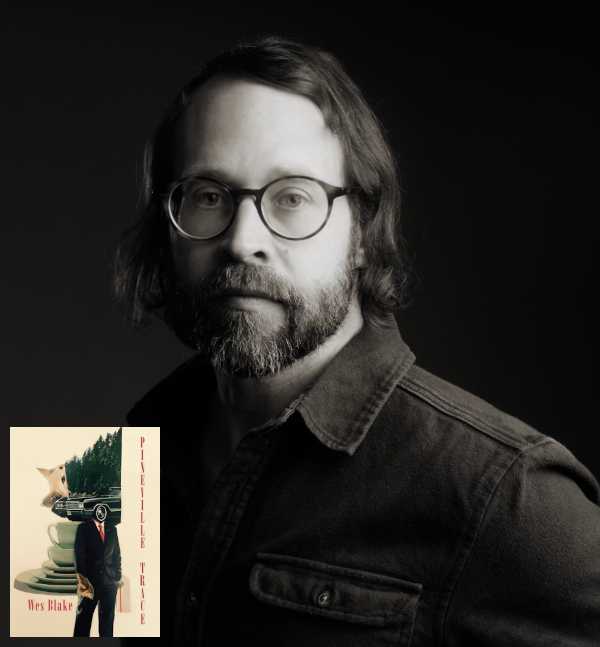
Wes Blake lives in Nonesuch, Kentucky, and is the author of Pineville Trace, winner of the Etchings Press Novella Prize. Pineville Trace follows Frank Russet, as he sets off on a quest following a cat named Buffalo. After Frank escapes from a prison in Kentucky, his journey to find meaning in the absence of his former life as a charismatic traveling preacher leads him all up and down the US and Canada, delving into his own memories and questions of faith, family, self, and stories—and where those stories lead us.
I spoke with Blake about the book, self-care, spiritual renewal, internality, animals, nature, the importance of place, and more.
Matthew Sidney Parsons: To begin with, I wanted to say how much I enjoyed Pineville Trace and how thrilled I am to discuss it with you. I didn’t realize how much I needed this story when I started reading, and now I almost feel like I’ve read a really good self-help book. I think that, in some way, self-care is at the center of this story. Can you talk a little about your character, Frank, and what led him on this journey?
Wes Blake: Thank you, Matt. That’s nice of you to say. I do agree about self-care being a tangible part of Pineville Trace. In the first chapter of the book, Frank Russet sees a vision of the town Pineville, Kentucky, after seeing a sign for it along the highway. And he imagines the outline of the town and a house hidden by pines. Much of the rest of the book follows Frank as he tries to find his dream vision in the real world—his dream cabin surrounded by pines. Hidden from the world. This is a dream of sanctuary. A place of refuge and safety. Early on, Frank Russet finds himself in a minimum-security prison on rural Pine Mountain after being sentenced there for fraud related to his years as a faith healer and revival preacher. In his former life, he had built a name for himself as a revival preacher, building a following with his brother across the south. And building that following even further when he took his revival show on the radio—broadcast from a Texas border station with a powerful antenna in Mexico that sent Frank’s voice across the country. By the time that Pineville Trace begins, Frank is tired. His ambition has fueled him to always be on the move. For years. He could never rest. Always working towards the next town, the next show. Most people who are driven to this level must have at their core a deep fear of losing everything. And this must have been the case with Frank. But instead of doing his brief time in the minimum-security prison and then working towards rebuilding his name and life when he gets out—he simply walks away. And becomes exiled from his former life. He walks away with his new friend, a stray cat named Buffalo, who has an uncanny ability of reminding him of what’s really important. He walks away from everything that the world had expected of him in his old life. As a faith healer, Frank was expected to live a perfect moral life, to heal people, and to revive them. To bring them back to life, in a spiritual sense. And he had to work ceaselessly to build his following, to keep it, to make his way, and all the while, people expected nothing less than miracles from him. So, when he walks away from the prison with his new friend, Buffalo, he walks away from all those expectations forever. He leaves his fear of losing everything behind. He lets it go. He embraces not having anything. Except for his new friend, Buffalo, who doesn’t expect anything of him but for him to be himself. He becomes freer than he could have ever been if he had done his time in prison and gotten out by the book. All of us have expectations that we must meet. Whether we set them, the world sets them, or we inherit them, we hold ourselves to them. And we can become chained to them. And because of Frank’s role as a healer and a religious leader, his expectations are dramatized but still universal. Frank throws off his identity because he has to. It’s worn him down, and it can’t serve him anymore. He doesn’t have the heart for it any longer. So, like the wise animals that Frank admires, he trusts his instincts and follows them blindly, seeking a truer version of himself and his life, leaving his worldly ambition and desire behind.
MSP: I’m so glad you brought up Frank’s dramatized but universal sense of spiritual renewal and Buffalo the cat (who seems to serve as an old-school spirit guide and doubles as an emotional support animal). The presence of spirits is palpable in the book. I want to turn to spirituality for a moment since it plays such a large role in this book. From Buffalo being a reincarnation of an actual buffalo, to unintentional baptisms and the recurring theme of revival and faith, I am blown away by how expertly you weave these reflections into your work. You include a wide range of spiritual feelings without alienating any of your readers and still manage to make the character feel singular and convicted. How did you think about tackling such a sensitive topic and how does it play out for you in the narrative? Is this something you included very intentionally, or did it come organically from the narrative?
WB: I think that spiritual renewal is the accurate phrase for what Frank experiences, and Buffalo is both a spirit-guide and emotional support animal for him. When writing Pineville Trace, I intentionally wanted to capture an accurate portrayal of a complex character’s inner life. And Frank’s spiritual renewal is a part of that. Literature can reveal and express interiority in a more direct and sophisticated way than any other medium. This is the great strength of literature. Film may be the only medium that can come close, and they have to resort to voiceovers, which are less direct and immediate. Before Pineville Trace begins, direct spiritual experience has become merely a subtext underlying Frank’s outer life because he needs to be constantly involved in the business of making his way in the outer world. And this requires so much of his energy and focus. When I started writing the story of Frank Russet in Pineville Trace, I knew that he would walk away from his former self and life with a stray cat named Buffalo. I wrote the book to find out where he would wind up and what he would experience on that journey. Although I had some signposts in mind of where Frank may wind up, a lot of the writing process was an act of discovery. I embarked on a process similar to that which Donald Barthelme prescribes in his essay, “Not Knowing.” I wrote to find out. To discover. I let my intuition guide Frank’s journey and inner experience, and many of the spiritual experiences and feelings that occur were borne out of my subconscious during the creative process as I journeyed alongside Frank and Buffalo. Barthelme wrote that “Art is a true account of the activity of the mind.” And that is exactly what I tried to capture when writing about Frank’s experience in Pineville Trace. I strove to stay close inside Frank’s mind and subconscious and follow where that led me.
MSP: That internality, for me, is what sells this story so well. In truth, we all live inside our limited cerebral experience.I wonder if that commitment to internality is perhaps part of what led to the chapter “KY-190”? This chapter isn’t exactly part of the narrative, but rather a reflection on a recording you took of yourself about the writing of this book. You write in that chapter, “I had been afraid to listen to the recording. Afraid that the manic weather and poor sleep would make it incoherent. Embarrassing. Repetitive. Meaningless.” A person reading this book could almost forget that this isn’t actually Frank Russet speaking, but you. There are no other chapters in the book like it. Tell me about that moment and what led you to include it. Was it a reflection of the internality you were exploring with Frank?
WB: That chapter is another layer of the interiority that guides the book. A lot of the book focuses on borders between things breaking down. For example, the border between countries, the border between past/present, sleeping/waking, day/night, and the physical world/spiritual world. Breaking the fourth wall by including that chapter also felt like another border, as well as another layer of interiority. Some of my favorite novels do break the fourth wall, and I love how this brings an added layer of complexity to the work. Kurt Vonnegut does this in Slaughterhouse Five and Gurney Norman does this once at the very end of his novel, Divine Right’s Trip. I love those moments in books when that line between creation and creator is broken down. When you get a glimpse of the humble Oz behind the curtain putting it all together. As readers, we willingly suspend our disbelief when reading fiction—imagining the fictional world we are in is real—and we agree to forget about the creator behind it. But when that fourth wall is broken, it brings this extra level of attentiveness. I had to weigh this decision because when I broke the fourth wall early in the book during chapter “KY-190,” it takes the reader out of the fictional world for a moment and disrupts the story. I decided to include that chapter because, although it breaks the spell of the fictional world for a moment, I wanted the reader to experience that extra layer of complexity and consideration that it brought to the work. In Shakespeare’s Othello, Iago famously breaks the fourth wall by speaking directly to the audience, making them complicit in his scheming. And this involves readers and viewers in the story more deeply. And by only breaking the fourth wall one time in Pineville Trace, it adds to the impact. Denis Johnson ends his story “Car Crash While Hitchhiking” by seemingly addressing the reader directly and saying: “And you, you ridiculous people, you expect me to help you.” Rilke’s “Archaic Torso of Apollo” is another example of a work that struck me as a reader by breaking the fourth wall and using direct address. The first couple of Rilke’s stanzas discuss how we can’t know what the legendary head of Apollo is like because it is missing from the statue. And it goes on to describe how that absence gives the statue more mystery and power over the viewer. And the poem ends with this sentence: “Otherwise this stone would seem defaced / beneath the translucent cascade of the shoulders / and would not glisten like a wild beast’s fur: / would not, from all the borders of itself, / burst like a star: for here there is no place / that does not see you. You must change your life.” This turn toward direct address, and this breaking of the fourth wall, involves the reader in such a powerful way. This is the kind of involvement and complexity I wanted to offer my readers. As a reader, I love moments like that. There is a brief section in the “Magic City” chapter that also uses direct address and discusses how at the end of Frank’s revival shows everyone was left alone with their own soul, “Even Frank. Even you.” Another reason I included that chapter “KY-190” was because it really happened just as described in the book. And the way the idea for Pineville Trace came to me, driving past Pineville, Kentucky, and then along the curving roads on Pine Mountain, and how I saw a late-fifties/early sixties model black Buick LeSabre drive past me on the isolated mountain road—just like the one Frank Russet drove in my first novel—was so strange that I wanted readers to experience it, too. And the strangeness of how that happened on Pine Mountain seemed to match the strangeness of Frank’s story in a nice way.
MSP: You’re right! I had completely forgotten about that moment in “Magic City,” which is a shame because that address is part of what I felt like I needed that I got from this book. It really gave me the feeling of total acceptance of the self. It puts one in mind of Alan Watts’ theory of one having “arrived.” No matter where Frank is on his journey, it always feels like he has arrived. I knew that had to have been a true story. It’s hauntingly vivid and brings the reader so much closer to the writer. At the same time, Frank is almost always lost in retrospection. Between his time as a confidence man, seasons spent in the north, and history down south, we see a lot of Frank looking back on his life. He even refers to himself as, “a pillar of salt. Always.” Well-placed biblical allusion aside, do you think that there’s a way for Frank to free himself from that? Even though it was a place where he seemed at peace, was his returning to the north really more of that reflection or its own version of pushing forward?
WB: In the wilderness and isolation, Frank does move closer to a spiritual experience like Alan Watts describes than the one he’d experienced in the public life of his past as a revival preacher. Frank is always being pulled back into the past. Reflection is a major part of his reality. And this brings him both joy and pain. I don’t know if he is able to free himself completely from that. It’s not impossible. But I don’t think it is likely for him to become completely free of it, permanently. His habit of losing himself in the past is so ingrained that ghosts seem more real to him than living people. He sees ghosts of his brother even though he is still living in central Kentucky, for example. And the time he spends ruminating in the past only further isolates him more from the present. Frank travels north two times during the story, and he does so for differing reasons. The first time he’s seeking sanctuary and peace. A place of refuge and safety. It seems he is seeking to push forward at this point. Yet even during this first time up north, he still clings to his past, but in a less harmful way. The second time Frank returns to the north, it seems he is seeking to escape from the present completely and lose himself in a dream of the past.
MSP: I had the same feeling. There’s something tragic about that constant returning, and yet Frank seems so at peace with his decisions that there is also catharsis. The reader gets the sense that, although it’s in an abstract way, they really know Frank. You find yourself rooting for him and, most especially, Buffalo. You mention your own cat, Pig, in “KY-190.” Animals play a prominent role in this story as both a narrative mechanism and as a foil for the main character when so much of the story finds us alone with him. It would be easy for a pet’s presence in a story to be either kitschy or mundane. Instead, you turn a house cat into a thing of majesty with almost supernatural abilities in understanding the human condition while not losing the aspect of the wilderness they represent. Did you find that the personification of the wilderness came naturally to you here, and did you draw on real life experiences with animals and nature to build that relationship?
WB: Frank admires the wisdom and intuition of animals. At the beginning of the story, when he finds himself in a minimum-security prison in eastern Kentucky on Pine Mountain, he is at the edge of the Cumberland Gap. And he realizes how the path through the Cumberland Gap—that Daniel Boone got so much credit for—was simply a path that the Cherokee and the Shawnee people had been using for generations, that they’d shown him. And before the Shawnee and Cherokee, the buffalo had made the path through the Cumberland Gap and walked it for generations. So, people didn’t really create this original path through the mountains. Animals did. And the people simply followed the animals’ path. Buffalo, the cat, would have had to be pretty savvy to survive on Pine Mountain. She would have to be intimately connected with the rules of surviving in the wilderness. And she’s also been tamed enough to trust the prisoners like Frank at the Bell County Forestry Camp. She must live in both worlds—civilization and wilderness—to survive. She would also have to be savvy enough to read people well and know which ones she could trust. I’ve been obsessed with cats since I was a kid. My brother was allergic, so we couldn’t have one. But my wife and I have had several cats over the years. And I’m always surprised by their emotional intelligence and power of observation when it comes to people. Pig can tell when my wife, Natalie, or I are upset. I’ve heard that the frequency of a cat’s meow is similar to that of a human baby’s cry. It amazes me that over time cats, as a species, have been intelligent enough to mimic the frequency of human babies to inspire humans to care for them. At the time I was writing Pineville Trace, three cats ruled our house: Pig, Bat, and Queak—a calico and two tortoiseshells. And each of them chose either Natalie or I to attach themselves to. We live in rural southern Woodford County, and our neighbor has a cat named Lulu, who runs around the big farms, hunts birds and small critters, and is also domesticated. A lot of cats have this ability to retain their wildness after they’re tamed by people. I always heard stories of a cat that lived in Red River Gorge that would hike alongside people. And I’ve heard stories about how stray cats visit the prisoners on the campus at Bell County Forestry Camp on Pine Mountain. Up until the time I was six years old, our family lived in Rowan County, KY in the middle of Daniel Boone Forest. And my dad, brother, and I spent a lot of time hiking in those woods. When we moved away to central and western Kentucky, we always found a nearby patch of woods to hike and camp in. Over the last twenty years, I’ve gotten in the habit of taking off to the Red River Gorge on a random weekday, when it’s not crowded, and hiking by myself when I need to get away. I’ve found it is good medicine. During the time I first got the idea for Pineville Trace, I spent some time hiking in the Cumberland Gap area. So, to answer your question, I used a combination of observation and imagination to portray Buffalo, her relationship with Frank, and her kinship and ease with the wilderness.
MSP: The story is moved by the natural progression of things and that gives it a real ring of truth. Let’s talk about the title, Pineville Trace. You mentioned Gurney Norman’s Divine Right’s Trip, which is a book I think is rooted in that connection to nature and to place, as well. Gurney Norman describes his book as a book of counterculture, rebirth, and reclaiming your place. There’s a strong thread of that in your work, as well, but it’s a more internal experience. Even so, we see a strong desire both for you as the narrator and for Frank to be rooted in a place. As Kentucky writers, “place” typically looms large in our broad themes. Is the title and the discussion of that geographic location rooted in a strong pull to place-based writing? Is Frank’s wilderness home in Canada a reflection of that desire?
WB: I hadn’t thought of the connection with Gurney Norman’s Divine Right’s Trip, but I agree that both books are connected to nature, rebirth, and reclaiming your place. Frank is searching for a place where he feels at home. And place does always seem to loom large with Kentucky writers. Happy Chandler said it best: “I never met a Kentuckian who wasn’t either thinking about going home or actually going home.” Oddly enough, the first novel I wrote about Frank Russet—that covers his life before Pineville Trace begins—was originally titled Going Home. And I didn’t realize how much that phrase resonated with Kentucky until just now. It’s also interesting how a universal longing like the desire to go home—an idea that has been explored in literature at least as far back as Homer’s The Odyssey—resonates so strongly with Kentuckians, specifically. With Homer and the Greeks, I would imagine it has to do with their seafaring life, the long spells they had to spend away from home, and the danger always present that could cut their lives short before they do return home. I do wonder what has made this such a characteristic quality for Kentuckians. Perhaps it’s an example of finding the universal in the specific. The title, Pineville Trace is certainly linked with that vision of home and place that Frank is seeking. The vision he sees in his mind of a cabin surrounded by pines could aptly be described as “Pineville.” And “trace” carries multiple meanings. It could refer to a path or way, like the path the buffalo made through the Cumberland Gap, sometimes called a buffalo trace. Which would suggest that “Pineville Trace” is the path or way to Frank’s vision of home and sanctuary. And since Frank’s pine-surrounded cabin in the Canadian wilderness is the realization of his vision of home, I feel his journey and that home is related to Frank’s desire to be rooted in place. “Trace” could refer to the process of discovering through investigation in the way that a detective would trace a suspect. This would suggest the process of discovering his vision of home called Pineville. Or “trace” could refer to “a mark, object, or other indication of the existence or passing of something.” When writing the book, I wanted to capture place as inseparable from character. I wanted the outer world to reveal the character’s inner architecture.
MSP: One of the things that haunts Frank is his perception of the past. One of the most powerful moments in the book, for me, comes in the form of the memory of the story from Joe where he refers to Frank as “Spirit Rock.” In that story, three warriors seek the Great Spirit’s favor and are rewarded with their greatest desires. The first asks to be a great hunter, the second for the company of a wife, and the third for “everything and to live forever.” The great spirit grants all of these, but because he is angered by the third warrior’s greed, he turns him into a rock. Spirit Rock. Frank embodies that third warrior because he is constantly experiencing change happening to him and because he sees himself as the greedy warrior who has asked for too much. Which one wins out? Is Frank greedily begging the spirit for more and being punished, or is there a wisdom to being the “Spirit Rock?”
WB: That’s a great question. Joe, the Native American man that tells Frank the story, sees Frank as the greedy third warrior, and the way that he laughs makes me think he must view it partially as a punishment when the greedy warrior is turned into a Spirit Rock for wanting too much. But I do think that becoming the Spirit Rock is the cure that Frank needs, even though his younger self would see it as a curse. A rock cannot move. It can’t chase what it desires and pursue its ambition. It must rest. Frank certainly viewed the fate of the warrior as a curse when he first heard it. When he was young and just starting to make a name for himself as a faith healer in Kentucky and throughout the South. The way that Frank keeps turning the story over in his mind over the years makes me think that he’s contemplating it as a more complex story than when he first heard it. And that maybe he is starting to view the punishment of this warrior who wants too much, as an actual gift. A rolling stone gathers no moss, but it also gathers no peace. The punishment and transformation of the warrior who wanted everything—being turned into a Spirit Rock—also aligns with the stillness Frank is trying to achieve on his journey in Pineville Trace. As he strives to quell the restlessness in himself, he is ironically becoming more like the still and peaceful Spirit Rock that used to be an overzealous warrior. I wonder if Joe—the Native American man who told him the story—already had a sense of how things would turn out for Frank, even when Frank was just getting started in the world? I get the sense that Joe did know how Frank would wind up. And Frank sensed some wisdom, judgment, and understanding in Joe’s laughter and story. Perhaps that is why Frank kept ruminating over the story for so many years. I would think that Joe’s story about Spirit Rock would hold different meanings for him as Frank, and his life, changed over time.
MSP: I know that it felt like it came to a spiritual conclusion for me and helped me release some of my own anxiety about the past when I finished the book. I almost woke my wife in the middle of the night to grieve over the ending. The repetition of, “He was seeing the stars …” from all of these different places in his memory really brought home just how close we got to Frank by the end of this book. You felt like you were there with him, mourning those same losses and remembering those same moments. You feel that tired he’s feeling. You want to rest right there in the pine needles, cuddled up to a white cat or sit right next to Frank Russet in that old Buick that’s not the same one as the one he had before. Almost like you’re one of Frank’s ghosts—or maybe like he’s one of yours. Thank you so much for talking to me about this exceptional work. Is there anything else you’d like us to take with us from Frank’s journey as we finish up? And one more question: what’s next for your writing?
WB: I’m glad that Frank’s experience resonated with you and that you felt a closeness with him. I feel that way about him, too, and I’ve enjoyed learning who he is over the last ten years as I’ve had the chance to write about him. Because this story focuses so much on Frank Russet’s interiority, my hope was that readers would feel like they know him. I’ve learned more about who he is in the process of writing this book because we do get so close inside his experience. And he is so isolated in some ways during this story that he does begin to feel like a ghost. I felt similarly about William Kennedy’s character Francis Phelan in his book Ironweed—one of my all-time favorite books. I appreciate your close attention and thoughtful consideration of Frank’s journey. When I wrote the book, I focused on letting my subconscious lead the way, and during our conversation I noticed details and connections that resonate in new and unexpected ways because of how you’ve illuminated the work. Frank is such a flawed character in many ways. And I sometimes do wonder how readers will relate with his experience. The way that you’ve described your experience with the book has caused me to think about Frank’s journey and its implications in a new way, and I am grateful for that.
I’m working on a new novel about a girl growing up in a Kentucky home for neglected children who has a calling to be a psychic and is trying to escape her hardscrabble existence. It’s about 50,000 words so far, and the first draft is about 70% finished. The research for this new book has been interesting—I’ve learned a lot about Tarot and divination. As part of the research, my wife and I visited a medium in Versailles, KY a few months ago and that was quite an experience. Antenna is the novel-in-stories that tells Frank’s backstory—leading up to the point where Pineville Trace begins—and I’m still tinkering with that manuscript. I started writing Antenna in 2014, and while a couple of the chapters/stories have appeared in Louisiana Literature Journal and Route 7 Review, the novel hasn’t found a good home yet.
Matthew Sidney Parsons is a poet, singer-songwriter, and farmer from Carter County, Kentucky. He is the author of the poetry collection Mountain Roosters from Pinerow Press and the chapbook, Holy Land, from Bottlecap Press. Matthew holds an MFA in creative writing and is the former director of the Carter County Public Library. You can find him at the144farm.com/miraclematts and by searching social media for @miraclematts on Instagram, Facebook, Twitter, and TikTok.
Check out HFR’s book catalog, publicity list, submission manager, and buy merch from our Spring store. Follow us on Instagram and YouTube. Disclosure: HFR is an affiliate of Bookshop.org and we will earn a commission if you click through and make a purchase. Sales from Bookshop.org help support independent bookstores and small presses.
 Heavy Feather Review