
I.
A bottle opener in the shape of a mystic—I purchased it at an antiquary that specialized in items made between the 50s and 70s. On a nail, the mystic hung upside down, legs crossed, praying with hands at his heart. It was molded in brass. I had to have it. It reminded me of the hanged man. I’d memorized all of the major arcana as a kid. Using the internet, I learned the mystic was not the hanged man though. It was actually a Siam dancer in royal attire. I am not Thai or Buddhist, but I still kept the dancer around. From room to room, move after move. I liked the dancer pinned to my vision board, downside up, meditating for me always. He became a talisman. Sometimes it felt like he was the only thing I had. He helped me with my independence. He reminded me to relax, to take it easy. I tried my best. I made an effort. The last I remember of the dancer is taking him off the wall and putting him into an Ikea bag because I was paranoid that a roommate might steal him. I have moved on since then. And I still believe the mystic is out there praying for me, dancing in one single place, even if lost.
II.
A Dove paperback of Gustav Meyrink’s The Golem—I’d been meaning to read it for quite some time. I wanted to know everything about kabbalist lore. I’m not even jewish, nowhere near. By bloodline, I’m a southern baptist. I still devoured volumes of The Zohar, translations by MacGregor Mathers, and interpretations by Dion Fortune until the tree of life finally began to bore me completely. One gets tired of climbing the same old trees. In kabbalah, the golem is a false-human created by a talented wizard. An effigy is crafted, and the wizard places a magical scroll near this effigy. Abracadabra-abrahadabra-ablanathanalba. The golem gains life. It reads books. It roams the shadows. It lights fires in the streets. It confuses the neighbors and becomes their double. The Golem stood on my shelf for years. I usually read speculative fiction during the winter months. I finally began the book in December. When I had the time, I read it on the train. I read it in the cafe. I read it in the bath. I enjoyed it cause it scared me. I appreciated fear. In Meyrink’s novel, Prague’s ghetto was dark and ragged, just like the city where I currently lived. Infinite gutters, trash, drunks, and thieves. Meyrink’s story inspired me to imagine my own double, my own hillbilly-homunculus roaming around Brooklyn with a mouth full of gold teeth and angel skin, not a single image inked into their flesh. Yeah, my golem. And so there I was one morning with my copy of Gustav Meyrink’s The Golem at Dunkin Donuts. I may’ve been stirring my hot brew when I placed the book down. Or perhaps it fell from my coat. I should’ve left the book at home. It was winter, and if my coat had room, I often carried a paperback in my pocket. It was a compulsion of mine. I may’ve lost it while trying to dodge the scrags on Broadway who always asked for money. The Golem might’ve fallen out of my pocket onto the street, a grimy part under the train tracks, while there still remained a few chapters left to be read.
III.
A journal used between January 2023 and August 2023—I’d been obsessed with the color blue. I wanted my writing to reflect it. I bought some journals in bulk and decided to watercolor one of them. I painted this journal very dark, a form of blue you only see with your eyes closed. When I write longhand, it’s automatic. Sometimes the words stick in my mind beyond the journal, most times they do not. Only one entry from the blue journal lingered in my head to the point where I decided to transcribe it into the computer. Perhaps more drafts would come afterward. Perhaps a draft with proper arc and lyricism. I soon realized that I misplaced the blue journal. I could not find it. In a frantic, I tore my place apart. It was nowhere in my footlocker of diaries. I checked in between the mattress and frame. I checked behind the shelves. I emptied my closet and found no blue journal. I was obsessive, believe me. I’d have to transcribe the entry from memory if I really cared. This complication became the impetus of the triptych you’re currently reading. From what I remember, the entry in the blue journal was about a cowboy hat. I’d taken to wearing a cowboy hat my whole life, as did my father and uncles. They were country men, but too poor for horses and land-ownership, so they rode motorcycles instead. I continued to wear a cowboy hat throughout my own travels, even wore one here in the city. My hat was a vintage gray Dobbs, open-road style. I knew it made me into a mark, and I didn’t care. People wondered and talked. Could I really hike myself on a horse or strum an old cowboy song? No, I could not. I had a long drawl and verbalized well. That was enough for most people. I wore the hat at parties. One time I even stepped into a Walgreens with it on. I needed a birthday card. My friend Sam was having a party closeby at a place called Canal Bar. Yes, there is a canal, a notorious one. The canal contains a substance called black mayonnaise, a mix between pollution and rot. Dolphins swim in these canals. Dolphins are intelligent creatures. Swimming in black mayonnaise must be like living with black mold. Later in the night, I’d stare into the canal-water with my cowboy hat on, but I had to buy a birthday card first. Sam was turning forty, which meant I turned forty soon as well. In Walgreens, I searched for the most religious card on the rack. I found a card with a blazing cross shining into the sky. Glitter glued into the clouds. This was my type of humor. What better time to acknowledge the great mystery than on one’s fortieth birthday? I waited in line. The only cashier was a thick guy, shorter than me, who looked like he cared naught for this job. You know how they do: maintain no eye contact while throwing your purchases around, disgusted at the total amount owed. So I was surprised when it was my turn and the cashier told me he liked my hat. I nodded and said, “Thanky.” That’s what I say when I’m embarrassed at a compliment. He scanned the card and asked where I was from. “Tennessee originally,” I said. Oh, he liked the country. He told me he always wanted to visit. The cashier had a colorful cuff-design tattooed on his wrist. His accent was from the city, probably a neighborhood close by. He looked around to see if anyone in the store was listening. He was ready to confess some more. People always tend to define their politics in these little transactional moments. The cashier told me that there were more laws in the city, more taxes, and less value than down there in the country. I agreed that some folks felt that way. I paid, and he kept on. He said the city wasn’t the place it once was. The cashier talked at me as if I was someone to be trusted, someone he could tell his truths to. Just because I wore this cowboy hat, the cashier thought I was some fully-developed apperceptive being. But I wasn’t the person he thought I was. I wasn’t a guru or shaman. I often questioned American values. I did not relate to random people at Walgreens. Yet I still kept my mouth shut and let the cashier say his piece. That’s just the type of person I am. This time, though, the confession caught me off guard. I’d think about it for the rest of the night. The cashier bagged up my purchase. He looked at me straight. He lowered his voice and whispered that one day he was moving off to Florida. He was being completely honest. He was lost here.
Garrett Crowe was born and raised in Tennessee. He now lives in New York City and works as an audio editor. He recently finished his first novel.
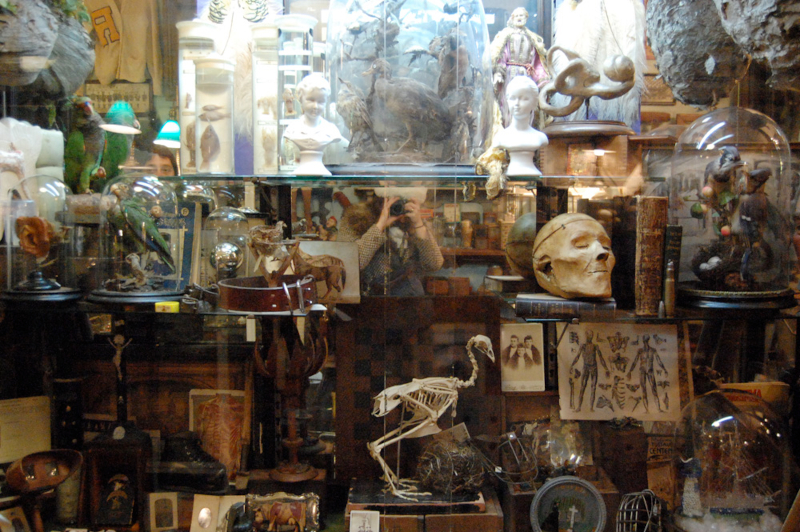
Image: hiddennyc.wordpress.com
Check out HFR’s book catalog, publicity list, submission manager, and buy merch from our Spring store. Follow us on Instagram and YouTube. Disclosure: HFR is an affiliate of Bookshop.org and we will earn a commission if you click through and make a purchase. Sales from Bookshop.org help support independent bookstores and small presses.
 Heavy Feather Review