
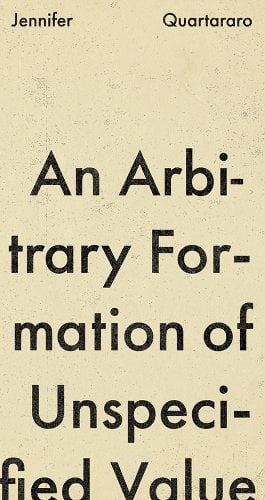
“A link exists between the deficiency of our blood and our embarrassment in duration,” the Romanian philosopher and aphorist Emil Cioran says in All Gall is Divided. He continues, “Don’t our conscious states derive from the discoloration of our desires?” In Jennifer Quartararo’s debut An Arbitrary Formation of Unspecified Value, the question of anemia, both clinical and metaphorical, centers on the speaker’s location and duration within a complicated city. Quartararo’s text is both an ode and an elegy to the city of Detroit, a city of tremendous and resilient history, with a lifeblood that seems to mirror the speaker’s own, lacking a healthy density, deficient. Through her wide and dexterous prose, we examine the oscillating conscious states of a writer negotiating her time and meaning within a contested space, sometimes fruitful, sometimes discolored.
Categories of illness serve as the fulcrum on which many of the disjointed and disparate scenes pivot. Quartararo’s text meanders from histories of Motown and General Motors, to ruminations about her central romantic relationship, to banal depictions of the city, but never strays too far from the subject of “blight,” which creates a poetic tension between the ecological and the urban. “Blight means not to be biologically possible of growth, of life,” she defines for us, “and yet many of the places deemed ‘blighted’ in Detroit today are those that are being reclaimed by nature.” We become instantly aware of the inherent irony of this word, an ecological scourge, specifically among elms, that experiences a complete transference of meaning, a city destroyed by nature’s reclaim. We also must reckon with the even deeper irony of this issue, that this blight is anthropological, the result of decades of development inaugurated ostensibly to support life, and the contrasting results of neglect, the toxic chemicals from automotive plants in the soil and the water, the collapse of industry that resulted in foreclosure and displacement, the detritus left behind, and the inevitably parasitic motivations of “urban renewal.” Blight becomes something circular, Anthropocentric. “Is it blight if you can’t see it? Is it blight if it’s in the river,” Quartararo asks, calling the nature of blight into a larger ontological framework. She follows this question with the image of a Mercury Capri (a now obsolete vehicle) covered in an invasive species of barnacle at the bottom of the Detroit River. The natural and manufactured worlds collide in an obscene spectacle of urban collapse, waste is contained by the ecological and the ecological grows through the neglected infrastructure, the two at once out of place and in a sustained dialectical relationship.
One cannot read into Quartararo’s questions of illness and ignore the subject of gentrification that pervades the text. While not explicit about her own participation in the gentrification of Detroit, the writer leaves hints of guilt regarding any notion of footprint or legacy. “Will I leave a trace on this city?” she asks. “Will I be the flower seed or the Styrofoam?” This seems to be the thesis of insecurity guiding Quartararo through the myriad meanings of Detroit, an impregnable question of whether she can ever have a stable relationship with a place struggling with its own insecurities, those of housing, zoning, development, work, etc. Quartararo’s question is a germane reflection on the ethical implications of urban living, specifically in areas where previous residents have been priced out and displaced. This is a familiar narrative to all of us in the increasingly urbanized and inflated United States now, so much so that we could all craft our own cliches. However, Quartararo avoids the cliches to the best of her ability and attempts a broader display of reverence for the place she calls home, perhaps not as an answer to the problem in question, but in awareness that there may not be a clear answer.
Capitalism makes the quality of living scarce for the majority rather than its intended opposite. This scarcity puts the bulk of us in a state of nearly constant insecurity making the question of where and how we might live impossible to ethically reconcile over our more immediate needs. We see Quartararo navigating this ethical dilemma while also struggling herself, in her health, in her relationships, in her career, and so it would be hasty to offer a polemical response to her relationship to Detroit. Still, there exists a juxtaposition in her prose that seems useful to analyze, namely the disparity between the urban blight of Detroit and the bourgeois quotidian of the speaker, a life that feels functionally impervious to not only the blight, but also the development. We know this to be demographically true. Quartararo moves through spaces of education, mobility, and opulence; there is plenty of food, plenty of wine, frivolous concerns and conversations, the social subterfuge of art, and in another context, maybe even another city, this would seem banal. However, against the background of urban blight, the bourgeois appears dystopian and Quartararo seems to occupy the liminal between the two.
“I want to describe not what it’s really like to emigrate to the kingdom of the ill and to live there,” Sontag says in Illness and Metaphor, “but the punitive or sentimental fantasies concocted about that situation; not real geography but stereotypes of national character. My subject is not physical illness itself but the uses of illness as a figure or metaphor.” Sontag’s point is not to draw a correlation between the physical space of the illness and the rhetorical space of the metaphor but to destroy the products of this metaphorical shortcoming, that illness is a place of inhabitance which is only further neglected by crass containers of social metaphor. An Arbitrary Formation of Unspecified Value is a direct examination of that inhabitance, both in body and in metropole, a body suffering from lack of production and a city suffering from overproduction. Quartararo takes aim at industry titans like Henry Ford who refers to obsolescence as “the very hallmark of progress,” interrogating his spirit in response:
Is that why there’s a plot of land in the Amazon with an abandoned town called Fordlandia? The town Ford began construction on in 1929, once the materials finally arrived, and which he had grand visions to turn into his own rubber-centric production facility. A town whose sole focus was production. Is that why all the rubber trees died?
The exploitation of land and resources is an all-too-familiar tool of settler colonialism and a model of cultural hegemony implemented in the larger capitalist framework of profit. When waste and obsolescence are seen as marks of success despite their greater social and ecological consequences, it is no wonder that the world grows sick with the excess of production.
In the end, Quartararo’s book is an examination of the parasitic relationships of humans forced into impossible conditions. It would appear that no one benefits and that the mutual destruction is both inevitable and totalizing. Quartararo writes, “Trees destroy and are destroyed by a city. Cities destroy and are destroyed by the trees. People destroy and are destroyed by cities.” The tautology of our modern ecosystem is that each component seems to be the cause and effect of its own demise. This is not because we lack reverence, if Quartararo’s book is any evidence, her reverence is abundant, but because the systemization of life and livelihood has become far too eminent. We, by and large, are impecunious not only in mobilizing finance, but in spirit as well. The requisites of burnout have turned us desperate and parasitic. The “value” of our lives cannot be “specified” because it resists being rendered a commodity (no matter how desperately the machinations of data strive for the opposite), because our value yearns for a connection simultaneously material and immaterial, a sense of indigeneity that is impossible for the majority of us to inherit in a land of conquest and acquisition. Quartararo’s debut successfully demonstrates this problem as our endemic state, here to be endured through our clever, albeit futile, fabrications of survival.
An Arbitrary Formation of Unspecified Value, by Jennifer Quartararo. Portland, Oregon: Bunny, June 2024. 148 pages. $16.95, paper.
Eric Tyler Benick wrote the fox hunts (Beautiful Days, 2023) and Memory Field; A Travelogue of Forgetting (Long Day, 2024). With Nick Rossi, he runs Ursus Americanus Press, a publisher of shorter poetics. His recent work has appeared in Bennington Review, Brooklyn Review, Copper Nickel, Harvard Advocate, NOIR SAUNA, and Puerto del Sol. His most recent chapbook, Solip Schism, is now available from Blue Bag Press. He lives in Brooklyn and teaches postcolonial and anti-carceral literatures at Wagner College where he is criminally adjunct.
Check out HFR’s book catalog, publicity list, submission manager, and buy merch from our Spring store. Follow us on Instagram and YouTube. Disclosure: HFR is an affiliate of Bookshop.org and we will earn a commission if you click through and make a purchase. Sales from Bookshop.org help support independent bookstores and small presses.
 Heavy Feather Review