
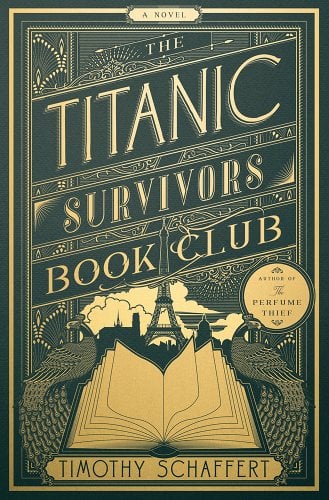
The tragedy of the RMS Titanic, which met its fate in the North Atlantic’s icy waters on April 14, 1912, during its maiden voyage, continues to awe, intrigue, and fascinate the general public. Modern-day disasters like the Titan submersible implosion not only renew interest in the infamous ship’s brief existence, they also reignite conversations about wealth, privilege, and social class which reverberate with today’s conversations about equity and inclusion. While most people tend to focus on the lives of those who either perished in the disaster or one of the few who managed to survive, few stories exist about those who were supposed to sail on the doomed ocean liner but instead chose to either forfeit their ticket or, for some other reason, not sail on the RMS Titanic. Timothy Schaffert’s novel The Titanic Survivors Book Club not only dares to imagine the lives of those who made the (ultimately life-saving) choice to not sail on what would become one of the most memorable ships in history; it also dares to portray social issues—like wealth, privilege, racism, disability, LGBTQ rights, and book censorship—in a historical context that makes us realize their relevance in today’s societal, economic, and political spectrums.
What makes The Titanic Survivors Book Club is, indelibly, its main character and narrator, Yorick. Yes, that’s right—Yorick. Named after the infamous Shakespearean skull of the Hamlet variety, Yorick’s own life is actually a Victorian blend of Shakespeare’s comedies and tragedies. Yorick’s father was mad for the stage and Shakespeare, hence Yorick’s name, and at a young age his mother sent him on a ship to England so that he could live with his father. Yorick’s young life is plagued by emotional abandonment and disaster: his father is, in reality, anything but a father, and the most affectionate person in Yorick’s life is Leopold, an old sailor with whom Yorick shares a deep friendship. During one of his father’s plays, young Yorick falls in the path of a moving stage prop—a ship—during a performance of The Tempest. The accident results in Yorick being permanently disabled, destined to use a walking cane for the rest of his life. Eventually, Yorick—despite Leopold’s warnings to abandon the sea’s calling—finds himself in the employ of the White Star Line as a librarian. However, Yorick is not just any librarian. He is, for a while, the second-class librarian for the White Star Line’s behemoth accomplishment, the RMS Titanic.
As those familiar with the Titanic’s history know, her presence in port and on the sea was an engineering and social accomplishment. She was the largest of the three Olympic-class liners at the time, and she was destined to carry some of the wealthiest passengers who lived during that era. Her first-class accommodations were designed to be the epitome of class, comfort, and luxury, and her advanced safety features—consisting of water-tight doors and compartments—earned her the reputation of being “unsinkable.” However, the Titanic also represented some of the era’s most egregious flaws. Only those of the highest wealth were privy to her luxuries, and her opulent Turkish baths and first-class cabins represented the upper crust’s preferences for pristine appearances and conformity. Yorick, with his visible disability, juxtaposes the White Star Line’s vision of an exquisite, pristine, and undamaged façade that would appeal to those with enough clout and wealth to access Titanic’s first- and second-class accommodations. Thus, Yorick finds himself removed as Titanic’s second-class librarian only a short time before she leaves port, and Yorick possesses enough self-awareness and socio-political awareness to realize that his disability may have played a part in his removal from his position. Eventually, dismissed from his position and in the wake of the Titanic disaster, Yorick—after receiving a generous inheritance—pursues his life’s dream of opening a Parisian bookshop. The bookshop flails, and Yorick’s life passes dismally, until a strange invitation lures Yorick into an unlikely circle of friends—others who held a ticket for the Titanic, but for varying reasons chose not to board and sail on the doomed ocean liner to New York.
Nonetheless, we discover that Yorick’s dismissal might have also stemmed from a rather admirable action on Yorick’s part—how he stealthily snuck banned books of the time into the libraries of the ships on which he served. For contemporary readers, this is the part where the novel most resonates with the current onslaught of book bans and legislations targeting librarians, predominantly in conservative states throughout the US. Yorick discreetly tucks books like Kate Chopin’s The Awakening, which, though censored because of its portrayal of female sexuality, was never technically banned. Yorick also incorporates French decadent and symbolist Rachilde’s Monsieur Venus, the story of a rowdy French noblewoman who transforms her identity while pursuing sexual pleasure. The book spurred Belgian authorities to pursue legal action, on the grounds of pornography, against the novel—which was found “guilty in absentia.” The novel’s focus on censored, challenged, charged, and banned literature is integral to the plot. The books Yorick assigns for the book club are those banned books he carefully placed in the libraries of ships like Titanic. Ultimately, the books help forge the synchronicities and relationships which emerge in the book club, but they—and the discussions they open—become a means by which each survivor confronts and challenges their grief stemming from the disaster. In other words, the hope, the enlightenment, and the camaraderie each banned book offers to the members of the Titanic Survivors Book Club outweighing their supposed threat—something each of the novel’s characters realize in their own way.
Carefully layered into an examination of banned literature is a critique of the time period’s inherent, and openly accepted, racism. This examination occurs mostly through the depiction of the experiences of Zinnia, a half-American, half-Japanese heiress who, along with her parents, was denied a place in first-class for being half-Japanese. Zinnia recognizes that her wealth provides a barrier of social protection. She describes America, despite growing up there, as a place with “such cruelty” and “laws against Japanese women.” Yorick, who lived in America as a boy, poses a question which still resonates in contemporary America—“What are they afraid of?” It is Zinnia’s honest, dynamic, and painful answer which reminds us that the United States of today unfortunately has not progressed past the discriminatory and racist practices of the early 20th century: “They’re afraid of what everybody’s afraid of … Afraid there’s not enough to go around. They think immigrants don’t earn anything, they take it. Any dollar a Japanese man has is one less dollar in a white man’s pocket.” France, nonetheless, offers Zinnia a refuge from America’s racist rhetoric, and, eventually, readers see that for Zinnia, Paris becomes a place in which she can explore, embrace, and celebrate her Japanese heritage.
Of course, one cannot read and talk about the novel without mentioning what truly makes The Titanic Survivors Club a memorable, notable read worthy of celebration—its subtle advocacy for LGBTQ rights and visibility. In 1913, the publication of Marcel Proust’s In Search of Lost Time marked the first time a Western author had treated homosexuality openly in literature. However, Proust’s book does not feature whatsoever in The Titanic Survivors Club. Yorick’s own recognition of his homosexuality—predominantly shown through his attraction to the alluring and mysterious character, Haze—is what draws LGBTQ rights and recognition of the time into focus for us. Yorick openly and honestly struggles with his attraction to Haze—who, despite his bisexual exploration with Yorick—is deeply in love with Zinnia. Yorick’s vulnerability shows even more in a particular scene as he weighs the potential consequences of visiting a place in which homosexual men gather to find love, sex, and partnerships. He briefly mentions the potential police raids which would have disastrous consequences for his future, and he finally decides to not visit the place after all. Yorick also frequently reflects about the public persecution Oscar Wilde endured because of his homosexuality. These astutely vulnerable moments are carefully weaved into the novel’s larger narrative. However, they convey France’s larger, systemic and social responses historically. After the French Revolution, the penal code decriminalized homosexual acts. Despite the decriminalization, the largely Catholic country disapproved of homosexuality, which influenced its relationship with its LGBTQ population into more recent times. Marches against homosexuality and same-sex marriage have continued in the country well into the 2000s. Thus, the novel bears an important recognition: that for many individuals, the struggle for visibility, equity, and equality is the same today as it was over a century ago.
Some of us may be disappointed that The Titanic Survivors Book Club does not follow the already well-established and stereotypical narratives in fiction inspired by the disaster. However, that, too is one of the novel’s beautiful attributes. As more and more calls to abandon Titanic tourism emerge from the public—including the relatives of some of those who perished during the sinking—as well as a few member of the scientific community, what the novel gently probes the manifestation of grief in the public and survivors after a disaster. The events that on unfolded on the night of April 14, 1912 will undoubtedly continue to intrigue generations of writers, explorers, historians, and the common public to come. The novel implores us to remember the disaster’s incurred human costs—and not just the body count of approximately 1500 souls who perished with the ship. Those who survived, and those who—for whatever reason—did not board lived with horrific psychological and emotional scars. Yorick and the other book club members are bound not only by their survivorship and their grief, but also their survivor’s guilt, which leads many of them—like Yorick and Zinnia—to reevaluate their true individual purpose in life.
The Titanic Survivors Book Club is deeply moving and poetic. Vivid in detail and imagination, and despite the tragedies threaded through its plot, it is one of the rare books to be published in a while that reminds us that hope—and friendship—can be found in some truly unexpected places. Most of all, Yorick emerges as an unlikely, multifaceted hero. His deep, philosophical, and literary nature fascinates and intrigues, and his resilience—like the books he so carefully and lovingly recommends to others—surely inspires.
The Titanic Survivors Book Club, by Timothy Schaffert. New York, New York: Doubleday Books, April 2024. 320 pages. $29.00, hardcover.
Nicole Yurcaba (Нікола Юрцаба) is a Ukrainian American of Hutsul/Lemko origin. A poet and essayist, her poems and reviews have appeared in Appalachian Heritage, Atlanta Review, Seneca Review, New Eastern Europe, and Ukraine’s Euromaidan Press. Nicole holds an MFA in Writing from Lindenwood University, teaches poetry workshops for Southern New Hampshire University, and is the Humanities Coordinator at Blue Ridge Community and Technical College. She also serves as a guest book reviewer for Sage Cigarettes, Tupelo Quarterly, Colorado Review, and Southern Review of Books.
Check out HFR’s book catalog, publicity list, submission manager, and buy merch from our Spring store. Follow us on Instagram and YouTube. Disclosure: HFR is an affiliate of Bookshop.org and we will earn a commission if you click through and make a purchase. Sales from Bookshop.org help support independent bookstores and small presses.
 Heavy Feather Review