
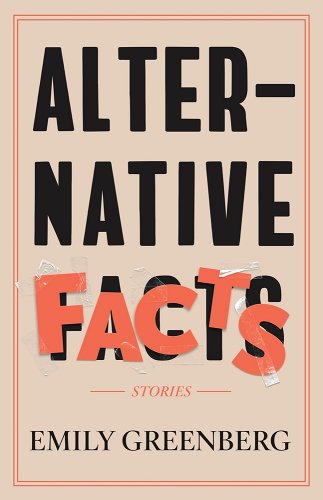
Midway through Emily Greenberg’s breakout collection, Alternative Facts, is a story titled “Lost in the Desert of the Real,” which begins with theorist Jean Baudrillard’s description of how images are degraded from being reflections of profound reality to simulacrums of themselves, self-referentiality with no external connection. It is a common enough danger of our media-infested reality, where our on-screen personas depict lives that are imitations of the lives we wish we were living. However, Alternative Facts does not go for the jugular but chooses to depict the twenty-first century condition in the best way possible: satire tinged with pathos. This is not the resigned, Marxian, tragedy-to-farce reaction, where we mock the people and things we dislike or fear. Instead, Greenberg creates the kind of literature that emerges in those murky parts of fiction where satire and empathy meet.
For instance, in the book’s titular story, “Alternative Facts,” we are introduced to the thoughts of Kellyanne Conway at Trump’s first (*sigh*) inaugural ball. The story is based on real-life events—which include Conway punching a man—and is a monostitch, a story told in one long sentence (those who have ever heard Conway speak will understand why this is an obviously fitting style). What Greenberg does with Conway, though, is avoid caricature, reminding us how much all of us invent realities and people. The reality of Conway is an alternative fact to what all people—left, right, or center—try to make of her. She herself is aware of this in the story as she ponders her life and the narrative she’s made of it: “she … did not approach the men about to fight each other and ask what was wrong and implore them to use their words, not realizing her own words would be so misunderstood, that the men would only hear what dripped from her mouth and not see what was in her heart …” The alternative facts of this book, in other words, are couched in a reality that is more complex than many of us tend to recognize in our day-to-day lives.
That’s the thing—sure, this book lets us laugh at famous people, but it also puts them on display as fellow humans. Greenberg is constantly reminding us people sometimes do and say foolish things, but they are still complex people. In “Lost in the Desert of the Real,” for instance, we see the governor of Hawaii nervously try to stop a false missile alert:
In his private office, the governor paces back and forth. In his private office, the governor stares at the Twitter log-in page on his cell phone screen and types in password after password to no avail. In his private office, the governor curses the stupid blue Twitter bird. He imagines plucking out her feathers with just his teeth and feasting on her glistening meat, running his tongue over the delicate breast bones and crushing a blue eyeball between his thumb and index finger … And then he cannot help wondering—does the Twitter bird even have eyeballs, and if so, what does she see?
It’s narrative moments like that that make Alternative Facts a profound work of art rather than a merely funny story collection, revealing our foibles even as we attempt to be better.
In “Black Box,” Greenberg provides a short, fictional biography of B. F. Skinner. The story draws heavily from reality, but it does so with imagination, asking how someone can seem to care so much about humanity in general yet seem to care so little about actual people. That, in fact, is not so far off from a later story based on Jay Leno’s real-life interview of George W. Bush, the one in which Bush shared his paintings. Does W care about the people he’s depicted, particularly the soldiers and civilians killed in war? We hold our breath as W weighs his options, ponders whether he should share his conscience or play the role of goofball. Skinner and Bush do not come off as admirable men here, but they are sympathetic and complex, Don Quixotes with far more to answer for.
The novella that wraps up the collection is a caper featuring the unlikely pairing of Thomas Pynchon and Paris Hilton. It’s a fun lark, though I’m the first to admit it might not entertain those who’ve never had the chance to read Pynchon’s oeuvre. “The Author and the Heiress” features more of the satire-meets-empathy that Greenberg does so well, but adds the dichotomy of Pynchon and Hilton. One, Pynchon, avoids the spotlight at all costs, while the other, Hilton, seeks it out, also at all costs. Together, in what is almost like a buddy cop movie, they are trying to find their way to Kim Kardashian’s party. The novella’s protagonists represent two sides of America: one is holed up, afraid of the vast conspiracies out in the world that are all trying to bring him down, while the other lives her shallowest life, devoted to clicks, likes, and the struggle for the spotlight.
The answer for Hilton and Pynchon is human connection—but that’s the point, isn’t it? Greenberg’s timely collection is a reminder of what we are missing, the fact that we are so full of fear and anger, loathing and mistrust, sadness and self-interest, that we’ve cocooned ourselves away, trusting very few as we live our beautiful, lonely lives. What Emily Greenberg does so well, besides make us laugh, is remind us is there are other facts to live our lives by.
Alternative Facts, by Emily Greenberg. Austin, Texas: Kallisto Gaia Pres, January 2025. 208 pages. $19.95, paper.
Matt Martinson teaches honors courses at Central Washington University, and occasionally reviews books for Heavy Feather. Recent fiction and nonfiction appear in Lake Effect, 1 Hand Clapping, and Coffin Bell; his piece, “Trout and Trout Remain,” received a Notable mention in Best American Essays 2024.
Check out HFR’s book catalog, publicity list, submission manager, and buy merch from our Spring store. Follow us on Instagram and YouTube. Disclosure: HFR is an affiliate of Bookshop.org and we will earn a commission if you click through and make a purchase. Sales from Bookshop.org help support independent bookstores and small presses.
 Heavy Feather Review