
Imagine the vast number of words written over the past 5,000 years, since the invention of writing and beginning of recorded human history. Many were written in attempts to explain the world in which the writers lived at the time. Now think about how many of these interpretations have since been labeled as incorrect—whether due to ignorance, laziness, or pomposity of the writers, or perhaps even ulterior motives (e.g., personal grudges against contemporaries with differing views). Other writers then reproduced these falsities by collecting the occasionally misguided or entirely fabricated observations and interpretations into their own publications. In many cases, these errors persisted for years, only to be revised yet wrongly again by later writers, and so on and so forth until, eventually, empirical data proved otherwise, with the intention of halting all further thought on the matter. But what if the writers of these books had been intentional in the inclusion of errors alongside truths? And what would happen if history’s pedants were less obsessed with correction and more inclined toward unbridled thought? Further yet, who is to say that an orderly mind is more fertile than, and thus superior to, a feral one?
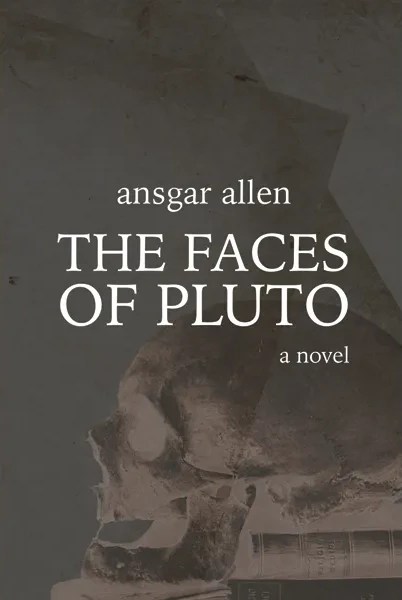
While entertaining these and related questions, Ansgar Allen’s novel The Faces of Pluto serves partly as a paean to history’s imperfect compendia and their compilers. While Allen, a professor in the School of Education at the University of Sheffield, employs a skeletal fictional framework in crafting the book, the text includes generous helpings of insights and errors from the works of, among others, Greek historian and “father of history” Herodotus, English polymath Sir Thomas Browne, English amateur archaeologist Thomas Bateman, and Roman author Pliny the Elder. Eschewing traditional chapters, Allen organizes the book into a sequence of text blocks of varying lengths that twine together, repeating and re-examining its ideas throughout, offering space for us to ruminate on them and second-guess our credibility.
The narrative commences, following introductory thoughts on writing and books, with the narrator receiving a note stating that a man “beyond the woods” requires a replacement assistant who can read and write and is willing to take on the job. The note further stipulates that the person must be “conversant with various understandings” and should have “canny powers of inscription and recollection.” The implication is that the narrator, with his unique skillset, is the only one able to fill this role. Realizing this and accepting his new responsibility, the narrator soon sets out on a journey through the forest to the land beyond. Upon his discovery of the note’s sender, lying in an earthen hollow as it were, the man launches into a diatribe on burial mounds and, more specifically, the barrow-digger Bateman, author of the book Ten Years’ Diggings in Celtic and Saxon Grave Hills. Thus begins a miscellany of digressions on topics ranging from the acts of recollection and writing to burial customs and the inevitability of death. The excised philosophical ruminations and dubious proclamations of the oft-unreliable writers under scrutiny are interleaved with the narrator’s wry and pithy commentary and his recollections of that of other characters whom he encounters, most notably and frequently the man in the hollow, who may or may not also be himself (time being anomalous here).
The geography of the novel’s setting comprises plains leading to a ridge from which extends a series of valleys, with distant mountains that slope down to a sparsely vegetated flat region, at the end of which looms an enormous stone wall with a single door. Inhabitants include those living in the valleys and the nomads roaming the hills; no one lives in the flat region before the wall. Each valley’s society and its citizens abide by a single guiding idea, inscribed on a monument at the valley’s entrance from the ridge. The description of the valleys yields an image of civilizations risen and fallen, of those long ended and those still intact. The narrator relates the characteristics and governing ideas of certain valleys, splicing in relevant comparisons to the historical records surveyed throughout the book. Among other topics, barrow excavation and the art of woodcutting are examined at length, the latter in contrast to the act of writing, which as opposed to cutting consists of engraving or marking, and so too even “the deletion of words cannot produce infinitesimal recesses, or voids of inexpressible detail,” as is achieved in woodcutting.
The wall at the end of the flat region is a central concept in the novel, first referenced early on and returned to throughout. All books, existing and imagined, are housed inside the wall’s chambers, connected by passages winding through a vast inner warren of the written word. Although at one point the wall is described as housing only books, later it is said to also contain all objects (“or certainly those written down”) and “all demonstrable truths.” These latter, as the age of empiricism progresses further, would come to reproduce in the wall from “multiple laboratories … within its recesses, unpeopled naturally, but mechanised, demonstrating the veracity of their claims.” This idea resonates at a present time when artificial intelligence (AI) has begun to replace the human research activities of sorting and compiling, by which following the input of terms into a search engine, not only has the order of results returned been manipulated by algorithms, but the results themselves also categorized and summarized through the use of AI. Are we then to accept these artificially generated answers to our queries as more or less truthful than those crafted by humans? One wonders how the novel’s illustrious compiler Thomas Browne, author of the encyclopedic work known as Vulgar Errors and a noted propagator of misinformation in his own right, would react to the role and value of AI in this context.
The Faces of Pluto is a work of what some call theory-fiction, a type of writing pioneered by writers such as Maurice Blanchot and Georges Bataille, who probed philosophical themes from within an outer shell of fiction. Theory-fiction casts off the bounds of traditional storytelling and the rigidity of academic writing, leaving a fruitful terrain in which to engage with theory. Allen’s novel hovers in this indeterminate space, its narrator leapfrogging between subjects, at times holding up the words of the writers under examination as keen insights to be seriously considered while at other times gently mocking the erroneous knowledge they are known to have furthered. The actions of writing and reading are both extolled and criticized. The architecture and significance of the fictional wall and the labyrinth on the ridge are discovered and described. Many of the themes at play are rooted in Allen’s ongoing interrogation of education by way of fiction—a body of work that includes the previous novels Wretch, The Sick List, The Reading Room, and The Wake and the Manuscript, among others. Collectively, these novels sound a call to arms—sincere but not without a note of skepticism—to revolt against the structure and practices of modern formal education:
It may be necessary to travel to a time before perception was organised by academians and their kind. A time before efforts made to regulate learning and insist that statements must stand before inspection. If that were possible.
The Faces of Pluto demands rigor—its abrupt transitions can be bewildering in the absence of concentrated effort. Allen’s writing challenges us to avoid becoming “readers who can be seen to stray but in glazing over do not escape” and whose “inattention is a further sign of their enslavement.” At a time when many of us clamor for the next uninspired novel spit out from the publishing assembly line, Allen offers instead a new novel that revisits the old—presenting and querying the traces of truth and error in the spirited, imperfect work of past compilers.
The Faces of Pluto, by Ansgar Allen. Santa Fe, New Mexico: Stalking Horse Press, October 2024. 264 pages. $21.99, paper.
S. D. Stewart lives in Baltimore, Maryland. He is the author of the novel A Set of Lines and a member of the collaborative publishing project Ghost Paper Archives. More information at sd-stewart.com.
Check out HFR’s book catalog, publicity list, submission manager, and buy merch from our Spring store. Follow us on Instagram and YouTube. Disclosure: HFR is an affiliate of Bookshop.org and we will earn a commission if you click through and make a purchase. Sales from Bookshop.org help support independent bookstores and small presses.
 Heavy Feather Review