
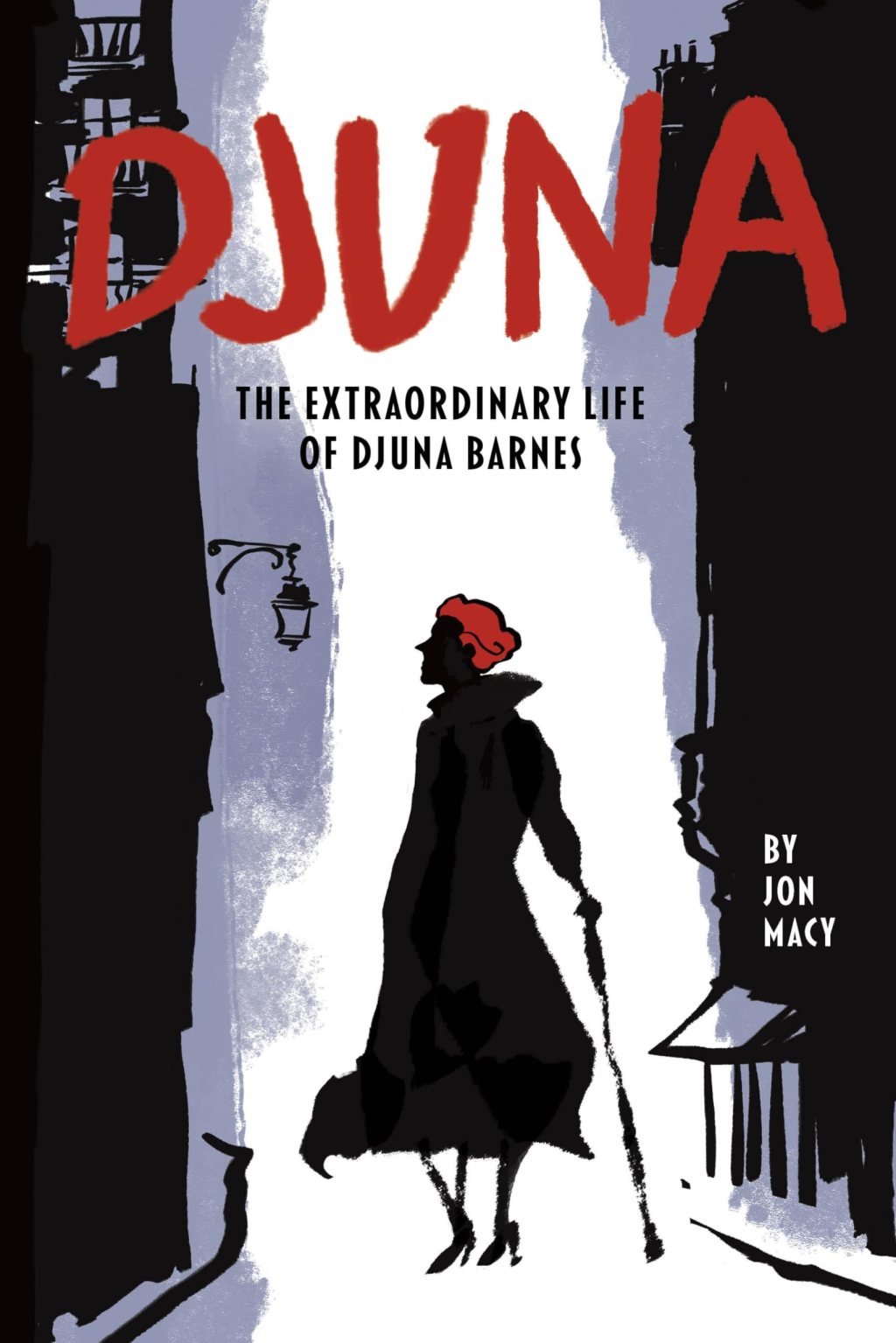
Why aren’t the women in Jon Macy’s graphic novel, Djuna: The Extraordinary Life of Djuna Barnes, more famous? Almost every female character in this visual biography was someone who I had never heard of or had only heard of in passing. I can guarantee the majority of Americans wouldn’t know their names. Why have we heard of Marcel Duchamp or even R. Mutt, but never, not once (!), heard of Baroness Elsa von Freytag-Loringhoven? Why do we know about Joyce and Pound but so little about Mina Loy or Natalie Barney? Where have the names Alla Nazimova or Bricktop or Romaine Brooks or Emily Coleman or Antonia White been hiding? Why do so few people know of the horrors that poor Zelda Fitzgerald was subjected to?
The answer is probably obvious. Homophobia, in part. More largely, we haven’t heard of them because they’re women. Still … I can’t get past the fact that there was this whole community of thriving queer women influencing art and culture that disappeared behind the opaque partition of history, or behind the names of their male counterparts. This is, of course, even further exacerbated by race, with women of color, as a whole, further excluded from memory. It is infuriating.
That being said, I had heard of Djuna Barnes. I have read her novel Nightwood. But I knew little about her life before reading this graphic novel, certainly nothing to the extent I know of her contemporary, Ernest Hemingway. Without particularly trying, I know a whole mythology around that man, from details regarding his upbringing and his service to places he lived and his many wives and more infamous stories about booze and guns. All I knew of the author before reading this biography was that she was a “lesbian” and “experimental.”
All of this to say, someone needs to buy the rights to this book and make a movie, immediately. This book has everything you’d want: a real but largely unknown history, complex characters, drugs and alcohol, glamorous rich benefactors and dirty Greenwich Village hovels, and sexy artists and sexy stars and sexy Victorians living like hippies, having sex all over the place, from New York to Paris to Morrocco to London. Best of all, you have art when art was still trying to make something completely new.
I really enjoyed learning more about life for this social circle of artists in the 20s and 30s. There is a perception of people coming out of the Victorian era, that they were conservatives with an extreme and violent priggishness. However, Macy shows us that Barnes came from a free-love community that challenged social expectations. For better or worse, these mores (and traumas) shaped her for the rest of her life. From this unorthodox upbringing, Barnes was launched into the creative Petri dish of early 20th century New York and a beautiful, bittersweet chaos ensues.
We aren’t able to help thinking about the parallels to the modern world, even though we’re separated by a hundred years. Economic instability, war looming, and a contingent rebelling against traditional values and understanding. A circle that feeds itself, we see the same struggles and aspirations, separated only by fashion and faces.
The complexity of the characters is what sets this life (this story) apart. You have Peggy Guggenheim, insecure but incredibly privileged patron of the arts. Then, there is the slew of Barnes’ lovers, including the horribly tormented and boundary-pushing Thelma Wood. There is a mad, cross-dressing faux doctor and the different communes of lesbian intellectuals and, on the farm, Barnes’ red-headed family, with their unfulfilled dreams and horrible downfall. Center stage sits Barnes herself, hair and heart aflame, reveling in beauty and art and the pain of it all.
Djuna: The Extraordinary Life of Djuna Barnes is an excellent graphic novel whose art enhances the text and vice versa, with no medium overtaking the other but simply complementing its partner. Macy never loses sight of the story and pays a perfect tribute to its magnificent and imperfect heroine. He has an adept ability to incorporate a giant cast of characters without confusing us and uses history as a powerful tool to explore our current circumstances. Five stars, thoroughly recommend—this was a great experience and I’m looking forward to reading up more work from both Barnes and Macy.
Djuna: The Extraordinary Life of Djuna Barnes, by Jon Macy. Brooklyn, New York: Street Noise Books, October 2024. 320 pages. $24.99, paper.
Jesi Bender is an artist from Upstate NY. She is the author of the chapbook Dangerous Women (dancing girl), the play Kinderkrankenhaus (Sagging Meniscus), and the novel The Book of the Last Word. Her shorter writing has appeared in FENCE, Sleepingfish, Exacting Clam, and others. Her play Kinderkrankenhaus will see its second production at the Brick Theater in Brooklyn in September 2023.More: jesibender.com.
Check out HFR’s book catalog, publicity list, submission manager, and buy merch from our Spring store. Follow us on Instagram, Bluesky, and YouTube. Disclosure: HFR is an affiliate of Bookshop.org and we will earn a commission if you click through and make a purchase. Sales from Bookshop.org help support independent bookstores and small presses.

