
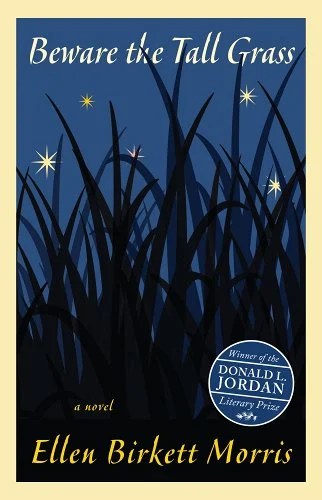
In her wonderful debut story collection Lost Girls, EllenBirkett Morris delivered 17 stories that explore in heartrending prose both the vulnerability and the power of the feminine. In her debut novel, Beware the Tall Grass, Birkett Morris maintains her focus on the feminine in the person of her protagonist, Eve Sloan, a new mother deeply concerned about the strange behavior of her pre-school-aged son, Charlie. Eve is a sculptor and a stay-at-home mom, her husband, Dan, an information analyst with the DOD. As such, each experiences their young son’s often bizarre ordeals very differently, generating the primary tension that serves as the main thrust of the story. But Beware the Tall Grass brings much more to the table than a family’s struggle to hold on through a mysterious trial.
In a parallel narrative from an earlier time, we experience the coming of age of a co-protagonist, Thomas Boone, a relative innocent from rural Missoula, Montana. As a child in the 1950s who enters his teen years in the early 1960s, Thomas suffers the turbulent years of the Civil Rights movement and the nascent Vietnam War from afar. Through it all, as an only child growing up on a remote farm, Thomas depends mightily on the constant companionship of his trusted horse, Beau.
In Birkett Morris’ telling, these two stories never lose sight of the common themes of familial dilemma and the urgency of hearth and home. Both Eve and Dan have had difficult upbringings resulting in complicated relationships with their mothers—relationships that prickle and stab at the couple’s desperate attempts to work through Charlie’s painful episodes. Meanwhile, Eve’s friend Amy, the closest thing to a sister she has ever had, struggles through the latest in a series of abusive relationships, causing even more strain as Eve comes insistently to her friend’s aid. In years long past, Thomas, a denizen of the grit and grain of rural Montana, is haunted by the searing memory of being forced, as a boy, to shoot dead his beloved horse Beau. This haunting memory throws him off-kilter as he grows into a young adult, finds his first love, Carrie, and then, in a fit of indecision about what to do after graduation, impulsively volunteers to serve in the U.S. Army. Thomas’ home life with his parents and with Carrie is, in contrast to Eve’s and Dan’s, stable and supportive. But that foundation, in the end, strains mightily against the ravages and violence of a faraway war.
Interweaving two very different stories with first-person intimacy, Birkett Morris shows us the steady hand of a skilled practitioner, delivering what all great fiction must: both the unique and the universal. Charlie’s confounding behaviors present Eve and Dan with a dilemma that is both bizarre and daunting, while the strains that this dilemma places on their marriage—strains exacerbated by all the other demons and daily challenges of life—are commonplace in most marriages. In Thomas’ case, the tragedy of loss and the fog of war will be rare and mysterious experiences for most of us, where the solitude of rural life and the comfort of a creature companion will be widely understood, whether or not you happen to have lived on a farm or owned a horse.
Birkett Morris further enriches the narrative by working with turbulent themes from both the 20th and 21st centuries. The long and tragic history of the Vietnam War long ago clouded the misunderstood early years of the conflict, during which a single personal tragedy could lead an innocent youth like Thomas Boone to entrust his early adulthood to a military campaign in a faraway jungle. Even words of warning from a concerned father scarred by service in World War II could not prevent the misguided impulse to sign up and volunteer. In her time in present day America, Eve Sloan is the concerned working mother who has people and expertise to turn to when faced with her son’s darkly peculiar behavior. But those choices, unfortunately, can be as confounding as the affliction when two spouses cannot agree on what to do next, and the pressures of work, life, and difficult relationships will not relent. By giving us two characters facing up to the demons of their times, Beware the Tall Grass both explores and illuminates the larger forces that can assail all of us from generation to generation.
These two narratives are, of course, connected, and as that connection slowly reveals itself, we are buffeted and propelled by rising tension and jarring events, and are ultimately enveloped in waves of tragedy and renewal. This compact, yet wide-ranging novel delivers both the expected and the unexpected, both the hardship of betrayal and the solidity of tireless devotion.
It’s no surprise to this reviewer that Beware the Tall Grass, Birkett Morris’ latest expansive exploration of all that makes us human, was the winner of the Donald L. Jordan Literary Prize. It’s a well-deserved distinction, and clues us to what we can expect from this rising literary talent.
Beware the Tall Grass, by Ellen Birkett Morris. Columbus, Georgia: Columbus State University Press, March 2024. 244 pages. $22.95, paper.
Bruce Overby’s story “Bookmarks” won First Prize in the Lorian Hemingway Short Story Competition, and his debut novel, The Cyclone Release, published in November 2022, was a finalist in the Madville Publishing Blue Moon Novel Competition. His short fiction has appeared online, in print, and in audio in publications including The Green Mountains Review, The Evening Street Review, and the anthology Home of the Brave: Stories in Uniform.
Check out HFR’s book catalog, publicity list, submission manager, and buy merch from our Spring store. Follow us on Instagram and YouTube. Disclosure: HFR is an affiliate of Bookshop.org and we will earn a commission if you click through and make a purchase. Sales from Bookshop.org help support independent bookstores and small presses.
 Heavy Feather Review