
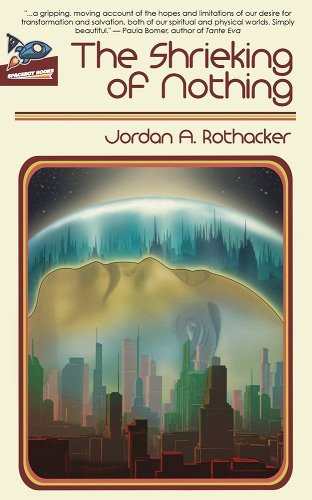
Jordan A. Rothacker’s sixth novel, The Shrieking of Nothing, marks his first venture into sequel territory, returning us to the futuristic world of RESURGA (23rd-century Atlanta) and the detective duo Assistant Sacred Detective Edwina Casaubon and Sacred Detective Rabbi Jakob “Thinkowitz” Rabbinowitz, who first appeared in Rothacker’s 2020 novel, The Death of the Cyborg Oracle.
One of the novel’s immediate strengths is its accessibility to new readers. While fans of the previous work will appreciate the deepening of established mythology, The Shrieking of Nothing operates like a classic mystery series where earlier installments enhance but aren’t prerequisites for enjoying the current installment.
Set in 2220, the story begins with the disappearance of Aho’eitu “Momo” Latu from New Gibraltar, a neighborhood in RESURGA. As Casaubon and Thinkowitz investigate, they encounter a diverse cast of characters and uncover a trail of clues, while a serial killer claims more victims in what appears to be preparation for a sacred sacrifice. However, to reduce the novel to its plot would be to miss its true essence. The detective case serves as a catalyst for exploring the philosophical and theological landscape of this future world, making this more a novel of ideas than a straightforward procedural.
Rothacker’s world-building is masterful in its subtlety. In 2220 RESURGA, all cultures, religions, and gods—whether contemporary or ancient—coexist in a post-capitalist society. The novel seamlessly weaves together elements from various mythologies and philosophical traditions. Throughout the novel, Casaubon and Thinkowitz interact with a temple priestess, a worshiper of Kōjin (the Japanese goddess of hearth), Zao Shein (the Chinese goddess of hearth), and travel to a location named after the Ninshubur Gardens of ancient Mesopotamia … to name only a few elements that populate the story.
The novel’s intellectual depth is particularly noteworthy. References to historical scholars like Maimonides and Euripides sit comfortably alongside mentions of contemporary figures such as Nina Simone and Percival Everett. The novel’s title itself references lyrics from David Bowie’s 1980 song “Ashes to Ashes,” a sequel to his 1969 hit “Space Oddity.” By treating these references with equal weight, Rothacker suggests a future where our current cultural touchstones have achieved the same gravitas as ancient wisdom. This approach respects our intelligence, offering no hand-holding or explanatory footnotes for its mosaic of cultural allusions.
While the novel’s pace occasionally slows to accommodate philosophical discussions, these moments feel earned rather than indulgent. Midway through the novel, during a shared tram ride, Casaubon and Thinkowitz discuss how the end of capitalism has shaped their way of life, seamlessly weaving quotes from The Book of Psalms and the Greek poet Antipater into their conversation. Such contemplations add depth to both the setting and the central conflict.
Though comparisons to noir masters like Raymond Chandler or science fiction visionaries like Philip K. Dick may be inevitable, The Shrieking of Nothing most closely resembles the work of Thomas Pynchon. Like Pynchon, Rothacker uses the detective story as a launch pad to explore deeper, existential mysteries, fearlessly drawing from an encyclopedia of knowledge spanning all facets of culture.
But what sets this novel apart from comparison is its underlying optimism. While RESURGA is no utopia—its citizens live under a dome to protect them from the destroyed earth outside—the future depicted here is one of surprising tolerance and intellectual achievement. Citizens freely choose their beliefs, authors are elevated to the status of great minds, and people have become more self-reflective, learning to live harmoniously in a post-capitalist world.
The relationship between Casaubon and Thinkowitz forms the heart of the novel. While Casaubon guides us through RESURGA, Thinkowitz steals every scene with his dry wit and formidable intellect. His presence allows Rothacker to explore Jewish history and theology, from Maimonides’ The Guide for the Perplexed to the Talmud, and apply these works to the mystery at hand. One of Thinkowitz’s most memorable lines—”You spoke to the irony of killing people in the process of killing their own egos”—perfectly encapsulates the novel’s blend of philosophical depth, noir sensibilities, and unexpected humor.
At a concise 180 pages, The Shrieking of Nothing demonstrates a remarkable economy of storytelling. Rothacker’s restrained approach to futuristic elements also avoids the common science-fiction pitfall of excessive technological exposition, allowing the story to maintain its momentum while presenting the world as matter-of-factly as the characters themselves experience it.
The novel’s success in balancing complex ideas with an engaging mystery suggests rich potential for future installments. If Rothacker chooses to follow in the tradition of serialized science-fiction and detective novels, he could use genre as a springboard to introduce philosophical and theological ideas to a wider audience for years to come.
The Shrieking of Nothing, by Jordan A. Rothacker. Spaceboy Books LLC, October 2024. 180 pages. $12.95, paper.
Eric Z. Weintraub is the author of the novel South of Sepharad (History Through Fiction, 2024) and the novella Dreams of an American Exile (Black Hill Press, 2015). When not writing fiction, Eric profiles true stories of complex medical cases where he works at the Keck School of Medicine of USC.
Check out HFR’s book catalog, publicity list, submission manager, and buy merch from our Spring store. Follow us on Instagram and YouTube. Disclosure: HFR is an affiliate of Bookshop.org and we will earn a commission if you click through and make a purchase. Sales from Bookshop.org help support independent bookstores and small presses.
 Heavy Feather Review