
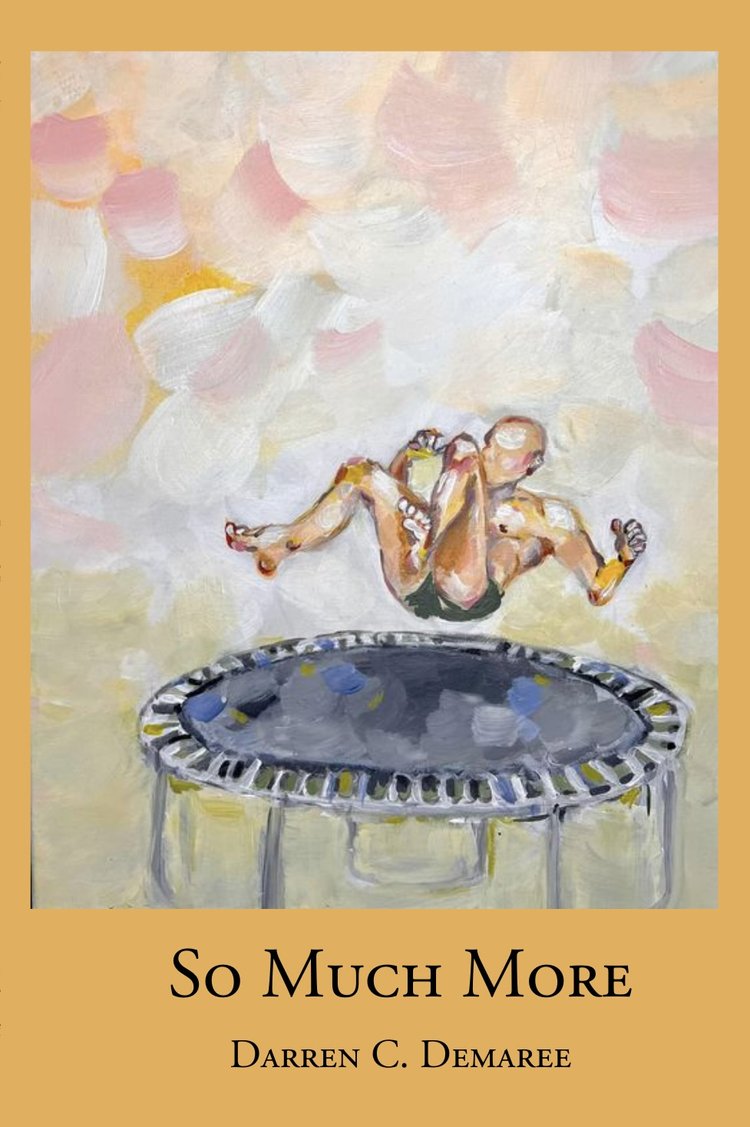
Darren C. Demaree’s latest collection, So Much More, feels particularly relevant in a year of political upheaval. So Much More is constructed around a series of abstracts, fragments, and political prose poems that deconstruct toxic landscapes disintegrating through the violence of human greed while addressing the fears of passing this world on to the next generation. This vivid Ohio is dotted with “the trees that grow through boulders,” “deer in your yard … in the middle of the road,” foxes, and reminders “every lake in ohio is manmade the salted bodies are not ours” that ensnare us as they traverse a semi-surreal state where you are never quite sure what is natural and what is artificial, sterile.
Lines like “we should start more fires near the water” call back to Cuyahoga River fires that culminated in a 1969 blaze that set off the environmental movement and lead directly to creation of the Clean Water Act, Great Lakes Water Quality Agreement, and the creation of the federal Environmental Protection Agency (EPA) and the Ohio Environmental Protection Agency (OEPA). Ohio in this sense moves beyond providing a sense of place for the speaker to inhabit but also offers us a grounded juxtaposition of horror and hope. If a polluted river once caught fire and spurred national change then maybe a modern Ohio, polluted from human activities and bad politics, can be cleaned up and lead the way to a better nation.
The speaker notes in “#26” that “if there is a river” that the “equation that can never be exact for if it was we would / vanish in the solution,” which is to say humans are both the cause and solution, the quickest way for us to heal nature is if humanity disappears. In “#25” the speaker tells us:
it’s the weakness that has driven us to hollow the land and fill it with water in places that have never desired the flood it’s the mutation of humanity that convinces us it’s okay to swim in such a wounded place.
These blocky prose sections refuse to fragment themselves to evoke the form of a river because the river has been contaminated past what a river can give. Frustration and hollowed acceptance float in Demaree’s poignant prose. It is this despair over the state of the land that gives rise to one of main thematic concerns of the collection, heritage.
In asking what we are passing along to the next generation, we are inevitably forced to ask how does a parent overcome the challenge of raising a child while feeling like you left them ill equipped for a future where you are “frightened / for their safety.” “#52” captures this sentiment through the speaker’s raw and desperate language:
i can’t look at this
any other way
the world can be so dry
& i was born
with water
& i have given that
water to my children
& told them
to give it away
& they did not blink
they closed their eyes
& offered it
& now i am frightened
for their safety
there is no other way.
Yet, despite these difficult questions, the collection offers an answer in the form of hope and empathy in the form of a child, the next generation we have hopefully taught to be better than ourselves. “For Katie, Queen of Ohio” fragment “#2” cheekily tells us:
Ohio is a bad deal
that already loves you
& questions your father.
Be mutiny.
Goddamn, Katie
you are hope.
I hope you fight.
Demaree’s poems challenge us to consider what we have and are in the moment creating. The collection’s themes of inheritance and environmental and political anxiety juxtapose its desire to remain hopeful-ish through teaching children to fight back against the world with empathy. Ultimately, the relevance of this collection feels agnostic to place and is instead rooted in the contemporary litany of headlines that constantly evoke environmental dread. Whether you are from Florida, Alaska, the southwest, northeast, or any other part of the country, the battle against degrading landscapes and human tendency to assault the land feels personal and relevant to anyone who worries about the future. Demaree’s So Much More is a relevant, worthwhile read this winter and one in which we find anxious affirmation.
So Much More, by Darren C. Demaree. Small Harbor Publishing, November 2024.
Alex Gurtis is the author of the chapbook When the Ocean Comes to Me (Bottlecap Press, 2024). A ruth weiss Foundation Maverick Poet Award Finalist and a winner of Saw Palm’s 2022 Florida Fauna and Flora contest, Alex received his MFA from the University of Central Florida. His work as a critic has appeared in Rain Taxi, Heavy Feather Review, Aquifer: the Florida Review Online, among other publications.
Check out HFR’s book catalog, publicity list, submission manager, and buy merch from our Spring store. Follow us on Instagram and YouTube. Disclosure: HFR is an affiliate of Bookshop.org and we will earn a commission if you click through and make a purchase. Sales from Bookshop.org help support independent bookstores and small presses.
 Heavy Feather Review