
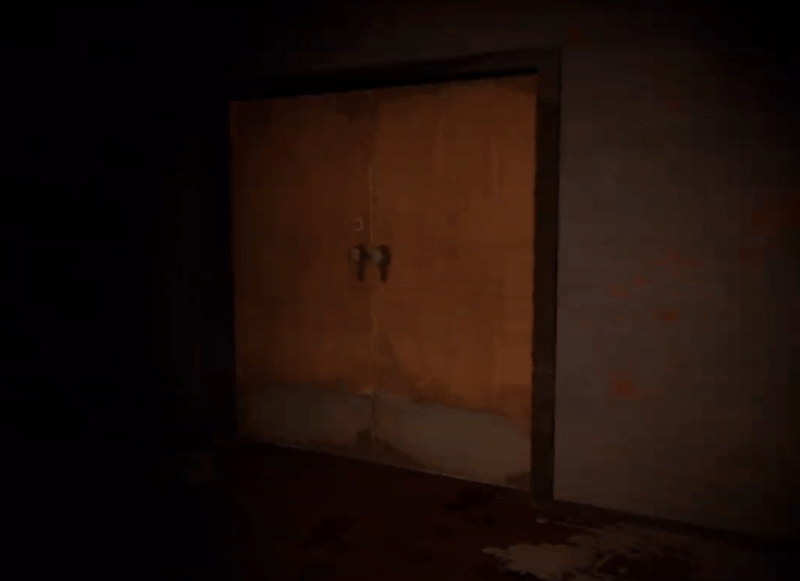
In the hallway of the gym at our school, far past the changing rooms and the water fountain, there was a room where the door was always locked. You could, however, always see inside. There was a window in the door, a window the janitors kept very clean. In this room, there was nothing but an empty brick fireplace.
The fireplace took up most of the wall to the right and was framed by a dark brown mantel. It was not always easy to see. The fluorescent lights in this hallway were usually flickering or dead, and, though there was a small window just beneath the ceiling on the opposite wall of the room, its panes were often dirty. There was no wood to fill this fireplace, no poker or tongs resting by the wall, no screen, only the wood floor and the empty mouth of brick. It was big enough to fit at least three of us inside if we curled up and huddled close (this was elementary school), but I could never see where it ended. Since no chimney rose from the roof, it was unclear whether or not the flue had been filled in. Sometimes I imagined an empty throat of brick concealed within the walls, the opening blocked off by the roof.
This room, and the fireplace inside of it, were the most obvious signs that the gym had once been someone’s home. Some said that the family who’d lived there had been forced out after financial ruin. Others said that squatters had lived there long after the place had been abandoned. Regardless of what the story was or wasn’t, there were other signs of the home that used to be, if you looked for them. In the boys’ locker room, there were three rows of white tiles at the threshold before the showers, tiles that had been painted with a pastoral scene we could only see some of. We used to play our own rushed version of hopscotch on these tiles as we went to and from the room—there was never much time to examine them closely. We were told that, in the girls’ locker room, there were a few wooden cabinets, like those in a kitchen. And, in the gymnasium, which had a very high ceiling, there were scuff marks on the walls where the upper floors had been removed. Once these details were spotted, they gave the impression of a hasty renovation, one that had to be accomplished quickly with insufficient resources.
The school grounds were full of buildings that had once been something else (this was no normal school, but a small and special one for the few who could afford it) so in this sense the gym building was no anomaly. There was a well, for instance, not far from the tether-ball pole that had long since been filled in with dirt. The kindergarteners planted pansies there every spring. The shed that housed the pogo-sticks and tricycles had, very clearly, once been part of a stable. These things were in plain sight, whereas we only passed the room with the fireplace on the way to the equipment closet. Gym class also was never the place for rumination and reflection. It was a place of constant movement, of frequent fights and falling outs. Everything that happened there was more consuming than the place it was happening in. And so the locked room with its fireplace, though distinctive, was seldom spoken of. It was, if anything, like a familiar fixture on the side of the road, remembered only when seen, then quickly forgotten.
Still, it did not strike me as strange that I should one day see someone on the other side of the glass. Instead, it felt supremely right, even reassuring, as though something long meant to be was finally starting to happen.
I had entered the gym when I was not supposed to. It was recess, and someone had accidentally thrown the frisbee over the wire fence and into a confirmed patch of poison ivy. The teachers had forbidden us to go in after it. Everyone was now playing soccer—but I was determined to distinguish myself by returning with a different frisbee. I was not good at any of these games. My peers barely tolerated this because I often took my anger at myself out on them. I thought this small act of generosity might make things better, and so I went to the gym in search of the equipment closet.
Once I opened the door and stepped inside the gym I felt the thrill of being somewhere for the first time alone. There were no gym classes in session and, as far as I could tell, no one else was there. I had never before heard the building so quiet, and I stood before the long hallway, watching the bad fluorescent lights cast their flickering beams on the floor, listening to their insistent buzz. When I took my first step, I was happy to hear an echo in return.
I knew I shouldn’t stay out of sight for long and guessed that if I didn’t move quickly I would be punished. I trotted down the hallway, intending to go straight to the equipment closet, but when I came to the locked door with the window I stopped. The temptation to look inside was too great. I doubted I would ever have another opportunity to inspect the room so closely.
When I brought my face to the glass, I saw her. There was, for once, plenty of light in this little room (someone must have cleaned the dirty window on the opposite wall), so it was not hard to discern her features. She had dark blonde, wavy hair that fell just below her shoulders, an oval face and a pointy nose. She wore a dark green hoodie and plain jeans. I could see dark circles beneath her eyes.
She looked, to me, old enough to be a lifeguard, or a camp counselor—I was an only child, and these were my most consistent points of reference when it came to teenage girls. As such, I did not doubt her authority to be there in this room I had never seen anyone enter, in front of the fireplace that was always empty.
She was in the process of unpacking a duffel bag. A pile of newspapers lay on the floor next to her—she took a few more out of her bag and placed them on top. She then retrieved a black-netted bag of fatwood, a plastic bag of dry leaves and set them down near the newspapers. I was pleased, for I could see that all this was kindling, and that the fireplace was finally going to get a fire. I was even more pleased to see her take out a box of matches and place them on top of the stack of newspapers.
She pulled out a bound-up rug, which I wouldn’t have thought her bag was large enough to contain. She pushed the pile of newspapers and kindling up against the wall, and unrolled the red, oriental rug on the center of the floor. Next, she grabbed a flashlight from the bag, turned it on, and shone it into the fireplace. Since it was daytime, the flashlight’s beam was little more than a thin suggestion, but her eyes followed it into the dark with an accusatory gaze, and her stance struck me as aggressive. Then, after staring into the fireplace, she sighed, turned off the flashlight, lay down on top of the rug and stared at the ceiling.
The afternoon sun fell through the window and landed on her chest. Her face was expressionless, her eyes unseeing. The fireplace seemed especially large with her lying on her back in front of it, as though it were a mouth patiently waiting to swallow her. It was easy to imagine her being carried inside on a conveyor belt.
Without warning, she rose and saw me. She showed no surprise, but gave me an exasperated smile. She tapped her wrist at me, though she was not wearing a watch, and I understood her meaning immediately. I sprinted from the building and back to the playground.
When I came running up the hill, the teachers were ringing the bell for everyone to come inside, and I must have looked like I was coming towards them in response to it. If I had stayed away any longer, my absence would have been noticed and I would have gotten in trouble. I returned to the classroom in better spirits than usual having discovered that someone had my best interests in mind.
I thought about this for the rest of my day. She had helped me. It was, in my eyes, something few people ever did or thought to do. The image of her standing there in the room, with her green hoodie and plain jeans, was one that soothed me the more I came back to it, as did the image of the fireplace she’d not yet filled with kindling. In those days, I was always getting in trouble—I only understood why half the time. I had the vague sense that I was heading somewhere disastrous, and that I had no way of stopping it. I knew I owed her thanks. Parents and teachers often told me I was ungrateful; it was now time for me to change. Surely, I didn’t deserve my good luck if I didn’t thank her; surely, she was worthy of my gratitude. I would make sure to speak to her the next time we met.
It took longer than I wanted for this to happen.
During gym class, I would dart down the hall on my way to and from the water fountain to see if she was there. The room was always unoccupied. I began testing the doorknob, and always found it immovable. I wondered who had supplied her with a key.
The fireplace, every time I saw it, struck me as especially inviting, though no fire burned there. I felt it was humming with a song that I might soon hear, if I was lucky. I longed to curl up inside, and had no doubts that the open space would receive me.
An opportunity to return presented itself without my forcing it into being. I was asked to go to the equipment closet to fetch a jump-rope for an activity our teacher had planned. I was pleased to have been chosen, and I took my task very seriously. My teacher, a tall dark-haired woman we called Emily, had been unusually kind to me that day, and I hoped she would be even kinder when I returned.
There was a gym class in session when I entered the barely-lit hallway, one for the very youngest kids. It sounded like they were playing “Fishy-Fishy, Cross My Ocean”—there were periods of silence followed by a screaming stampede. I moved cautiously, as though a single step might set loose the horde on the other side of the wall, and stopped in front of the locked room.
She had come back and was crouched in front of the fireplace. I brought my face close to the glass and saw with satisfaction that much had progressed in this little room.
The stack of newspapers was next to the fireplace again, with both matches and kindling. Yet now there was a brass bucket with a poker, tongs, and a broom beside them. A pair of bellows, which I knew how to identify but had never seen anyone use, was propped against the wall on the other side of the bucket. There were also chairs set up against the wall behind her, perhaps in expectation of guests who had yet to appear. These new additions gave me a little thrill of anticipation, though I was again confused by what she was doing.
She was kneeling on the rug, staring into the brick enclosure. She squinted, she mouthed a few inaudible words, she lifted her hand, whether to wave or to block her eyes I could not tell. She might have been focusing on something invisible to me, or maybe there was much more to starting a fire than I had ever realized. I craned my neck to catch a glimpse of what she was staring at, but saw nothing new.
She said something and glared as though waiting for a response. She then snatched the poker from the bucket and brandished it in the air, her eyes on the fireplace. With her other hand, she shone the flashlight into the dark, flicking it on and off—there was something intimidating in the way she did this. She set the poker down, then repeated the same stunt with the broom, the box of matches—these she shook in the air with particular vigor, then they spilled all over the floor. She cursed, or looked like she did (I heard nothing), and knelt down to gather them up.
Once this was done, she rose and made for the green chair in the corner.
Just as she was about to sit down, I knocked on the glass.
She saw me instantly and jumped. I tried hard not to laugh. It is always hard for me not to laugh when I scare someone, because I never do it on purpose. In spite of my best efforts, I could not stop laughing. I wanted to, but this was not easy when she watched me so seriously. She stood there in front of the chair, dark circles beneath her eyes, her mouth slightly open as though she were on the brink of chastising me. But then she started to smile as well, though it was a wry, scolding smile. I saw her body shake with a few silent spasms of laughter, after which we both became quiet.
I knew I would need to return to the classroom soon. This was my time to thank her—we could speak more later—but I was unsure if she’d be able to hear me through the glass. I seized the doorknob and rattled at it, though of course I knew that it was locked.
She came across the room quickly and stopped by the window. The circles under her eyes were now much darker, almost bruise-like. Her breath misted the glass. The odd thing was that I could really feel her on the other side of the door. A wave of warmth came through, as though she were a mere inch away from me. If I had stayed there longer, the sensation might have made me drowsy. I rattled at the door again and our eyes met. She shook her head without any sign of anger, then she raised her left hand and pointed towards the end of the hall. I understood what this meant, though it disappointed me. I ran to the supply closet. The children were screaming and stamping on the other side of the wall.
On my way out, jump rope in hand, I came close to the glass and raised my free hand to wave at her. She didn’t notice She was sitting on the chair with her knees drawn tightly to her chest. Her eyes had been drawn back to the mouth of the open fireplace.
I came back to the classroom to find that a flower vase had fallen and shattered on the floor. The room was in chaos, with Emily frantically trying to keep everyone away from the broken glass, while well-intentioned students couldn’t help themselves from trying to gather the scattered pieces. If I’d been gone longer than I meant to, no one knew. I squeezed the jump-rope, happy to know that I at least gave the impression that I had done what I was supposed to.
I kept thinking of the girl sitting there on the chair in the corner, staring into space. This picture became more vivid to me the more distance I had from her. The dark, swelling circles beneath her eyes, the vacant expression on her face, the way she’d seemed to be sinking into her chair. Her limp hands resting on her lap. It was a vision that both soothed and worried me. I wondered what could have led someone to look so sapped of life, and why such a person would ever bother to help me. But, she had saved me twice now, and deserved my thanks even more.
The room, whenever I got a chance to look inside, struck me as active rather than empty, even when she was not there. I saw, in the bare wooden floors, on the unadorned walls, a place on the precipice of some great event. And, in my mind, there could be no greater event than to see the fireplace filled with fire.
But this was school and my life was not my own. I was not doing especially well in class, struggled with every subject, was watched with greater vigilance, and, the more I was watched, the more mistakes I made. I was sent three times a week up a rickety set of stairs to where my tutor kept her office. My peers were not supposed to make fun of me, but often they did. I was used to that, though I didn’t like the way it felt to know I was always doing something wrong.
Since my movements were more restricted, I was less likely to cross paths with the girl again.
I did see her twice on my way in and out of gym class. These were only brief glimpses, in which she appeared very agitated. She was walking back and forth, attending to something outside my vision, never staying fully in view. The one time our eyes met she shooed me away, though I saw no anger or unkindness on her face, only urgency (she had saved me again, for I walked in just as the gym teacher had started inquiring about my absence). Still, I hadn’t managed to thank her.
One day I had to come to school late—a doctor’s appointment had conflicted with class. The doctor ended up letting me out early, so I was back at school before expected, and my mother, hoping to return to work as soon as possible, dropped me off and asked that I check myself in at the front office. As I walked up the path, and my mother’s car disappeared down the driveway, I realized that no one would notice if I did not go to class immediately, provided that I was careful. I turned and took the side path to the gym.
When I opened the door I thought the building was unoccupied, for everything was quiet. The fluorescent lights buzzed and shone weakly on the floor. A few inexplicable creaks sounded from the walls. It was the perfect moment to run screaming down the hall, and I almost did. But I soon heard laughter on the other side of the wall, followed by the stern voice of the gym teacher chastising the unseen troublemaker. Whatever class was in session, they must have been stretching, or doing something similarly sedate. I was disappointed—now I would need to be especially quiet and quick. I tiptoed down the hall to the locked door and saw that she’d returned.
Again, she was seated on the chair in the far corner. She’d pulled up her hood so that some of her curls were spilling out near her neck, and she held her knees to her chest. The circles beneath her eyes were close to bruise-purple, and her face seemed gaunt. She gazed out at the fireplace as though it had somehow defeated her, and there was no way she would ever be able to rouse herself.
The room was not much different than when I’d last seen it. Some cushions had been placed on the floor in front of the chairs as if in anticipation of more guests. A screen for the fireplace, rusted red, was leaning against the wall beneath the opposite window. A bottle of lighter fluid had joined the matches on top of the newspapers.
There were still no logs in the fireplace.
I knocked gently on the glass. She turned her head and gave me a very thin smile. I beamed at her with enthusiasm, hoping this might change something in her, but she remained unmoved. I pulled my cheeks wide and stuck out my tongue. Her eyes narrowed and she smiled a little more, but she showed no signs of moving or letting me speak to her. I knocked on the glass again.
Suddenly she bolted from the chair and ran to the door. I was amazed at how quickly she moved, but had no time to linger on my amazement, because she immediately opened the door and pulled me inside. She ushered me over to the fireplace and the two of us crouched down inside of it. She sat behind me and tightly clasped my shoulders.
Soon, the doors to the gymnasium opened and voices and footsteps came bursting into the hall. They must have been the oldest kids—the sixth graders. Their voices were deeper, and their footsteps had much more power to shake the building. I felt like I was hiding from a storm. If I had remained outside, I would have been seen, or perhaps trampled. I opened my mouth to thank her, but she shushed me and squeezed my shoulders. Her breath fell on the back of my neck.
Her hands, now that I finally felt them, were very warm and held me firmly. Her breath was equally warm, and seemed somehow to pass through my skin. I stayed very still.
The noise died away as the older kids disappeared into the changing rooms. We stayed where we were. I watched the dust motes dancing in the one ray of light coming through the far window. The room smelled pleasantly musty, and looked larger now that I was inside. The building erupted in noise again as the kids left the changing rooms and returned to the main building.
After a moment, the gymnasium door creaked open, and the gym teacher shouted a hoarse command to someone. His slow footsteps continued down the hall until he too left the building, and the door outside clattered shut behind him.
“We can come out now, Caleb,” she whispered into my ear.
She stood up and led me by the arm out of the fireplace and into the room.
I wondered how she knew my name, but it made me happy that she did.
Once we stepped onto the carpet, she let go of my arm and returned to her chair. She smiled when she saw me watching her, but soon her eyes left me and the vacant expression returned to her face.
Now that there was finally time to thank her I could see that her demeanor did not invite conversation.
“Should I go?” I asked her.
She shrugged, but said kindly, “You can stay for a while if you want.”
I took a quick glance around the room and saw that the fireplace was very dark. I couldn’t see the brick wall where it stopped. I assumed this was due simply to the way the light was falling in the room right then. I tried to remember if I had felt the presence of a wall when we’d been hiding inside. I walked back across the room to get a better look.
“Don’t go too far.”
I turned back to her. She hadn’t moved, nor did she appear concerned.
“You can go inside. It’s alright. But you shouldn’t go too far without me.”
I stared at the empty fireplace and saw that, even up close, I could not tell where it ended. This didn’t seem right. The interior was not pitch black, only murky and indistinct. I had never seen anything like it. I stepped away from the hearth and turned to her.
I opened my mouth again to thank her, but what came out was, “Is there anything you need help with?”
She shook her head.
“Maybe later. Not now.”
She pointed to the fireplace.
“That’s the only place that needs work and we’re not ready yet. We need to wait till the last minute. Just in case they change their minds.”
Her eyes looked past me, as though something more important had come into focus.
“To be honest, it’s hard for me to imagine being ready, even though I know what needs to happen. But I guess that’s out of my control,” she bit her lower lip inward and fell silent.
Since I had no idea what she was talking about, I was silent too.
She stared into space and spoke as though a wiser, more understanding person had come into the room with us.
“It’s not my fault if I’m the only one who accepts that it’s time,” she went on. “It is time. It is time. Or it will be soon enough,” she paused, seemingly dissatisfied. “All the signs are there. And it’s not my fault for knowing.”
“How do you always know when I need to be back?”
The question startled her. She stared at me as though she’d just remembered I was there.
“You stay somewhere long enough you start to know everything. Provided you really listen.”
I was about to walk over to her. She had given me an opening. If there was a moment to thank her it was now, and I was now brave enough to say it. Yet as soon as I took my first step she sprung out of the chair and ushered me towards the door.
“Speaking of which,” she whispered. “You need to go,” and she pushed me out into the hall.
I ran out of the building and back to the classroom. I knew what was happening. The time when my parents had said I’d return was quickly approaching. She had saved me again, for I entered the room just when my teacher was asking where I was.
I did not see her at gym class, nor the few times after school I managed to sneak into the building alone. I began to think that whatever it was that “needed” to happen had happened, and I’d missed it. My failure to thank her was now especially embarrassing, since I’d squandered my opportunity at our last meeting, and I was even a little angry with her for pushing me out so quickly. The coming weeks were dull, depressing, confusing. School became a machine endlessly rotating its gears, I was always lagging behind and losing steam, the days felt gray even when they were cloudless.
Then, as if someone had abruptly snapped their fingers, the world sprang to life. Rehearsals for the spring play had commenced, and this was the first year I was old enough to participate. My tutor pushed me to sign up, telling me that I might have fun. I’m not sure I would have done it otherwise.
We would gather in the gymnasium for rehearsals and, even before we had costumes, when the set was simply a bare, raised platform, when everyone was still hiding their noses in their scripts, the room became a completely different place to me, a place charged with significance. Seeing my peers adopt new voices and poses, hearing them speak sentences they would not otherwise have said, watching them turn red and burst out laughing when they flubbed a line or took an awkward step was something I found delightful and engaging. I caught myself starting to like them. Everyone, no matter how outwardly confident they were, had become nervous and tentative, as though the script we’d been handed, while coaxing everyone into unfamiliar territory, had revealed that all of us were standing naked. I loved to watch the shape of the story taking hold in and around us, and I was surprised to find all this so exciting, for I had never enjoyed watching plays.
We were doing a musical adaptation of Tom Sawyer, cobbled together from several existing versions, and every so often there was a need for a horde of scrappy Southern kids. I did not have much to do in this play (the younger kids never did). Mostly, if I was onstage at all I was in the background, but there was one scene in which I was allowed to speak. For reasons unknown to me, I was cast as the preacher who eulogizes Tom and Huck without knowing that they are still alive. I had a long, weepy, over-the-top monologue which I hammed up without intending to please anyone but myself. Everyone loved it—they thought I was hilarious. The music teacher had to stop me the first time I practiced it because she was close to tears. I was admired, I was welcomed, I was tolerated. After the first performance, I was introduced to a new term when I was told that I “stole the show.”
Opening week arrived and the gym was transformed even more radically. A row of colored lights on tripods was set up along the wall opposite the stage and they struck me as mind-boggling contraptions. Half of the hall was cordoned off from the public by a row of white curtains, behind which were a maze of tables for props and neatly taped off sections for pieces of scenery which we would bring on and off stage. There were also clothing racks where all our costumes hung with our names written on pieces of masking tape attached to the hangars. I loved this place, with its many resting items waiting to come alive, with our soft steps and whispers to one another as we tried to keep inaudible, almost as much as I loved the stage. Another curtained section designated two changing areas, one for boys and one for girls—we were not allowed to use the gym changing rooms, since they were so close to the main entrance. It was hard, even at the age of ten, not to feel the excitement as we could all hear one another rustling in and out of clothes, then emerging into the light as different people. The room with the fireplace was a short walk down the hall from all this activity, but its importance was overshadowed, for the time being, by what was happening in the world of Tom Sawyer.
I was onstage plenty at the beginning as part of the horde, then waited backstage for a while before I entered in my preacher’s gown and collar. For three scenes before my entrance—three scenes replete with long musical numbers—I was the only one waiting back there.
The first performance, I was so eager to hear every word spoken on stage that I stayed behind the raised platform for the whole night. The second night, I turned restless and wandered the hall.
I didn’t do this with the intention of going very far from the stage. I could hear what was happening very clearly (Tom and Huck were preparing to cross the river), and it pleased me to roam under the perpetually dying fluorescent lights in my preacher’s robes and to imagine that he had much more in his life than the play, or Mark Twain, had given him. I talked to myself in his voice as quietly as I could and found it easy to pretend that I was somewhere else besides the dark hall of the gym.
Something caught my eye and drew my attention elsewhere. It was a flickering light at the end of the hall. I did not need to think hard to know where it was coming from. I wondered if I could get away with visiting her. There had never before been anything competing for my attention when she was there, at least nothing I cared about so much. I had a while to wait before my presence was necessary, yet the prospect of missing my entrance was terrible enough that I almost didn’t go. But again I felt guilty at not having thanked her, and at having neglected the room for so long, and it struck me as odd that she was busy there tonight of all nights as opposed to watching the play. I would go there and invite her to come out, then she might have a chance to see me perform. I thought she might like that.
I walked down the hall and stopped before the window to the locked room.
She was standing in the center and staring into the fireplace, with the room having been altered in a few telling ways.
Now there was light, since she had placed a lamp at each of the room’s corners. I couldn’t see where they were plugged in. They cast a warm glow over all the little room contained. There were now two rows of chairs instead of one, and three rows of cushions in front of them. These rows were neat and organized, like they were waiting for an audience to fill them so that they could watch the fireplace, in which there was finally a stack of logs.
I could not believe my luck that something equally momentous was happening during my second night on stage. Surely, there would be time to see her light the logs before I needed to get back. Then, once the fire was burning and safely covered, I could sneak her into the audience and she would at least see my scene.
I knocked on the glass. She turned her head and saw me. With one hand, she beckoned me to come inside. I turned the knob and found that it was not locked.
“You look very nice,” she said to me with a wry little smirk. I didn’t know if she meant this seriously. She then gestured at her hoodie and jeans, and whispered, “These aren’t my normal clothes either.”
Though I wondered what she meant by this, I didn’t really care, because it was time for me to invite her to the play. I opened my mouth to do just that, but she interrupted me by summoning me closer.
I went to stand next to her and she placed her palm on my shoulder. Again, her hand was bewitchingly warm in a way I had never felt from anyone else. It made me feel more keenly the degree to which I’d neglected her. I opened my mouth to say something, but again I was interrupted.
“It’s almost time,” she whispered. I couldn’t tell if this was a good or a bad thing. She pointed to the fireplace. “Maybe before that you could go inside for a minute.”
“What do you mean?” I asked.
I had always thought the fireplace would be more crowded once there were logs to fill it, but this was not the case. Though I was not sure, I thought that the mantel and surround had swelled to accommodate the pile of wood, and there was certainly enough room for me to step over it and into the dark, which extended behind without visible end. Still, this was not my primary concern with what she’d said. I waited for her to explain.
She made a helpless gesture with her hands, one that contained much emotion but little energy. She seemed closer to tears than ever before, but I knew that her sunken face, with its near black circles beneath the eyes, would never manage to weep.
“If you ask them to come out, maybe they will,” she said. “People listen sometimes when a little boy tells them sweetly,” she gave me a forced smile. “Don’t go far. Just step over the logs and squat down. I’ll be right here”
She had never let me thank her before. I guessed that this was the way in which she wanted me to do so.
I went over to the fireplace and lifted my preacher’s robes so that I did not trip. I looked back to her for approval, and she gestured for me to go forward. If she was hopeful, it didn’t show. I bent down, stepped over the logs, into the dark, and squatted on the brick floor.
Immediately, and without being able to see it, I had the sense of vast space above me. I assumed I must be beneath the long-hidden chimney, but there was much more open air around me than the cramped quarters of a chimney would suggest. I felt certain that the chamber before me extended further without end. Though everything was dark as a cave, it was in fact very easy to breathe—there was somehow an airflow in this enclosed space. That was roughly when I noticed them.
First, I heard their breathing and whispering. I heard footsteps, some slow and considered, others rapid and frantic, and, though it was unclear where any of these beings were, their footfalls and voices made them feel very close. I thought I heard a chair scrape across the floor, thought I saw the shape of a leg, a forearm, a jawline, the curve of a throat—but all these things vanished so quickly I could not be sure of them, could not even identify them as human. An argument erupted in whispers and then came to an end; a cork popped; there was laughter. I heard one voice sob, another cough, then a match strike, though I saw no flame follow. All this noise was subdued but incessant, never staying quite the same.
I opened my mouth to speak, remembered very clearly what I was supposed to say, but I made no sound. I was shaking too hard to speak.
She seized me by the shoulders, pulled me back into the room, and ushered me to the door. Her face was hopeless and exhausted. She was already grabbing pieces of newspaper to crumble into kindling. I reached for her hand but she did not reach back. “Never mind,” she said. “You need to go.”
She pushed me out into the hall.
As soon as I was outside, I heard that the musical number before my entrance was about to conclude, and I bolted for the stage.
I did turn back, only for a moment, and saw her through the window holding a lit match.
I was told after the show that it was the best I’d performed thus far. This confused and even angered me because it made no sense – my mind had been completely elsewhere, with barely discernible bodies in the dark, with a fire I was not there to see burning, with the girl I had failed to give thanks. Even so, I was the success of the night. Many adults told me in conspiratorial whispers after the show that I was much more talented than the older kids. I don’t remember how I responded to them.
When I next saw the room there was nothing inside but a bit of charcoal dust on the hearth. I remembered her words and I guessed, looking through the glass, that what I saw on the other side would never change. I pictured the dark chamber filling with smoke, as it must have after I’d been pushed from the room. I wondered if I ever should have wanted that fire to be lit.
She clearly had not wanted that herself.
I reached out and held the doorknob. I did not try to rattle it open, but held it gently beneath my palm, as though trying to wake a sleeping body without disturbing them.
I stayed there until the gym teacher came and asked me what I was doing there all alone.
Andrew Plimpton is a writer living in Western Massachusetts. His fiction has appeared in The Dalhousie Review and in Silo. His plays have been performed at The Tank in New York City. He is currently at work on a collection of stories and a full-length play.
Image: realityremake.com
Check out HFR’s book catalog, publicity list, submission manager, and buy merch from our Spring store. Follow us on Instagram and YouTube. Disclosure: HFR is an affiliate of Bookshop.org and we will earn a commission if you click through and make a purchase. Sales from Bookshop.org help support independent bookstores and small presses.
 Heavy Feather Review