
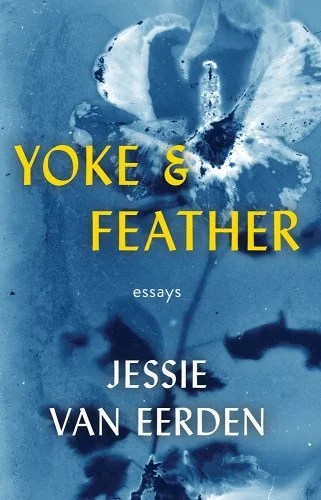
Yoke & Feather, an essay collection by Jessie van Eerden, reaches toward grace, in the deepest sense of that word. That grace is sometimes the grace of a Christian god, yes, but van Eerden more often looks for the grace to be found between people while we wait for that God to show up. Her theology, if that is the right word, begins in the difficult minutia of living, living which, as it turns out, just keeps happening.
The opening essay, “Meet Me at the Dollar General Across from the Family Dollar,” immediately establishes the concerns of the collection. The title of the essay flows directly into the first line of the essay, which continues “when Jesus comes back.” The cheap chain stores that have filled the empty space of the decimated Appalachian economy and the final revelation that happens with the return of Jesus Christ. However, the essay doesn’t dwell on the return of Christ, who is “taking his time” to return but rather what happens in the meantime, while we wait for that return, while “it’s this earth and it’s this pain and it’s this body breaking down to be reckoned with. The haggardness of our bodies, and especially the bodies of those living in a place like a poor Appalachian town. Even the revelation will be bodily; His return will reveal what happens to our body when we die.”
Some essays, like “When I Dreamed Us into the Book of Ruth,” engage with biblical text more closely than others. Christ and the grace of a Christian God are present throughout the collection. That explicitly Christian framework may put off some people. It shouldn’t. As a religious meditation, the works sits alongside the idiosyncratic meditations of Simone Weil more than traditional Christian scholarship, and the collection certainly, certainly, has nothing in common with contemporary mainstream Christian writing.
Van Eerden is essaying in the true sense. The words in these essays are attempts. They are attempts to write toward a maybe unattainable state of grace in and with the world. Van Eerden suffers no illusions. Maybe it is not possible, the grace she seeks to write toward. Nevertheless, she needs “to pull on the natty sweater, light the lantern, and write all night for love’s possibility despite the given,” as she says in her essay “The Story of Mary and Martha Taking in a Foster Girl” or, as she says in “Sunday Morning Coming Down,” “fight for gratitude in the midst of a quiet panic.” In that essay she admits the impossibility of writing but also the “insistence that we go forward, marching toward failure, amen and amen.” The attempt. It’s not that God so much is everywhere but the possibility of God is everywhere.
Her writing is fluid and agile. Throughout the collection there is a surprising associative logic. One idea opens into another which opens into another. This kind of thinking is both calming and invigorating to read. It helps get the mind moving again when it may be sluggish or beaten down. Even if one is not interested in meditations on Christianity, the book still contains a rare motion of thought that even a secular individual would find illumination in.
Another essay that showcases these qualities is “Bless the Hollow: On Longing and Online Dating.” It is an essay on the subject of online dating unlike any other. She uses dating websites the same as everyone: she scrolls through profiles, she engages in conversations that go nowhere, she goes on dates, she even begins a relationship that doesn’t work out. But in these experiences she finds things that few essayists do. Online dating is a well worn topic for personal essays, but there are likely no other essays on online dating that lead to a place like “maybe the myth began with God the concave, God who longs as we do … God’s hunger and feeding are one, simultaneous” or digress into a meditation on the grammar of Egyptian hieroglyphs, whose absent vowels are “the longing of the word.” In this essay the tenderness of her writing is apparent. She sees the profiles of men, the pictures shirtless men on ATVs and the bathroom selfies and the profiles that say nothing much of substance and feels worry, feels “more attuned to the awful vulnerability of everyone roped into the whole enterprise.” She feels the loneliness in those profiles. She is lonely too. She is on those dating websites out of loneliness and longing too. She is on those websites in an attempt to close a gap between her and other people too. Her writing, likewise, is an attempt to close that gap. She writes toward other people. And that is another form of grace. Jesus may be taking his time, the gap between earth and God may feel unbearable sometimes, it may be hard to see God’s grace, but she can create her own moments of grace by extending grace toward others.
Yoke & Feather, by Jessie van Eerden. Ann Arbor, Michigan: Dzanc Books, November 2024. 212 pages. $17.95, paper.
Jacob Stovall is a writer currently working in Chicago. He is the Books Editor at Apocalypse Confidential.
Check out HFR’s book catalog, publicity list, submission manager, and buy merch from our Spring store. Follow us on Instagram and YouTube. Disclosure: HFR is an affiliate of Bookshop.org and we will earn a commission if you click through and make a purchase. Sales from Bookshop.org help support independent bookstores and small presses.
 Heavy Feather Review