
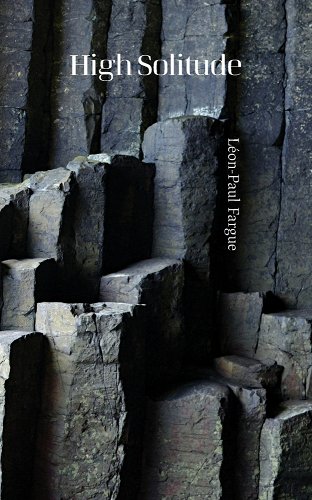
In A Wave of Dreams, Louis Aragon named him one of the “Presidents of the Republic of Dreams,” along with such figures as Sigmund Freud, Pierre Reverdy, and Giorgio de Chirico; in the first Manifesto of Surrealism, André Breton declared that he was “surrealist in atmosphere” if not in fact. He was Léon-Paul Fargue (1876-1947), a poet whose work built a bridge between the Symbolism of the late nineteenth century and the Surrealism of the interwar period. His late-career book of prose poems, 1941’s Haute solitude, extended the Baudelairean tradition of the flâneur prose poem into territory in which the empirical given and the imaginary are put on an equal footing and synthesized into a genuine sur-reality. Haute solitude now appears as High Solitude, in a lively new translation by Rainer J. Hanshe.
Fargue was mainly a poet of his native city of Paris, particularly the nocturnal and early morning Paris of nightclubs, cafés, alleys, and markets, which he was in the habit of circumnavigating on foot, like a cop on a beat. From “The Wait”:
It’s my tour as a police officer between the gaslights, it’s the heartache of market gardeners at five in the morning, the trucks bending over the meat of the Halles like jungle phenomena, it’s all the love and all the disgust of the saunterer whom I encounter, deprived of hope and solidity, when 6 A.M. strikes, when one begins to confuse vagabonds and revelers, stars and tail lights, men and beasts, wheels and wailings.
Fargue’s Paris is like the New Haven of An Ordinary Evening in New Haven by Wallace Stevens, himself a translator of some of Fargue’s poems: a “metaphysical” city that, apprehended as much through the imagination as through perception, transcends the mundane, empirical facts to which “the eye’s plain version” confines it. Fargue’s metaphysical city is characterized by what he calls a “secret geography”—the title of the poem from which the above excerpt is taken—reflecting “the rather turbulent story of my tragic returns between my shadow and myself.” In High Solitude Fargue’s secret geography describes a Paris that has become the natural homeland of what he calls, in one poem’s title, the “nomadic spectres” of his past. His Paris is a city haunted by “the uninterrupted footsteps of parades of spectres,” one in which the sights of the present are permeated by recollections of his past. From “Walk”:
Now, in this sowing of the city, in this honeycake where the houses suck in their stomachs, these houses that squint with their human eyes, I bend to the right, to the left. I begin this with trodden stone at a young age, this interminable monologue along the towpaths. I walked along these boulevards; I grazed these open doors one after another.
To be sure, the empirical city is fully present in these poems, with its streets, apartments, railroad stations, and trees well-represented. But not as a non-place containing prosaic things common to everyone and peculiar to none, but rather as a lived-in place full of landmarks reimagined and expressed in a vivid idiolect reflecting the desires, memories, regrets, and fantasies which Fargue projects onto them—and which, in a dialectical reversal, they solicit from him as he transits through them.
Fargue imaginatively transmutes the plain city into the secret geography of a metaphysical town through a kind of verbal alchemy. He forges complex images composed of chains of associations which objectify his imagination in the concrete realities of the things he brings together. In Horoscope, for example, a work that takes his own interior rumination as its point of departure rather than an exterior scene, Fargue begins with a dazzling concatenation of images that seem lifted from an entry in an idiosyncratic thesaurus:
I know my time. Without having examined, with a magnifying glass, a compass, a goniometer, a red light, the point of the ecliptic found on the horizon when I crossed the void with joined feet … My sign is that of the holacanthes, zebras of the sea, Heniochi, barbed ptéroïs, squamous cerniers, spiny fish with suckers and muzzles so blue that they appear close-shaven.
As we might or might not guess from this, Fargue was a Pisces—he was born on March 4, 1876. He doesn’t tell us this directly, but instead alludes to it in a roundabout way by capriciously listing some examples of the type of creature the sign represents: angel fish; seahorses; barbed lionfish; scaly Atlantic wreckfish or stone bass; and a spiny fish with remarkably blue features. This mostly ichthyological catalogue also somewhat incongruously references the Heniochi, an ancient tribe living along the coast of the Black Sea. But that is how Fargue’s poetic imagination works. All of these images are connected to the root or kernel image “fish” and elaborate it directly or indirectly. The angel fish, seahorse, lionfish, stone bass, and spiny fish are obviously fish; by a leap of analogical association the Heniochi tribe are connected to the idea of fish by virtue of their living close to the sea. This elaborately itemized image constructed of many parts shows Fargue reveling in language as he assembles a growing pile of common and less-common names whose cumulative effect is to show off the sensual, material side of language as it rolls off the tongue or around in the mind. (Here is his original French, accessible through the Archive.org lending library: “Mon signe est celui de holacanthes, zèbres de mer, hénioques, ptéroïs en barbelé, cerniers squameux, barbiers à ventouses, qui ont le mufle si bleu qu’il paraît rasè de prés.”)
Much of the poetry of High Solitude is grounded in Fargue’s tendency to use analogies set up on the basis of what Breton described as “partial likeness,” in which he description of one thing in terms of an imperfectly similar other breaks the law of logical deduction and allows us to imagine a meaningful interdependence of objects or images from distant ontological regions. In Paris, for example, Fargue reminisces about going
to see a cousin, an old cousin who was dying in a fifth floor apartment, who stood behind life, like a trademark on the back of a plate.
The analogy drawn between the cousin’s terminal condition and the placement of the trademark on a plate makes a kind of intuitive sense that resists logical analysis. How exactly is being in extremis like being on the underside of a plate? Perhaps there’s a partial similarity based on the notion of invisibility—an imperfect parallel between the trademark’s being hidden from view when the plate is used and the cousin’s imminent disappearance from life, which “he seemed happy to be leaving.” At the same time, a trademark stands behind a product as a guarantee of quality and of authenticity just as, in an existential sense, recognizing and consequently embracing one’s death, as Fargue’s cousin seems to do, is a way of affirming the authenticity of one’s life—of standing behind it.
The publication of this attractive volume is a welcome event. Very little of Fargue’s poetry is readily available in English; as far as I can tell only one other volume of his work, the long prose poem of 1928, Vulturnus, is currently in print in translation. While having the original French facing the translations would’ve enhanced the pleasure to be had from these poems, the length of the book may have made this impractical. Regardless, High Solitude deserves to bring the voice of this President of the Republic of Dreams to a wider audience, and thus to increase his constituency.
High Solitude, by Léon-Paul Fargue. Translated by Rainer J. Hanshe. New York, New York: Contra Mundum Press, September 2024. 220 pages. $21.50, paper.
Daniel Barbiero is a double bassist, composer, and writer in the Washington, DC area. He writes on the art, music, and literature of the classic avant-gardes of the 20th century, and on contemporary work, and is the author of the essay collection As Within, So Without (Arteidolia Press, 2021). Website: danielbarbiero.wordpress.com.
Check out HFR’s book catalog, publicity list, submission manager, and buy merch from our Spring store. Follow us on Instagram and YouTube. Disclosure: HFR is an affiliate of Bookshop.org and we will earn a commission if you click through and make a purchase. Sales from Bookshop.org help support independent bookstores and small presses.
 Heavy Feather Review