
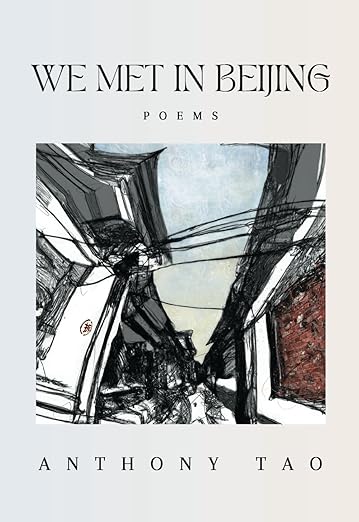
Anthony Tao is a well known figure in Beijing. He’s the coordinator of Spittoon Beijing (an English language writing collective) and a part of Poetry x Music Band which has released an album and accompanying poetry booklet. We Met in Beijing is Tao’s debut poetry collection.
The book is divided into four sections, which are laid out chronologically: the fun times, the pandemic, and the time immediately after.
“I landed in Beijing” acts as a preface and frames the ensuing narrative by taking the moment of return and looking back at all the things that have happened from the beginning until this point. The opening lines tells us that “everything had not changed / like they said.” The images of dust, coarse aesthetics, jaundiced fields, and anorexic trees somehow abut “the unspoken hopes, the glittering struggles.” The city is presented with an accurate lens that refuses to gloss over the tarnished bits to make a better picture, taking on an almost documentary quality to it.
The first section works like a diary of sorts, chronicling the party lives of the city’s ex-pat community: “We drank and ate too much, cheese / dumplings and numbing hotpot, / sucking air through our teeth, ranting / on American politics and Michelin bullshit.” It paints a free-wheeling time of excess, fun, late night conversations, and eventual transition: “How do I tell you / everyone we saw, real / and imagined? How immaculate / they were. Do I tell you how we danced?”
There is a nostalgia that creeps into the second section as the narrator begins to miss the friends who have returned home or moved on: “Friend / I do not expect to see you, but just in case—” When asked “are you happy?” the reply comes: “Where else would we rather / run out our clocks, / with bar openings and club- / goings at dawn, always // a reason to get fucked / and strut in the imperial dust.”
The third section centers around the coronavirus lockdowns. Here, Tao questions the role of the poet: “The poet says / truth is what’s proclaimed before judgement, / but what does it matter?.” The spirit of this communal moment is laid bare: “Demanding nothing / is the key to thriving in 2022 Beijing, / a simulacrum we accept.” But now when the poet tallies who is missing and who is gone, this activity now takes on a completely different meaning: “70,000 to 80,000, / the barber estimates, gone. They don’t count them / anymore.” It’s up to us to “live / live live. And remember, for as long as we do.” Tao deftly tackles this pivotal era in Beijing’s history while making sure to keep the focus human and relatable. This is not punditry, but rather a record of what happened to real people.
“We Met in Beijing: 2008-2020” functions as a coda, recounting the crowd from the opening section and many of the places (many no longer around) and escapades therein. Nostalgia without melancholy, an acceptance of the impermanence of social scenes, communities, favorite haunts: “We met in a bar called Great Leap / Eventually, even it will cease to be // ‘We’re all renting an experience,’ its owner told me / He left for good during COVID-19.”
We Met in Beijing works in several ways. It adopts a confessional mode, naming names, places, and conversations of a specific group at a specific place and time. In this way, the focus on the personal helps to render the poems more universal as Tao contemplates aging, change, and loss. This mode gives way to a poetics of witness. Tao’s lines are well-crafted and flow in a deceptively conversational style with ease. The whole of the book works cinematically, each poem depicts a scene (often a specific location in Beijing) that together create a narrative with the preface poem and last poem acting as bookends to a long contemplation on place and community.
We Met in Beijing, by Anthony Tao. Golden Weasel, April 2024. 114 pages. $12.95, paper.
David Harrison Horton is a Beijing-based writer, artist, editor and curator. He is author of Maze Poems (Arteidolia) and the chap Model Answers (CCCP Chapbooks/subpress). His work has recently appeared or is forthcoming in The Belfast Review, Mantis, and Verbal Art, among others. He edits the poetry zine SAGINAW. More: davidharrisonhorton.com.
Check out HFR’s book catalog, publicity list, submission manager, and buy merch from our Spring store. Follow us on Instagram and YouTube. Disclosure: HFR is an affiliate of Bookshop.org and we will earn a commission if you click through and make a purchase. Sales from Bookshop.org help support independent bookstores and small presses.
 Heavy Feather Review