
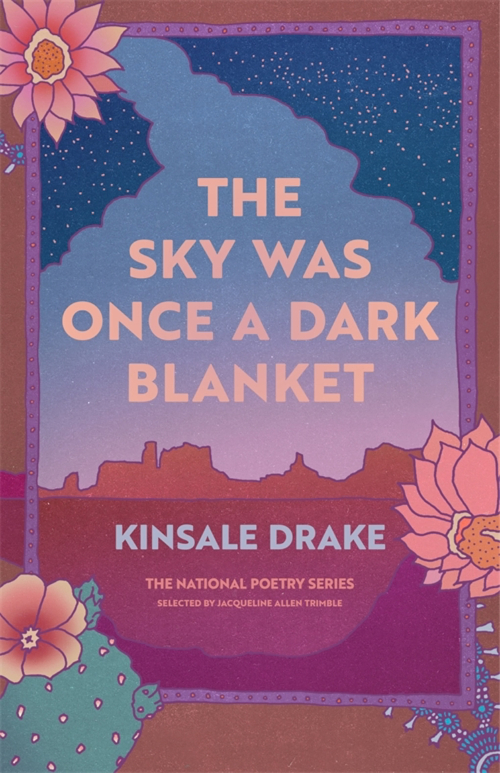
Kinsale Drake’s debut poetry collection, The Sky Was Once a Dark Blanket, chosen as one of the 2024 winners of the National Poetry Contest by Jacqueline Trimble, span across themes of family, legacy, colonialism, femininity, and mythology, with many poems set in the American South/Southwest. Through her imagery and linguistic choices, Drake makes a radical reclamation of her identity while challenging present oppressive structures in America today.
From the book’s opening poem, “spangled,” Drake’s direct address to the idea of American identity along with patriotism shows her intentions with the book- to place into conversation indigenous culture against the oppressive structures of America. Some of the lines perfectly portray Drake’s manifesto:
I must sing the hum of the yucca
and icy heartbeat of river. I must sing
our grandparents’ blues knocked down in the grasses
and thick in the farmhouse.
In these lines, Drake pushes us to picture the lush images of her poetic landscape, yet also ties in faces of family to her writing, quickly establishing a deep emotional connection between the book and audience. The ending line, “from deep in our throats— // our song:” brings us curiosity and urges us to flip the page, ending up into the first of the book’s three sections.
Featuring poems such as “August,” “NDN Heartbreak Song,” and “prickly pear woman blues,” the first section plays a lot with musical forms, specifically those from NDN and BIPOC writers. One of such poems is a triptych created as tribute to Mildred Bailey, an NDN jazz singer from the 1930s. Another piece of note was “everything is weird in the NE because there are no NDN memorials, only NDN names.” In both aforementioned poems, Drake includes the motif of trains as a means to examine the violence done unto NDN communities in past and present; in “for mildred bailey, in three parts,” Drake writes “In New York, all train tracks lead away from Georgia,” and in “everything is weird in the NE,” she expands on the clash between the ideas of trains and legacies:
When our bones are found Indeed, Drake’s questioning brings forth the blunt truth: there is no way to fully articulate the violence done onto indigenous communities and their lands. Finishing the first section is the poem “Remembering,” where Drake continues her battering of gemstone lines: “How do I start a story I never lived? / I think I remember stories because they are violent. / Or because there is music.” The poem effortlessly encapsulates the form and thematic essence of the section, with all its emotions and musical inclusions. The examination of legacies and ethnomusicology continue throughout the book’s second and third sections, but the poems take a deeper, more nuanced turn. In “After Sacred Water (Our Emergence),” for example, the poem is split into four parts starting with a summer day, to the destruction of nature due to white greed, and the broken legacies which remain. Similarly, in “Sounds of Under Water,” Drake examines ideas of wildlife along with colonialism. “Rocks are the oldest storytellers … The Badlands shrink behind us, gray teeth swimming in ghosts,” writes Drake, a chilling line which shows the hauntings of NDNs past into present-day. Language also becomes an important way of examination throughout the book, in “Navajo-English Dictionary,” Drake directly plays with the definitions of Diné language to English, yet fragments the words and adds her personal memories to contrast with the etymologies. Drake writes: Didzédík’ózhii – choke berry And later: words climb spring stalks slow What also shatters poetic bounds is Drake’s expert use of plant and nature life to build the lushness surrounding her writing. From the passage above with the inclusion of the choke berries, to scenes of the American southwest, Drake never ceases to dazzle us, creating landscapes of emotion while exemplifying her culture. In “the greenhouse,” Drake writes: I want to weave this correctly. I hung around the orchids, the insectivores, and cacti. This was my first winter, when the world grew stiff and brilliant-white.
In “Making a Monument Valley”: You rock with the rose quartz, the sweetgrass, the cedar. In the summer, our city smells almost like dusk on the rez. The reservoirs too shallow, we imagine an ocean, the one that covered the Four Corners.
And finally, in “Themes for the Nautical Cowboy”: There was once a prehistoric ocean all around us, In these excerpts, Drake expertly brings together themes of history with the present, where the flora and fauna acts as a platform for her to advocate for the destruction of cultural identity and memory for indigenous communities. The book’s concluding poem, “BLACKLIST ME,” prompts a much more aggressive call-to-action for us, where Drake brings together her previous motifs of music, nature, and memory. She writes: … I want six strings and a truck careening
into the horizon. I want the explosion live forever instead of on Kinsale Drake’s The Sky Was Once a Dark Blanket is a masterful debut that weaves together rich imagery, cultural critique, and profound emotional depth. Through her evocative language and powerful themes, Drake not only invites us into the vibrant world of Diné culture but also challenges us to confront and reflect on the enduring impacts of colonialism and cultural erasure. These poems aren’t just beautifully written, but they create a legacy within themselves. The Sky Was Once a Dark Blanket, by Kinsdale Drake. Athens, Georgia: University of Georgia Press, September 2024. 80 pp. $19.95, paper. Saturn Browne (she/they) is a Chinese-Vietnamese writer and the author of BLOODPATHS. Her work has been recognized by Gone Lawn, GASHER, Beaver Mag, Pulitzer Center, Foyle Young Poets, and others. Check out HFR’s book catalog, publicity list, submission manager, and buy merch from our Spring store. Follow us on Instagram and YouTube. Disclosure: HFR is an affiliate of Bookshop.org and we will earn a commission if you click through and make a purchase. Sales from Bookshop.org help support independent bookstores and small presses.
it’s called a haunting
Where do the birds go? Who
gets a funeral? Everything is a burial
ground, even the sky.
In the old ways, this was someone’s back,
The constellations bulletholes straight through
his stomach
Blasted with light—
How many ndns must die here
for anyone to know?
Didzé – berry berries
I am so starved
for words
unlike when I was a girl memorizing books
in English diitaa’—they/ it—
fell apart—
went to pieces
shattered
even whales. We puff out
the great swimming shapes
of their bodies.
This layer of rock, trilobites.
This layer, some ancient eel. How small we are,
how funny.
as grand as cicadas amping
out the sound of the night as the 8-track
rolls and rolls and my favorite singers
some balding president’s blacklist
 Heavy Feather Review