
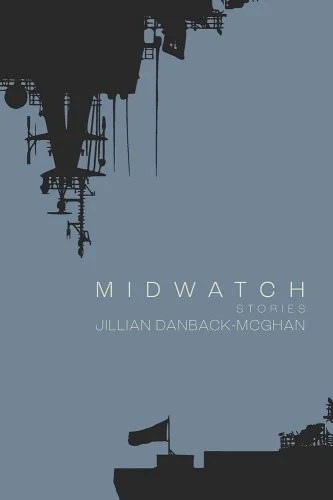
One of the stories in Jillian Danback-McGhan’s collection of short fiction, Midwatch, is set in the Gulf of Aden, where American troops are boarding fishing vessels, trying to catch pirates by searching for weapons and other evidence of illicit activity. Did you know the U.S. Navy did that? Any military veteran could casually talk about their service experiences and tell those of us who have not served many things we don’t know. That is one reason to read fiction about military service and war. Danback-McGhan is a Navy veteran who says in her introduction that book-length fiction featuring women service members is underrepresented in the canon of U.S. military literature, and that she hopes this book will contribute.
When the troops in that story board the fishing vessel, their leader is a woman, Kali. The men around her question her judgment and fitness to lead in a way that seems gendered, though that part is, in this story, unspoken. We are six stories into the book by now, and have been primed to think about gender, and so must make our own judgments about how gender is operating in this story, in much the same way that Kali and other women service members must always do. Kali knows that to be a woman in the military, she must be perfect. But when her colleague stands up for her against the other men in their unit, she lets him down. She is imperfect. She joined the Navy at least partly as an outlet for her violent urges, which have gone unrecognized by the people around her throughout her life because they don’t square with the impression she gives as a “nice, pretty girl.”
This study of a female main character and the men around her is playing out on the fishing vessel they have boarded, among the resentful crew, who must submit to American power. I felt uncomfortable with this, because the people who are foregrounded are the powerful people—ourselves—and because I wasn’t sure that a story of female self-actualization was the right story to tell when characters’ lives were at stake. But these stories do not question those things. The author makes an effort to show the non-American characters clearly, given the limitations, which include a language barrier and the fact that every time the troops board a vessel they are conducting an investigation, searching for clues that they cannot immediately puzzle out. But the author doesn’t apologize for her setting. Her characters were not drafted. They signed up. And her stories show that the military is as appropriate a setting for young women’s coming-of-age stories as, say, the campus of a liberal arts college, or the Manhattan offices of a fashion magazine, or the drift of underemployment. Women are here too, these stories are saying. Lots of them. And they are as complex as anyone else, of course.
Almost every story is told in the first person. (One is in a close third, and one is presented as a play, with no interior dialogue, until the end, when the narration switches into first.) Each of these characters knows what story they are trying to tell, and they are reliable narrators. They know what happened to them in the past, how they got where they are, the problems that hold them back, and what they are likely to face in the future. With narrators so emotionally intelligent, despite problems such as PTSD and alcoholism, this narration can seem redundant with the story, depriving us of the chance to put things together or be transformed by the things that are happening. The stories end with strong final statements from these narrators—sometimes a kind of summation of what has happened, sometimes a description that carries the significance of the story’s final instant—which, cumulatively, started to make me long for different storytelling approaches from one piece to the next.
The author and/or editors were thoughtful about ordering the stories. Halfway into the book, I thought I could tell you which elements each story would have. They are full of violence and danger, stalking and bullying. Death comes for characters en masse or one at a time. Characters, usually the crew or spouses of the crew of a ship that is preparing for deployment, struggle for power. They gossip and spread rumors, always about female sexual behavior, and those rumors reinforce hierarchies and injustices that do real harm.
But the later stories in the book branch out in content and style, so that it gets harder to find consistent elements. The author is making art. She wants to tell stories, she cares about the complexity of people and institutions, and she is trying new things, story by story. I would guess that the stories appear roughly in the order in which the author wrote them, because they seem to deepen over time in a way that suggests increasing mastery. But it may also be that once I felt at home in the world of the stories, I felt more sensitive to subtlety.
I particularly enjoyed the last two stories in the collection, “The Patron Saint of Cruise Missiles” and “Trou.” The stories combine great scenarios with good character interactions. “The Patron Saint of Cruise Missiles” shows the countdown to a missile strike on a terrorist compound. And “Trou” gives a different kind of countdown, to the moment when the protagonist must decide what disciplinary action to take in response to an incident between students at the Naval Academy. All the stories in the collection give insights into U.S. Naval operations and culture that reward the layperson and probably give the pleasure (or pain) of recognition to military veterans. And these final stories do this in a way that feels more immersive than the earlier stories, like the author is really taking the time to inhabit the world she has created and allow us to look around. Although the clock is ticking, the action takes its time unfolding, giving the main characters time to have many conversations with the people around them. Most of the stories’ protagonists are racially unspecified, and their sexual behavior is hetero, and some of these conversations with other characters give both the protagonists and us wider perspectives on marginalization within the military.
In the future, when I hear about any subjects that are touched on here, this book will be a reference point for me, because it is adding to my very limited knowledge base. And there are some evocative moments that will stick with me in the way that literature can haunt you. But the narrative voices remain intrusive even in the later stories, in a way that can make it hard for the things of value to shine through. For example, in “The Patron Saint of Cruise Missiles,” we learn that a cruise missile strike begins when the ship “receives strike tasking.” In this story, this is a retaliatory strike after a suicide bomber strikes a polling place. The officers follow a checklist. They are going to launch 33 cruise missiles, and must make sure they don’t accidentally hit the wrong target, like a school. Hours pass from the time they receive strike tasking until the actual launch, and someone must give verbal approval to launch each missile, one at a time. For me, this is an interesting and evocative idea, and the author seems to think so too. But she allows her narrator to use a lot of metaphors that seem less strong than the facts themselves: “We’re in the preparatory stages now. Things will move slowly at first. There’s no magic button which sends a missile careening hundreds of miles away on a whim. No spontaneous lightning strike from a vengeful god. It’s a slow, protracted roll of thunder.” I thought this voice and other such voices throughout the collection often got in the way of the facts, which were interesting on their own. I felt the tension of this story in spite of the language, and when I think back on it, I think it will keep stirring my imagination, without my remembering the exact prose. The author has stories to tell, and the progression within the collection suggests that she is a thoughtful writer who is experimenting with the best ways to tell them. I hope she keeps it up.
Midwatch, by Jillian Danback-McGhan. Split/Lip Press, February 2024. 134 pages. $18.00, paper.
Ashley Honeysett’s debut book Fictions won the Miami University Press Novella Prize and was published in 2024.
Check out HFR’s book catalog, publicity list, submission manager, and buy merch from our Spring store. Follow us on Instagram and YouTube. Disclosure: HFR is an affiliate of Bookshop.org and we will earn a commission if you click through and make a purchase. Sales from Bookshop.org help support independent bookstores and small presses.
 Heavy Feather Review