
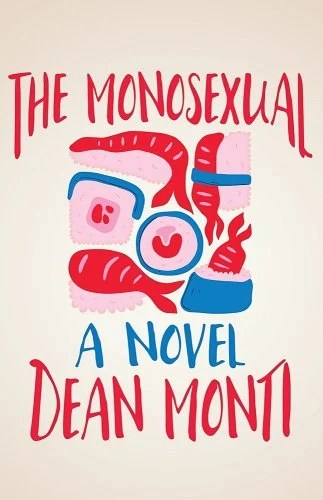
It is rare to find a book that seems to have been written just for you, but I found that in Dean Monti’s latest novel, The Monosexual. The novel is a zany romp through an unnamed time period that based on pop culture references (Sinatra, The Ed Sullivan Show, and classic jazz) and treatment of male/female relations appears to be the 1960s or 70s. As a child of the 1970s who was fascinated by the tastes of my writer father, who happened to love jazz and comedy, I found lots of touchpoints in the novel.
Monti writes in the vein of humorists of an earlier era like Woody Allen and Bruce Jay Friedman, writers whose worked I have read and laughed at, even though their content might raise huge red flags today. So much of the art created in that period is hard to digest through the lens of modern sensibilities, but Monti walks that tightrope well, evoking days gone by, but not crossing any lines that caused me to set the book aside.
The result of his efforts is a metaphor driven, retro-vibing work of fiction that is a fast paced read. I value humor in fiction and at times the story made me laugh out loud. Monti is also the author of The Sweep of the Second Hand, published by Academy Chicago Publishers and reprinted in paperback by Penguin.
The Monosexual reads like a fever dream, which is fitting since the main character, Vincent Cappellini, is under the influence of heartbreak, alcohol, and several kinds of poisonings. The most ironic of those conditions is the severe sunburn he gets when he travels to California to cover a dermatological conference and pursue his lost love, Melissa. I was all in. I think buying in is essential to really enjoying the novel, riding the waves of the jokes, metaphors, and wild situations.
Vincent’s central driving motivation for his sometimes unexplainable actions is his self-proclaimed Monosexuality, an obsessed ultra-monogamous love for Melissa and only Melissa. At times, his dedication to the concept strains credulity, but those who accept the premise will enjoy Vincent’s misadventures. Vincent coins the term himself and describes it this way:
Monosexuality is Vincent’s self-appointed, glittering, gold badge of honor,
A rare, eclectic, yet-to-be discovered phenomenon that makes him special,
Makes Melissa special. Makes being with Melissa extra special.
It is a hard concept to buy, and I watched as Vincent’s dedication to his guiding rule was tested. The plot was driven by the question, would he break and connect with another woman? As I watched Vincent suffer, I hoped the answer was yes.
Too red to show his face to a bunch of dermatologists, Vincent meets Paige, a bartender, and ends up driving down the coast with her, eating sushi, singing Karaoke, and finding a new perspective on life.
He runs into a cast of zany characters including an angry dermatologist known as the Lizzie Borden of Botox, who is both Vincent’s nemesis and his pursuer. Vincent’s transformation through his nighttime romp with a strange cast of characters recalled the film After Hours.
Monti uses humor to good effect. Sometimes the metaphors are stretched to the breaking point and the humor is over the top. One example is Topo Genio, a topical cream for sunburns derived from mice and named after a puppet from The Ed Sullivan Show. I also questioned the plausibility of a sushi restaurant named Slammin’ Sammy Sushi, named for Sammy Sosa, being located on the west coast.
His chapter subtitles help guide us and are humorous. I especially liked the subtitle cheddar, in reference to a woman who has been cosmetically enhanced in every way.
The prose is a rhythmic rat-a-tat-tat with a touch of sarcasm that is worthy of a Sinatra lyric. One example:
He takes out his cigarettes.
“Smoke?” he offers.
“No thanks, I don’t smoke.”
“No, me neither,” Vincent says. “Bad for you.”
They both light up.
As the tale unwinds, we learn more about Melissa and what may have become of her. This helps make some of Vincent’s delusions a bit more plausible. Monti could have pulled back on the jokes and deepened our sense of Vincent and Melissa’s connection so his post-breakup grief would resonate more clearly.
But the overall effect is a satisfying journey into the mind of a unique man whose love colors his perceptions until he gets far enough out of his comfort zone to begin to look at the world in a different way. Reading the novel was like a good night in with an episode of The Rockford Files on television, Sinatra at the ready on the stereo and a Scotch on the rocks within easy reach.
The Monosexual, by Dean Monti. Madville Publishing LLC, July 2024. 222 pages. $20.95, paper.
Ellen Birkett Morris’ novel Beware the Tall Grass is the winner of the Donald L. Jordan Award for Literary Excellence, judged by Lan Samantha Chang, published by CSU Press. She is the author of Lost Girls: Short Stories, winner of the Pencraft. Her fiction has appeared in Shenandoah, Antioch Review, Notre Dame Review, and South Carolina Review, among other journals. Morris is a recipient of an Al Smith Fellowship for her fiction from the Kentucky Arts Council. Her interviews and reviews have appeared in Southern Review of Books, Ploughshares, Prairie Schooner, New Orleans Review, Minneapolis Star Tribune, Electric Literature, Gulf Coast, and The Rumpus.
Check out HFR’s book catalog, publicity list, submission manager, and buy merch from our Spring store. Follow us on Instagram and YouTube. Disclosure: HFR is an affiliate of Bookshop.org and we will earn a commission if you click through and make a purchase. Sales from Bookshop.org help support independent bookstores and small presses.
 Heavy Feather Review