
The Bird’s Heart Stilled by the Roar of the Inferno
*For Ikenna, whose father was killed in a Boko Haram terrorist attack.
He used to call me his little eagle. He’d hoist me high on his shoulders. From that perch, I could see the line where the burnt sky met the thirsty land. He said an eagle needs the sun on its wings, needs the vastness to learn to fly. He called laughter a bird’s heart. Once, I held a piece of charcoal, I wondered, where did the wood go? How did it become ash? Ash, my fascination since childhood—the way it drifted, weightless, from the smoldering remains of our hearth. I’d watch the gray flakes spiral, wondering how something solid could become so ethereal. I learned its language—the fine, delicate dust that once held form, now formless, spread by the wind. It was science, it was magic—wood to powder. The day the inferno came, the guttural shouts clawed at our door like ravenous birds. His voice met them head-on. Father. “Go out through the back. Now.” We ran like panicked animals. Mama clutched my hand, My little brother with vacant eyes. We didn’t look back. We couldn’t. Days later, they said he was ash now. What is ash? A new beginning? The wave of a goodbye? Finality clinging to the air after the last ember fades. The space a star leaves behind. A charcoal sketch on the ochre earth. Ash can’t hold laughter, can’t tell stories, can’t build a fire that chases away the night. I held the urn, cold and heavy in my small hands. It sits on the mantle. Sometimes, I open it, sift the ash through my fingers, searching. But there’s nothing, other than the sound of my heart yearning for the sun on my wings. I see a ghost-moth with inked wings flitting around the room in a ballet in the same wind that carried the inferno’s roar. They trace the outline of my father. Sometimes, I swear, I can hear a sound like a bird with broken wings calling from the sky. “Soar, little eagle. The sky remembers your wings.” But when I chase the sound, it dissolves into the dust, And all I’m left with are insects, around the empty socket of a burned-out sun.
Mini-interview with Nwodo Divine
ND: I cannot pinpoint a single moment that defined me as a writer. But I will say it is my family who have been the most significant “shapers” of my writing journey. Growing up in a low-income household, we faced many financial challenges. Yet, despite these constraints, my father always found a way to buy novels for me. By the age of eight, I had immersed myself in the works of Shakespeare, Chinua Achebe’s Things Fall Apart, Chimamanda Ngozi Adichie’s Half of a Yellow Sun, Oliver Twist, and many other literary masterpieces. These books sparked my passion for writing. The beauty and power of these texts captivated me so deeply that I yearned to create something similar. At the age of ten, I penned my first short story in an exercise book. However, as a child, I didn’t grasp the value of storytelling; it was merely a fun and curious endeavor, so I tore the book and used it to make a paper kite.
HFR: What are you reading?
ND: Presently, I am reading Hao: Stories by Ye Chun. It is a collection of short stories, penned by a Chinese American author that portrays into experiences of Chinese and Chinese-American women in the United States.
HFR: Can you tell us what prompted “The Bird’s Heart Stilled by the Roar of the Inferno”?
ND: The inspiration for “The Bird’s Heart Stilled by the Roar of the Inferno” stems from a personal tragedy. A very close friend of mine lost his father in a Boko Haram terrorist attack. He is just one among the countless victims of the relentless terrorism in Northern Nigeria, where the death toll continues to rise while the government remains largely indifferent and the international community turns a blind eye. This is a genocidal ethnic cleansing in progress. I felt an imperative to lend my voice to this crisis. Writing the poem from my friend’s perspective was a way to capture the raw human anguish and the existential weight of such a loss. As Emmanuel Levinas suggests, our humanity is affirmed in the face of the other’s suffering. To recognize and respond to the pain of the “other” is the essence of our ethical duty as writers. It is through the articulation of their stories that we can begin to comprehend the broader implications of suffering and bridge the chasm between self and other, our own comfort and the unimaginable pain of those caught in such crisis.
HFR: What’s next? What are you working on?
ND: Response: I am currently working on two short stories. One is a reflection of my personal experiences growing up as a child who was deemed “effeminate” and the other addresses the harrowing impact of Boko Haram terrorism. Additionally, I am developing a novel, although it remains a long-term project.
HFR: Take the floor. Be political. Be fanatical. Be anything. What do you want to share?
ND: I implore the world to acknowledge the tragedy unraveling in Northern Nigeria. Nigerians are systematically targeted, kidnapped, raped, and murdered, while the Nigerian government remains willfully blind. Reports indicate that Boko Haram terrorists receive backing from certain extremist political figures and other global Islamic terrorist groups. If we fail to act, this malignant cancer will inevitably metastasize to neighboring West African nations.
I also call upon contemporary African writers to resist the seductive lure of apolitical silence. For in the face of suffering, to remain neutral is to be complicit. Indifference is the fertile ground where fanaticism takes root.
We must remember the legacy of the likes of Wole Soyinka, Chinua Achebe, and Niyi Osundare, who, through their fearless critique of government malfeasance, thrust Nigeria into the global consciousness
In the face of oppression, it is our moral duty to speak out, to challenge the status quo, and to illuminate the darkness with the light of our stories. We must strive to be the voices of the voiceless, the chroniclers of our struggles, and the architects of a just future.
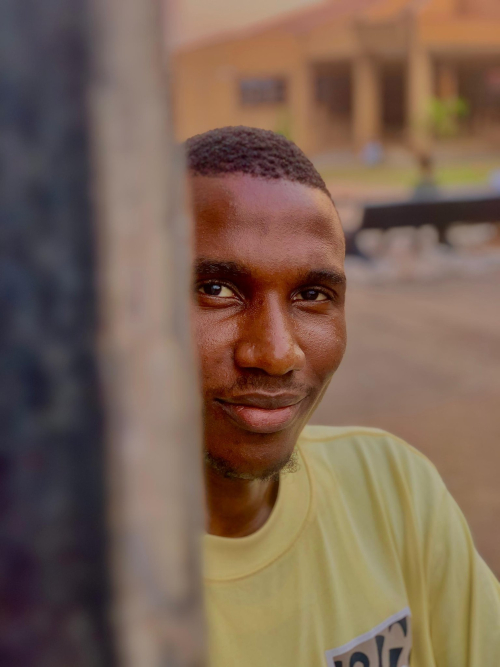
Nwodo Divine is a Nigerian author and editor. He earned his BA in English and Literature from the University of Benin in Nigeria. His work has appeared or is forthcoming in Poetrycolumn, African Writers Magazine, Alan Squire Bulletin, The Winged Moon, and other publications. He is currently an editor at Akpata Magazine and a submission reader for The Word’s Faire.
Check out HFR’s book catalog, publicity list, submission manager, and buy merch from our Spring store. Follow us on Instagram and YouTube. Disclosure: HFR is an affiliate of Bookshop.org and we will earn a commission if you click through and make a purchase. Sales from Bookshop.org help support independent bookstores and small presses.
 Heavy Feather Review