
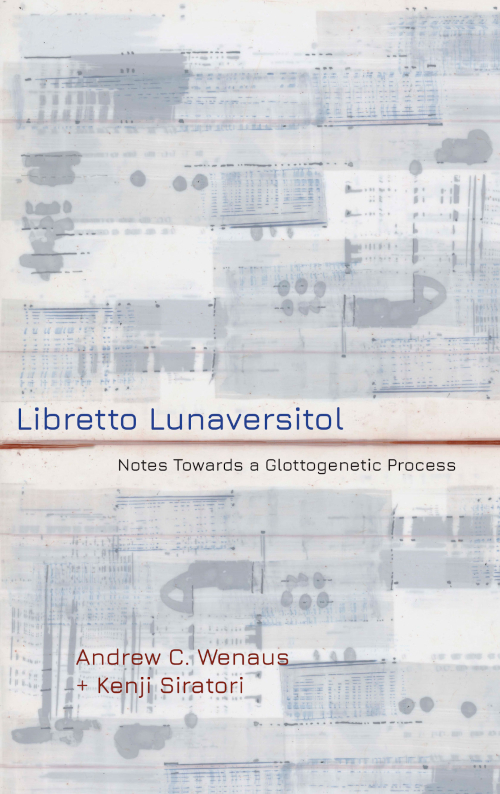
In Libretto Lunaversitol: Notes Towards a Glottogenetic Process, a pata-mathematical writing project composed and created by Andrew C. Wenaus & Kenji Siratori, the English language is pulverized into phonetic fragments that slowly drift like stars across the night sky. The text is written in a radicalized aleatory language that does not reflect any kind of known reality; instead, phonemes refract, distort, and decenter all truth-claims regarding actuality. These phonemes embody a new form of crypto-mathematical mysticism that cannot be accessed by traditional means or, least of all, by traditional memory. When vocalized, the phonemes that make up Wenaus & Siratori’s super-hybrid technical language hint at semantic meanings that lie beyond an unseen horizon. The fragmented poetic sounds exemplify an incantatory power that expresses a pure, immediate reality that transcends itself. On the surface, it suggests a secret language that may have been spoken on the flying island of Laputa. Laputa was home to scientists and philosophers whose clothes were ill-fitting and were adorned with various astrological symbols and musical notations. The inhabitants spend most of their time listening to the “music of the spheres.”
But how do we interpret this new kind of mathesis universalis, the scientific search for the truth of things that was so dearly loved by 16th and 17th century philosophers and mathematicians? By comparison, the search today seems almost parasitic, as it metastasizes around the meaning generated by a living language. As iconography, however, visual representations of this new inquisitive language create ephemeral three-dimensional spaces that invite a new aesthetic of understanding. Does this iconographic language generate meaning in the traditional sense of the term? No. But, as text-based art, it does provide new aesthetic forms of visual pleasure. Some resemble intergalactic insignia, or ideograms that hint at a future state of affairs. Ironically, this iconographic language also resembles the Linear B syllabic script that was used for writing in 1400 BCE Mycenaean Greece before completely disappearing in the Greek Dark Ages of 1200 BCE.
So, the question still remains: Are we encountering a language of the future, or an ahistorical pure and universal language of a pre-Babel past that is accessible only through Kabbalistic reflection? The linguistic constellations that we experience in this book hint at a pata-physical future language that exists above and beyond the metaphysical metaphors that we use not to represent reality but to translate it into terms that we can all share. And yet this hyper-technical language also displays an almost Pythagorean precision in its mathematical syntax. It not only belongs to the future but is accessible in the present only through a radical rethinking of the function of memory. But how can we remember something that does not yet exist at a semantic level?
In the ancient world, religious representations were directly concerned with the historical condition of memory. Close links existed between the techniques of mental recall and the way individuals were able to picture memory to themselves. Memory was – and continues to be – a very complicated function related to psychological categories of time and identity. The sacralization of Mnemosyne (the Greek goddess of memory) indicated the value of memory in a culture whose traditions were entirely oral. At that time, poetry represented typical forms of divine possession or madness (hence the Lunaversitol of the book’s title). The poet, thought to be “possessed” by the Muses, interpreted Mnemosyne’s songs. Accessing memory allowed the poet to travel back into the midst of ancient time and events. By traveling back to the ancient past, the process of recall not only sought to situate events in a temporal framework, but to reach the very foundations of being, that is, to discover what lay at the origins of time.
Mnemosyne was the conduit through which the primeval reality of the cosmos emerged. She made it possible to understand the process of becoming as a whole. History—as sung “through” Mnemosyne—was a deciphering of the invisible, the beyond, a geography of the supernatural. Astral travelling through memory took the poet out of their own temporal existence and into an ancient past. Mnemosyne conferred to them the possibility of contacting other worlds through a glotto-genetic process, of entering into and returning from them freely.
In Libretto Lunaversitol, however, the process is reversed, in that the poet must radically rethink the task of memory as a signifier of historical time and identity. In the same way the semantic structure of language breaks down into unitary phonemic units, the boundary between self and other, upper and lower, biology and technology also break down and must consequently be rethought and reconstituted into new forms of being. Visions of these future-poets can be shocking and disorienting. It is one thing to contemplate the literary potentiality of bio-mechanical bodies but another to encounter them as visual representations. The future-poets depicted in Libretto Lunaversitol incorporate Japanese cyberpunk (e.g., the Tetsuo: The Iron Man trilogy), a Cronenbergian body-horror aesthetic, and radical incarnations of characters that appear in Chuck Palahniuk and William Burrough’s later writings.
Why do these bio-mechanical bodies appear in this book? Perhaps they are depictions of the chrono-warriors who stand on the threshold of the present physiological organization of humanity and are presently undergoing radical transformations in order to ‘hear’ the super-hybrid technical language of the future. Because we are contemporaneous with these mechanical-genetic transformations it stands to reason that we do not yet know what the final version may look like. Thus, in the context of a theory of bio-mechanical evolution, we are merely looking at hybrid beings who are adding/losing limbs or orifices in the hope of avoiding the complete extinction of humanity.
The linguistic constellations that are featured in this fascinating book shape themselves into sometimes recognizable forms but still require new notions of aesthetic beauty to fully appreciate them. At the very least they operate as remarkable visual representations of the literary tenets of Letterism of the mid-1940s. More important, however, is the radical gesture of positing new forms of beauty in the presence of potential human extinction. Given the prospects of humanity as a biological dead-end, the worship of the sun and the stars—a cosmological sharing of gifts—means a dismantling of the bureaucratic and late-capitalist interpretation of human reality. This is the potent message that this project attempts to deliver. Libretto Lunaversitol compels us to communicate cerebrally, digitally, directly with the stars above and to share these pagan gifts with everyone.
A final word regarding the accompanying soundtrack. The text in Libretto Lunaversitol must be experienced—in the fullest sense of the term—while listening to the musical score provided by Andrew C. Wenaus and composer, soprano, and keyboardist Christina Marie Willatt. Willatt’s fragmented and ethereal vocal “sounds” resonate in and out of reverberating electronic textures that musically reproduce the three-dimensionality of the visual and written texts. The immersive music that accompanies the poetic-phonetic texts is a truly postmodern example of a “Gesamtkunstwerk” (a “total work of art”).
Libretto Lunaversitol: Notes Towards a Glottogenetic Process, by Andrew C. Wenaus & Kenji Siratori. Calamari Archive, August 2024. 88 pages. $16.00, paper.
Edward J. Matthews teaches philosophy, writing, and communications in the School for Language and Liberal Studies at Fanshawe College in London, Ontario, Canada. He is also a part-time lecturer and instructor at the Centre for the Study of Theory and Criticism at Western University. His most recent publications include Arts & Politics of the Situationist International 1957-1972: Situating the Situationists (Lexington Books, 2021) and Guy Debord’s Politics of Communication: Liberating Language from Power (Lexington Books, 2023). He is currently working on a new book, In the Shadows of the Enlightenment: The French Philosophes and the Rise of Materialism.
Check out HFR’s book catalog, publicity list, submission manager, and buy merch from our Spring store. Follow us on Instagram and YouTube. Disclosure: HFR is an affiliate of Bookshop.org and we will earn a commission if you click through and make a purchase. Sales from Bookshop.org help support independent bookstores and small presses.
 Heavy Feather Review