
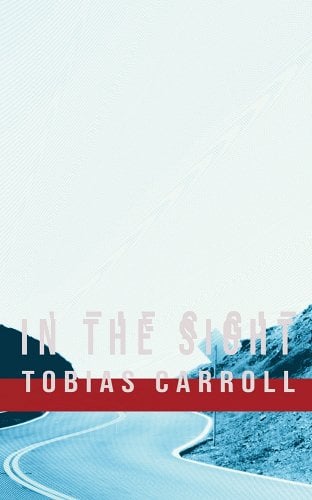
While In the Sight, Tobias Carroll’s third novel, is definitely a road novel of a dark America, it’s also a novel with a hook. The main character, Farrier, sells a brain-hacking drug that was created by him and other members of a secret society that’s now defunct. The disintegration of this secret society remains largely a mystery, as does the mechanics of the drug they created. All we are clued into is the fact that this drug, a few weeks after it is administered, makes the user a new person. It doesn’t change their gender, or, really, much of their body, but they become someone else entirely with little memory of their last life. When we meet Farrier at the beginning of the novel, he is dropping off the drug at one of the nondescript rest stops he feels most at ease at, to a person he will likely never see again. But this time is different. The person he hands the drug off to lets him know he is being tracked. And so begins Farrier’s trip across a degraded United States of gas stations, standard-issue motels, bars tucked off to the sides of them, and hotel breakfasts.
As the hook is more hinted at than fully laid out (in a recent interview in Electric Literature, Carroll said he never had any intention of delving deeply into the science or process of the brain-hacking substance), what we’re left with is not only a road novel of man doing his damnest to escape his fate, but a character-driven one.
The road novel lends itself to the sort of introspection that Carrol’s main character is wont to do. The interesting thing about Farrier is how little he seems to know himself despite this introspection. His thoughts about who he is are ironclad—he is the sort of man who does one thing, not another—but throughout the novel, he is consistently proven wrong in his own assessments of self. “Farrier had never really been into senses of chemical highs,” the third-person narrator reveals just before Farrier undergoes his own version of brainhacking with a machine he carries with him and uses frequently. When Farrier’s mortality is looming from a run-in with someone he’s sure has been sent after him, “He felt few regrets, until he did.” When he meets a client of a friend who is involved in a similarly off-the-books business venture to his own, “Farrier was not someone to dislike someone on sight, but Nault was rapidly becoming an exception.” At another point, he thinks about how he’s not a man who has a favorite article of clothing, just after describing his favorite article of clothing. Again and again, Farrier contradicts his knowledge of himself, as if the self he has brought to each new sterile location in his journey is a different one than the one he assumes he has come to know. This is clearly a choice Carroll makes again and again in the text, keeping Farrier at a distance from himself.
This is in keeping with a character who does what Farrier does, a sort of glorified drug dealer who seems to think of himself more as a chemist. Farrier knows that what he is doing is a precious balance, and yet seems genuinely shocked when the whole enterprise starts to fall apart.
As Farrier travels through the country, interesting characters and locations pop up like mirages on the horizon, soon to be passed, leaving the reader wondering which of them existed at all. There is Emilia Kopel, described as “an architect and libertine, obsessed with creating spaces as habitable for the spirits of the dead as they were for the bodies of the living.” She sends Farrier secret messages in code. There is Finch, an old college friend of Farrier’s and a marine biologist who takes him to abandoned aviaries and interstate diners. There is his old friend Washburn, who gets him into more trouble than he was in to begin with. These characters appear and disappear the same way ghosts on the highway do throughout the novel. The reality of any of the characters becomes as indistinct as a hallucinated desert oasis. The long-dead man that Farrier imagines he sees on a drive is as real and unreal as Emilia, Finch, and Washburn are, no matter how little space he takes up in the novel.
The book’s cover copy calls In the Sight “an ode to gas stations and convenience stores,” but the locations of this road novel are much richer than just these in-between spaces. There is the aforementioned abandoned aviary, there is a bar “with the Prohibition cosplayers,” there are rest stops glowing like welcoming beacons off the highway, there are unnamed towns with colleges in their center, there is Nashville, there is Pittsburgh and Lake Erie. The effect of these locales piled upon one another is collage-like, giving a fractured view of America that somehow holds together in just the right ways.
Because of Farrier’s escapist wanderings, it is no surprise that the narrative leaves us off with him in a place of choice. He has ad-hoc created a final dose of the brain hacking drug, and he has happened upon a bartending shift in one of his favored motel bars. The lack of final resolution is the perfect ending for the meandering narrative of his voyages. Will he find the answers to the universe in this final motel room, in his thrown-together chemistry rigs? Will he crack jokes behind the bar for life? Will he become someone new? Remain himself? Carroll leaves us with questions, finally, and we are to decide if we know Farrier better than he can know himself.
In the Sight, by Tobias Carroll. Whiskey Tit, February 2024. 152 pages. $16.00, paper.
Alex DiFrancesco is the author of Psychopomps, All City, Transmutation, and Breaking the Curse. Their work has appeared in The New York Times, Washington Post, The Guardian, and more. In 2020, they were the first transgender awards finalist in over 80 years of the Ohioana Book Awards. They were a 2022 recipient of the Ohio Arts Council’s Individual Excellence Award.
Check out HFR’s book catalog, publicity list, submission manager, and buy merch from our Spring store. Follow us on Instagram and YouTube. Disclosure: HFR is an affiliate of Bookshop.org and we will earn a commission if you click through and make a purchase. Sales from Bookshop.org help support independent bookstores and small presses.
 Heavy Feather Review