
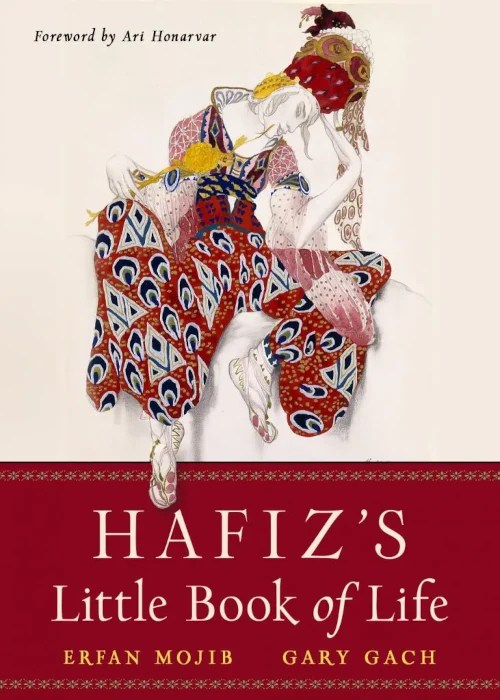
The 14th century Persian poet Hafez, also spelled in English Hafiz, is one of Iran’s most cherished poets, a Sufi poet working within Islamic culture much like the mystical Sufi poet Rumi. Hafez lived in the city of Shiraz, where he was renowned as a professional reciter of the Koran from memory as well as esteemed writer of spiritual ghazels in self-depreciating and clever voice. He was supported by patrons at times, one of many within a ghazel tradition. Hafez’s ghazels celebrate both wine and divine intoxication, romantic love and love of the divine “Friend,” and favor human follies and spiritual longing over religious masks of perfectionism. Sometimes his love poetry simultaneously seeks the earthly and divine beloved, and this simultaneity feels close to the essence of Hafez for me. In several ghazels translated by Robert Bly, Dick Davies, and Peter Avery with different emphasis, Hafez urges us to enjoy our earthly delights, where the divine light also shines. Live fully, as Bly translates, in “Pre-Eternity.” American Transcendalist Ralph Waldo Emerson and German poet-philosopher Goethe both admired Hafez, which makes sense: All three champion a divine universality within inherited cultures. By the way, Hafez makes one chuckle; his resonance ripples to a smile.
Creative translators Erfan Mojib & Gary Gach in Hafiz’s Little Book of Life basically pull quotes from Hafez and turn it into sayings in the shape of early modernist poetry. Some are centered on the page, appear as just one sentence, present as seven or six line strophes, or offer the airy brevity of a haiku. Hafez never wrote a book of life. His work was collected after his lifetime, which means the book’s title also is a creative act by the translators. Mojib & Gach explain this in the back, at the “Translator’s Notes” on page 193 onward, which should have been the preface. They credit their inspiration to Iranian poet Abbas Kiarostami, who did the same in Iran. Of course, the modernist collage and concision on display here is now one century old. Hafiz’s Little Book of Life will confuse a new reader looking for Hafez in English, but might intrigue those familiar with him.
Within the premise of experiment, it’s uneven. At times Hafez’s joy is pulled out and isolated so that the paradoxes and nuances are lost, and the saying then is banal. Further, Hafez is more romantic and passionate in fuller form. The quotes sometimes verge on the didactic, because unlike early modernism, these concisions do not emphasize imagery. Let me quote and you decide:
Blaze, O my heart
The flames
Can be very beneficial
I liked this poem a bit, because I read into it the passion and contradiction of Hafez. Yet without that background, does it work? Could it not just state: Yes my friend, flames can be beneficial, a provocative contradiction in a colloquial voice? “Blaze, O my heart” is a bit archaic. Here’s some more:
Divine grace of the Holy Spirit And: Love Being drunk Again I liked the kaon: “Love / Arises / From “Our Little Secret,” though it seems Hafez preaches or teaches the divine is both hidden and omnipresent, a sort of big available secret. At times, Hafez is a poet of paradoxes, so let’s laugh. Is the secret getting comfortable with paradox? This all said, these excerpts reduce the nuance and often excise the context. For those searching to read Hafez, I recommend the translation by Robert Bly, The Angels Knocking on the Tavern Door (Harper Perennial, 2008), for its bold clarities. The title hints at the worldly and mystical contradiction of Hafez. Meanwhile translator Dick Davis offers a more ornate approach to Hafez along with two other Sufi poets in Hafez: Faces of Love and the Poets of Shiraz (Penguin, 2012). Davis uses ballad stanza, rhyme, and ghazel more than Bly, which emphasizes the sophisticated tone of this sophisticated poetic entertainer. I would be remiss not to recommend Peter Avery’s Thirty Poems of Hafez (Other Press, 2003), which is more epigrammatic. I imagine the Hafez within his milieu and native tongue was epigrammatic, because he wrote within a tradition for those who know common shared subjects. His ghazels in translation play with a theme across tercets and sometimes offer a refrain. In “A Thousand Doorkeepers,” Bly translates that little secret as follows in the first tercet: No one has ever seen your face, and yet a thousand The poem ends with: The cries that Hafez has made all of his life Lastly, there is another translator in English, Daniel Ladinsky, who is more of an interpreter of Hafez rendered as a Beat poet, in free verse spoken-voice style. While maybe not faithful, Ladinsky is zany and so is Hafez (with more subtlety). Like Ladinsky’s interpretive merry prankster performances, Hafiz’s Little Book of Life looks to early William Carlos Williams and others of that era playing with concision and white space to billboard quotes. It cannot compare to the massively potent, spiritual Sufi poet. Hafiz’s Little Book of Life, by Hafiz of Shira. Translated by Erfan Mojib & Gary Gach. Newburyport, Massachusetts: Hampton Roads Publishing, October 2023. 244 pages. $15.95, paper. G.H. Mosson is the author of six poetry collections, including Family Snapshot as a Poem in Time (Finishing Line Press 2019) and Singing the Forge, forthcoming from David Robert Books in May 2025. His poetry and reviews have appeared in The Tampa Review, Rattle, Heavy Feather Review, The Cincinnati Review, California Quarterly, and beyond. He has an MA from The Writing Seminars at Johns Hopkins, an MFA from New England College, and lives in Maryland. For more, seek ghmosson.com. Check out HFR’s book catalog, publicity list, submission manager, and buy merch from our Spring store. Follow us on Instagram and YouTube. Disclosure: HFR is an affiliate of Bookshop.org and we will earn a commission if you click through and make a purchase. Sales from Bookshop.org help support independent bookstores and small presses.
Descend again
To enable ordinary people to do
As once did Jesus
Arises
From “Our Little Secret”
One can piece
Secrets
Doorkeeepers have arrived. You are a rose still closed,
And yet a hundred nightingales have arrived.
Have not gone to waste: a strange story has emerged
Inside those cries, and a marvelous way of saying.
 Heavy Feather Review