
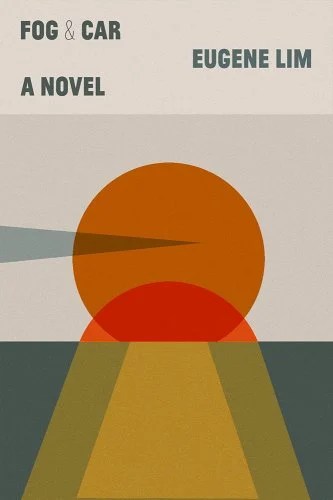
Rife with love, melancholia, grief, and a supernatural hint, Eugene Lim’s debut novel Fog & Car is a psychological mindbender with the potential to reshape and redefine fiction. It follow Jim Fog, who after a divorce finds himself marooned in a small Midwestern town. Meanwhile, his ex, Sarah Car, seems to skip any regret or other depression she may have about the divorce. Instead, Sarah leaps headlong into a new life in New York City. Nonetheless, the couple cannot quite sever their ties for good. They are bound by an old friend, and when both of them decide to chase him down, their lives and souls blur and bend in ways neither of them could have imagined.
Nonetheless, Lim’s novel is not for the easily shocked or those who are not ready for a reading challenge. Part of the novel’s enigmatic draw is that, in many ways, though it is labeled as fiction, it defies genre. Part of the poetic and psychological magic of Fog’s sections are that, at first, his thoughts are metaphysical yet sensical:
A certain memory then, of objects that substantiate his movements, these memories this nostalgia incorporates into this doing of this exact moment. It is this drumsong and this engraving of a leather belt, this hat, and this ravine.
The careful, prosaic lines consisting of linear thoughts are easily accessible. As the book continues, however, Fog’s segments become disjointed. Short, fragmented lines ebb into longer, more descriptive paragraphs:
Why—if he did, never, he knows, would it get done—so always think
this is a burden?
before the rush of scrubbing tops.
Stretching again to help his waist and shoulders, back. He can’t recall ever doing
doing this as a repentance, also wishes wasn’t doing it now. Pride […]
Initially, we discover that Fog’s parts are written like rather long poems—free verse epics of sorts—in which fragmented lines and paragraphs that break off midsentence mimic Fog’s dwindling mental and emotional states.
Sarah Car’s initial chapters are more pragmatic, more traditional. While they do convey a woman’s journey into post-divorce liberation and exploration, they possess a melancholy that echoes Fog’s segments. Car’s voice, however, philosophically echoes Fog’s. Her contemplations about time, time’s existence, and time’s careful escape from one’s logic help create the novel’s supernatural effects. Car wonders “again where the time has gone, or more accurately, what has become of it. What it has become. She would return tomorrow, think it again.” This sensational fluidity carries us through the novel’s later sections, where the structure once again mirrors the characters’ actions and emotional states.
The paragraph and even the sentence structures create a physical connection for us to Fog & Car. Making the novel even more sensational is its incorporation of multiple points-of-view. For the first part of the novel, we are held at a distance—and in some senses even disconnected—from the characters, and most specifically Jim, because of the of third-person point-of-view. Midway through the novel, this changes. We suddenly find Jim narrating his own story. The sudden shift from third-person to first-person is sly, so sly that we are actually surprised, maybe even confused, at the shift. Nonetheless, the first-person point-of-view makes Jim’s journey even more intimate and even more of an emotional experience. This sly trick is what deepens the novel’s psychological nature as well as the sense of fluidity. It also reinforces Car’s ideas about time’s own fluidity and inability to be captured.
Of course, what might most standout is the nondramatic way that Fog & Car reiterates the idea that, simply put, life is messy. Relationships—even friendships—are messy, especially for Sarah, who thrives socially during post-divorce life. Jim, for the most part, has the benefit of solitude, but that solitude comes with a messiness entirely its own. Thus, for many of us, Jim may seem like the more complex character. Solitude—and ultimately the inner thoughts to which we are privy—reinforce Jim’s complexities. Again, form and structure benefit the character in this regard, giving the book a multilayered effect that is as complex as its own characters.
Certainly, one cannot ignore the novel’s examination of marriage, divorce, and social contracts which determine an individual’s—and to a smaller extent society’s—path. The relationships portrayed throughout Fog & Car are like a giant puzzle. As the novel progresses, and more and more characters enter into Jim and Sarah’s lives, the puzzle—and the pieces to complete it—become even more difficult to place. However, we should think about what it takes to disassemble a puzzle rather than to assemble it. By the novel’s end, what we realize is that the novel is, to an extent, a critique of the deconstruction of one’s life that occurs because of any major life event. Interconnection is a huge focus, and Fog and Car’s inability to separate for good because of their friend is simply one example of what it truly takes to disassemble one life in order to establish another.
Reading Fog & Car is an investment of one’s time. Its structural, psychological, and philosophical labyrinths are not easily navigated if one reads hastily. In fact, Fog & Car is the type of novel that requires multiple readings, because each reading would provide a different reading experience and emotional experience. That, too, is part of its rather esoteric beauty. Very few books published these days echo the psychological twists and bends of literary greats such as Camus. Nonetheless, Fog & Car does, and because of that, it is quite unforgettable. Also, it possesses a metaphysical poesy that is so rare in today’s fiction, and its structure—from the simplest sentence to the longest chapter—are testaments to the fact that for good writing, each word, each sentence, each paragraph truly matters.
Fog & Car, by Eugene Lim. Minneapolis, Minnesota: Coffee House Press, July 2024. 256 pages. $17.95, paper.
Nicole Yurcaba (Нікола Юрцаба) is a Ukrainian American of Hutsul/Lemko origin. A poet and essayist, her poems and reviews have appeared in Appalachian Heritage, Atlanta Review, Seneca Review, New Eastern Europe, and Ukraine’s Euromaidan Press. Nicole holds an MFA in Writing from Lindenwood University, teaches poetry workshops for Southern New Hampshire University, and is the Humanities Coordinator at Blue Ridge Community and Technical College. She also serves as a guest book reviewer for Sage Cigarettes, Tupelo Quarterly, Colorado Review, and Southern Review of Books.
Check out HFR’s book catalog, publicity list, submission manager, and buy merch from our Spring store. Follow us on Instagram and YouTube. Disclosure: HFR is an affiliate of Bookshop.org and we will earn a commission if you click through and make a purchase. Sales from Bookshop.org help support independent bookstores and small presses.
 Heavy Feather Review