
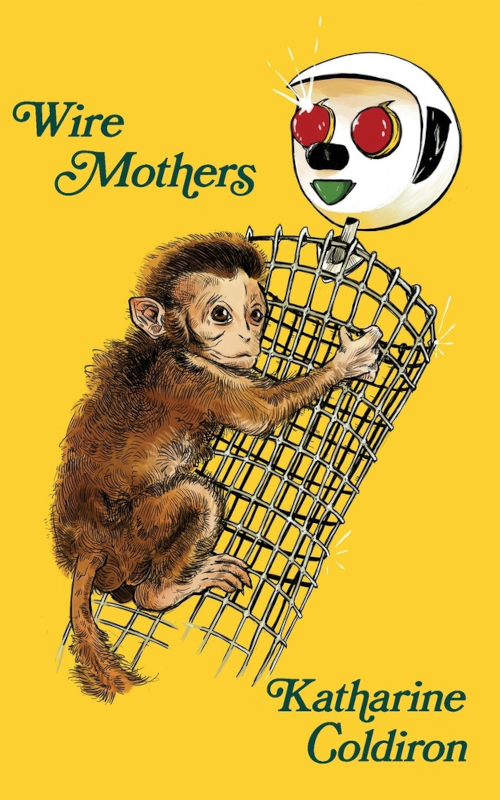
None of the five short stories in Katharine Coldiron’s debut collection Wire Mothers are specifically about psychologist Harry Harlow’s attachment experiments with infant rhesus macaques and wire/cloth “mothers.” Instead, Wire Mothers earns its title through accretion, as the characters in each of Coldiron’s stories seek comfort from others yet remain unable to connect, just like baby monkeys rooting at birdcage breasts.
The relational dysfunction between characters in Wire Mothers reveals itself slowly, through convincing third and first-person narrators who let family secrets slip through what is and isn’t said. At its best, Coldiron’s deft construction of deliberate penny drops is reminiscent of Margaret Atwood’s short fiction and the spare, distant plays of Caryl Churchill. For example, “The First Snow” begins Wire Mothers with a nostalgic recollection of visiting cousins “Tetrised together” in sleeping bags. Jill, a girl who “eeled out of bed” late at night to meet the neighbor boy for a romantic midnight kiss, embodies preteen tension. Her attempts to dodge her creepy rabbit-killing uncle Don’s moonlit trudge around the house alternate with scenes describing young Donald’s own plot to steal a kiss back in the 1950s, his pubescent body “a bony cushion with explosives embedded in the upholstery.” Coldiron builds an eerie tone through allusions to forgotten and present predation, until Don’s past bleeds into Jill’s present with shocking consequences.
“Rich and Beautiful” also unsettles through the unsaid and unseen, with a young ex-assistant hotel concierge describing two days spent “sweating through high-class errands—fresh pomegranates, artisan sodas, organic toothpaste” in St. Louis. Assigned to look after the Zariphes, an uber-wealthy itinerant couple and their bookworm teen daughter, the concierge gradually uncovers the truth behind the family’s “radical approach to relationships.” Meanwhile, she finds odd familiarity in their daughter’s belongings: “I recognized one of her little zip-up bags as the same free gift I’d gotten at a Clinique counter last year. I’d been buying foundation for my mother, who loved nice things but didn’t like spending money on herself.” “Rich and Beautiful’s” deadpan observations about socioeconomic class and work are subtle and skewering while eliciting empathy for the surly teenager caught in the middle of her parents’ life choices.
“To-Do” induces a singular combination of empathy, amusement, and horror at protagonist Gran Lily, a wire mother who abducts her grandchildren (aged eight and five, “Not babies. Not snatched.”) from her daughter and “that Connie, her radical haircut and her furious eyes.” The titular to-do list is embedded throughout the story as Gran Lily’s manic attempt to organize the kidnapping as she goes, because “Enjoying them didn’t seem enough to fill up the time, the black void, and anyway she’d forgotten how their presence could grate and grate until her nerves bled.” Tension builds as Gran Lily makes an escalating series of childcare mistakes, revealing exactly why her adult daughter tried to keep her own kids far, far away.
Coldiron’s peculiar brand of realism gives way to a more magical conceit in the papercut sharp fable “Between Four and Six.” Here, a self-assured narrator finds that nothing from Trader Joe’s snack aisle will satisfy her hunger between the titular hours each day. Desperate, she turns to books, first relishing the descriptions of food within them, then literally consuming the pages: “I went faster, swallowed more and more: short books like appetizers, long books like casseroles.” As with so much of Wire Mothers, the realization that “Between Four and Six” is horror dawns deliciously slowly.
Closing story “Carlotta Made Flesh” follows Jamie, a freelancer who spends each Wednesday interviewing the mother of a little girl who became Internet-famous for her bubbly attitude in the face of terminal illness. The b-plot concerns Jamie’s failing marriage and mercenary affair with a horny jerk who knows the features editor at The Atlantic—Jamie’s hoping to parlay all the interviews into a feature. While the affair exposes Jamie’s flawed morality and uneasy relationship to the truth, it’s far less interesting to read about than the a-plot’s exploration of identity on the Internet, which the narrator describes as “a miracle, a wonder of the world … a place of such versatile and inexhaustible fertility that anything can flourish there—art, ideas, fraud, wealth, work, play, pornography, evil, communion, truth.”
Not a chapbook, yet slimmer than most fiction collections, Wire Mothers is one of those “short books like appetizers” the bibliophagic narrator of “Between Four and Six” devours—an untraditional length more small presses might consider, especially when the stories within are as emotionally vast as these.
Wire Mothers, by Katharine Coldiron. Whiskey Tit, May 2024. 86 pages. $12.00, paper.
Jess Bowers is the author of Horse Show, a short fiction collection out now from Santa Fe Writers Project. Learn more at jessbowers.org or on Twitter/X @prettyminotaur.
Check out HFR’s book catalog, publicity list, submission manager, and buy merch from our Spring store. Follow us on Instagram, Bluesky, and YouTube. Disclosure: HFR is an affiliate of Bookshop.org and we will earn a commission if you click through and make a purchase. Sales from Bookshop.org help support independent bookstores and small presses.

