
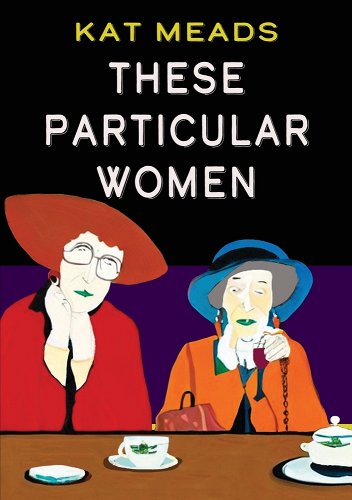
It’s a particular type of writer and a particular type of writing that illuminates (ten-fold over ten essays) as much as it informs. It’s also a particular type of writing and a particular type of writer that uncovers details (oh-so-delicious details) as much as it declares and reveals universal truths. These Particular Women, written by Kat Meads and published by Sagging Meniscus Press, embodies all these characteristics—and more.
Each essay in the 182-page collection centers and celebrates a unique (and oh-so-particular) woman of varying degrees of celebrity/anonymity and controversial/rebellious singularity/sensationality. In crafting portraits of her complex and curious subjects, including Virginia Woolf, Agatha Christie, Lida Estelle Oldham Franklin Faulkner, Caroline Blackwood, and other creators, Meads engages with related research to degrees rarely accessible in traditional form.
The work opens with an extended, long-form essay (forty-one pages and the longest in the collection) on Virginia Woolf (nee Stephen) titled “Things Woolfian.” The essay is a fitting entrée that delivers on a promise, and premise, of there always being more to discover, including for “Woolfians” and others fascinated and inspired by the power of women to behold, beguile, and overcome.
“Things Woolfian” shares delightfully personal details (from Virginia Woolf’s marriage to Leonard to sibling rivalry to sustained questions of sanity) and series of curiously intimate questions proliferate.
Intimacy bubbles in questions dressed in plain clothes. Woolfian examples include: Just how bad were Woolf’s teeth? Did she really dislike clothes shopping? Just how “snobbish” was she? And did she really wear an “upturned wastepaper basket on her head”?
The collection’s ensuing essays delight in similar ways, with more questions to ponder and explore. Meads unravels and undresses private anecdotes in ways that bare flesh and pique curiosities about her equal parts clever and controversial subjects (including Jean Harris, Diana Trilling, and Shana Alexander in “The Headmistress, Interpreted” and Margaret (“Peggy”) Mitchell in “Margaret Mitchell’s Dump”). From the demise of the Scarsdale-diet doctor to the room in which “Peggy” composed the “majority” of Gone with the Wind, Meads unpacks the locked (and regularly messy) closet that is often used to secure (and sometimes bleach) a historical record and air-dries laundry, both clean and dirty. From insights on the twenty-two-year-old Virginia’s Woolf’s “constant fight against Doctors follies” to the harsh reality that “Virginia’s ant-Semitism was ingrained, reflexive, unrepentant, utterly undisguised, and often aimed at her husband,” for example, Meads humanizes as she disarms.
Meads shares her meticulous research in blunt, bare, and biographical forms that are as powerful as they are particular. Meads takes down standard biographies as she takes up less standard forms including the role of biographer. With extraordinary attention to detail, each essay is strong alone, yet stronger together. The essays push and prompt us to revisit biography as both a noun and a verb. The author’s biographical notes, infused throughout individual pieces, further propel the collection of biographical essays into territory that is both reflective and perceptive.
The work is simultaneously daring and demure. It wears its subjects (further examples include Agatha Christie, Kitty Oppenheimer, and Mary McCarthy) on its sleeves and offers windows, with drapes fully parted, into lives and worlds rarely seen. Throughout, Kat Meads takes on the role of a tour guide and informant. The work of each essay feels both covert and overt, like previously unopened windows into the lives of women who, at first, might appear to share only the page but who later reveal commonalities across theme, tone, and context, including the inherent subjectivity to biographical writing of all kinds.
In the opening pages, Meads notes that “attics often give shelter to what shouldn’t be preserved.” Ironically, though, it’s the often overlooked details of a life, as shared throughout the work, that make the text so strong. The focused essays are unique in subject yet uniform in appeal. The pieces, each of which offers a peek into a very particular time, place, and woman, are as distinct and as quirky as their subjects—also as memorable.
As plot is secondary to the particulars of the essays’ subjects, the collection too can be consumed in whatever form and sequence strikes us best. The essays can be sat with (as Meads writes of reading Woolf—“to stay with and within a moment”) or read at a quick clip—“Margaret Mitchell’s Dump” is six pages in length and “Mary McCarthy Performs Mary McCarthy” is ten pages long. Irrespective of essay length, Meads masterfully creates an undeniable and welcome intimacy between reader and writer, while she punctures misconceptions as to what it means to be any one of the collection’s subjects. The collection is a particularly notable keeper. It’s equal parts fascinating and fun and can be revisited regularly—for the joy of discovery, the roughness of reality, and the lovely (and oh-so-quirky) biographical details of remarkable (and very particular) women. These Particular Women is a must-read.
These Particular Women, by Kat Meads. Montclair, New Jersey: Sagging Meniscus Press, April 2023. 182 pages. $19.95, paper.
Jen Schneider is a community college educator who lives, works, and writes in small spaces in and around Philadelphia.
Check out HFR’s book catalog, publicity list, submission manager, and buy merch from our Spring store. Follow us on Instagram and YouTube. Disclosure: HFR is an affiliate of Bookshop.org and we will earn a commission if you click through and make a purchase. Sales from Bookshop.org help support independent bookstores and small presses.
 Heavy Feather Review