
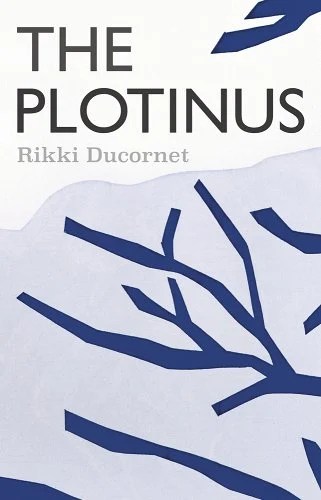
Forget “Call me Ishamel” and try on this opening line instead: “Agitated and pressed for time, I grabbed the knobby stick—a harmless memento of the footpath—now long gone—that had for a time provided access to the woods (such as they were) and ran into the street unprepared for the inevitable encounter (such a dope!) with the Plotinus.” Not as easy to memorize as Melville’s opener, I admit, but it resonates all the same, leaving us with a handful of important questions. And therein lies the joy of Rikki Ducornet’s latest novella: The Plotinus raises a host of questions about the dystopic, future reality it presents, yet as it slowly answers some of them, it makes us ask larger questions about our current reality.
The narrator and protagonist of the book is an unnamed man whom I assume, through one small hint in the text (citrus trees), lives in the American southeast. Not that it matters, as he is taken prisoner on the book’s first page and spends the story incarcerated by a Plotinus.
Oh, you want to know what a Plotinus is? Sorry folks, Ducornet feels no pressure to explain the Plotinus; it is robotic in nature and apparently comes in a variety of sizes, but the narrator is less keen on telling us the origins or any real details about the Plotinus. Or how this dystopia came to be. Or what is actually happening beyond the fact that our protagonist may have been living in a tree to hide from the Plotini (my attempt at pluralizing). And that the narrative takes place in a closet.
A monologic, one-room, sci-fi narrative can sound a bit, well, confining, but as I read The Plotinus, I found myself thinking of a handful of literary gems: Dostoevsky’s Notes from Underground, Beckett’s Malone Dies, and Ravn’s The Employees; an impossible synthesis if one were try to do it on purpose, yet Ducornet seems to pull the best of these books together. In other words, the book is both brilliant and entertaining, to say nothing of thought-provoking and astute.
The narrator certainly does not seem to be thinking straight, no doubt thanks to his being locked up for an indeterminate-yet-lengthy amount of time, yet, in the ways that matter, he sees and narrates very clearly. Sure, we are not told what a Plotinus is. But considering the book’s consistent allusions to ancient people and beliefs, it seems more than reasonable to think the novella has a connection to the grandfather of Neo-Platonism, Plotinus, the philosopher who took Plato’s ideas to their logical conclusions. It was Plotinus who raised the spiritual above the physical, connecting the earthly world, which includes our physical selves, with what is ugly, both in the literal and metaphorical sense, while elevating all things metaphysical and equating them with goodness, beauty, and justice.
The Plotinus and its Plotini ilk act as robotic overlords in this brave new world where the rich and well-off have escaped to the heavens—quite literally, to live on Mars—while the poor are left to dwell in the squalor of a desolated earth, where they are harassed and entrapped by robots. In other words, Plotinus’ teachings turn out to be prophetic in Ducornet’s fiction. The well-off are living in the ether while our impoverished narrator walks with his “knobby stick,” in a world always described as, parenthetically, “(such as it is),” the implication being ontological in nature, a connection of our narrator to a physical, ugly, shoulder-shrug of reality.
But resistance—both to injustice as a whole and to manmade destruction of the natural world—is always lurking in the interstices, as demonstrated by Ducornet. Our unnamed narrator is highly interested in the ancient philosopher Theophrastus, particularly his work on rocks. That’s right: Theophrastus wrote a philosophical work, still extant, on rocks, titled On Stones. And since he is far from being a common name, I will mention he was a follower and basically a disciple of Aristotle.
Though never mentioned directly in the book, the above information just might be helpful to ponder when reading The Plotinus. Whereas the book’s villains are associated with overly spiritual Plotinus, our protagonist and would-be rebel is linked to Theophrastus, who wrote about stones and plants, a philosopher with an earth-based ontology.
As if to complicate matters further, the book introduces Vector, a being who sometimes seems mechanical, sometimes human, sometimes on the side of our protagonist and sometimes not. Oh, and this being may or may not have physical form or even exist. Yes, I know, t’s a lot. The historically minded might just be reminded here of Euclid, associated not just with vectors but with Euclidian space, an abstract notion of the physical space in which (geometric) problems are worked out. Just as Euclid is sometimes a go-between linking the opposed spiritual and materialist schools of thought, so the Vector acts to try to unite the book’s two worlds until the narrator talks about the beauty he sees in a visiting hornet, which brings a swift rebuke from the Vector:
Until that moment, the Vector had looked upon me with something like awe, even affection. But now he appeared to rise above me like a hydraulic life, to take on height and heft. His visage veered rufulus and his mood erupted.
To love animals, he scolded, is as hateful as loving a member of one’s own sex. It is abhorrent in the eyes of the Archons, the heart of the Hierophant, the mind of the Vectory, the souls of the planets, the ears of the Mantis.
Achons? Hierophant? Mantis? No, we are not given more to go on as regards these maybe-characters. The Plotinus introduces a variety of beings in the manner displayed above, rarely explaining them to our satisfaction, but no matter their actual modes of being, their names continuously contain blatant philosophical and religious allusions. And though the religious persecution feels ecumenical, underlying it is a sort of dictatorial Gnosticism that would punish a human for loving or simply being physical matter.
But still he persists. The book follows its narrator as he in turn follows the progress of his beloved hornet, Smaragdos, as she and busies herself with a nest. Smaragdos—a name implying a second greening, as if the second coming were not in reference to an ancient messiah’s return but the natural world’s resurgence: “Smaragdos—my winged dragon, my angel, embodies the greatest of wonders, and this brings me to the Beauty who, in a moment of forgetfulness called out, Darling! Do not forget the knobby stick!” As the wealthy set their eyes on the heavens and many of the most religious among us hope global destruction can strongarm their messiah into showing up early, Ducornet reminds us that we are embodied beings, that therefore true love is an Eros-based, physical love, and it is there, on the physical plane, that beauty and change occur.
The Plotinus, by Rikki Ducornet. Minneapolis, Minnesota: Coffee House Press, July 2023. 88 pages. $14.95, paper.
Matt Martinson lives and teaches in central Washington. You can find his most recent fiction and nonfiction in the journals Lake Effect, Coffin Bell, and 1 Hand Clapping.
Check out HFR’s book catalog, publicity list, submission manager, and buy merch from our Spring store. Follow us on Instagram and YouTube. Disclosure: HFR is an affiliate of Bookshop.org and we will earn a commission if you click through and make a purchase. Sales from Bookshop.org help support independent bookstores and small presses.
 Heavy Feather Review