
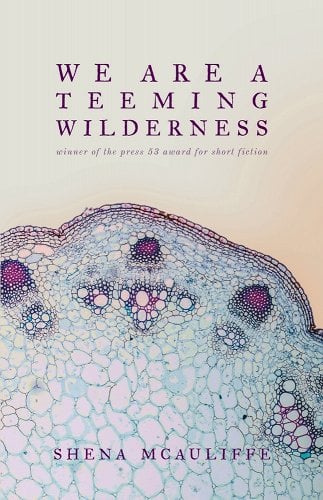
Shena McAuliffe’s third book, the inventive and quietly powerful story collection We Are a Teeming Wilderness, acts as a field guide to characters who devote themselves to systems of belief—a business model, a pseudo-science, a taxonomy of the body—at odds with their lived conditions. The friction between the imaginary and the real, however, isn’t particularly damning; it’s the cracking open of a geode, an opportunity for intimacy and empathy, a breeding ground which allows us to stave off our loneliness and coexist within, to borrow one of McAuliffe’s titles, this precarious hive.
Almost half of the stories in We Are a Teeming Wilderness contain visual representations such as a postcard, photograph, map, diagram, or instruction set. Other stories foreground historical figures and external texts like The Odyssey. These embedded media lend a grounding authenticity to the collection, a historiographic tint that extends the concerns of McAuliffe’s earlier, creative nonfiction book, Glass, Light, and Electricity (University of Alaska Press, 2020). Yet while these external influences intimate a neat mapping onto the story, they instead generate a medial friction which reinforces the gap between a character’s mental construction of the universe and the material world they inhabit. In the opening story, “Real Silk,” we follow Ruben, a somewhat unsightly and extremely inept door-to-door salesman. Ruben believes that if he follows the sales manuals written by the Real Silk company owner (the historical figure William C. Kobin), he will acquire a decent wage, the adoration of married women, and the love of his Alzheimer-afflicted mother. Interspersed with the narrative are photographs of Kobin, performative lists (“Say, ‘How do you do’ (not Howdy-do).”), pages from official sales manuals, the histories of the silkworm and the production of silk, and diagrammatic photographs (“Position of fingers as hand is put into foot of stocking”), all compiled from Real Silk manuals. Ruben falls in love with the story of Real Silk; he superimposes its romance onto his own life. He sees himself as storyteller, as matchmaker, a conduit “between his customer’s leg and the stocking he hopes to sell her … Her skin, he tells her, can kiss the luxury of Ancient China.” Of course, his investment in the Real Silk stories is highly aspirational. When he touches one of the housewives on the knee, he is rebuffed, and his fantasy dissolves into a pool of shame. “His hand was a monster,” McAuliffe writes.
As with “Real Silk,” where the instructions for selling stockings fetishize the female leg, McAuliffe’s stories tend to focus on women’s bodies. Brains and irises become subject to classification, to a direct correlation between physical attribute and psychological behavior. Spoiler: it rarely works well. In “Anatomy of the Eye,” a doctor’s obsession with the pseudo-science of iridology leads him to misdiagnose a pregnant patient he desires. And in the poignant “Benevolence,” the prison matron Eliza Farnham (also a historical figure) is obsessed with rehabilitating incarcerated women through the application of phrenology. By reading the shape of their skulls, she hopes to find a cure for their internal weaknesses. It’s clearly laudable, this desire to save women who, in the mid-19th century, had few advocates. Still, phrenology’s emphasis on genetics and biology means that Eliza cannot recognize cultural context and personal experience as contributors to the striated terrain of these women’s bodies. In her analysis of the skull of the prisoner Eliza, to whom she is erotically drawn, she recognizes the slope of a bone, “the organ of spirituality,” but does not remark on Eliza’s prominent scars, which come from being severely beaten by her husband.
McAuliffe’s stories don’t offer up such troubled misrecognitions simply to highlight a character’s alienation from intimacy. In “The Mugged Body,” the use of a diagram to retell a cross-dressing man’s recent mugging enables the man to resist the calcification of that trauma. Organized by body parts (ear, thigh) which are assigned letters (F, Q) on a classical drawing of the male body, the story literally deconstructs, objectifies, and reconstructs the body to create a critical distance necessary for healing. Ultimately, the memory of the mugger’s voice and his “oniony breath” are replaced by bird sounds, which suggests the narrator’s ability to scatter the pain of the mugging, which in turn allows him some semblance of control, relief, and agency.
If I had to pin down McAuliffe’s brilliant and deceptively strange domain, I locate it at the nexus of storytelling and the body. And in the act of storytelling, it is the listening ear that best allows us to reimagine ourselves, truly grep the other, or feel less isolated. In “The Mugged Body,” the ears hold court over the eyes. At the end, “(F) hears wings flap and scatter. (F) listens.” The story “This Precarious Hive” asks us to “listen” to the stories untold by the hundreds of dentures assembled in an uncanny art installation. A pregnant woman can do little more than listen to her unborn child and hope they come to term in the flash fiction “A Hotel Patio in Orizaba.” And in “Until We See Signs and Wonders” (the title paraphrases John 4:48), the protagonist’s ability to listen to a psychic’s mystically-divined advice allows him to help save the life of a child. Charlie, a skeptical young journalist driven to find chicanery in Edgar’s performances, must finally admit that science can’t explain everything. “Maybe,” he says, “I hadn’t even begun to imagine the complexity of our world. Maybe our spirits ebb across time and mingle with trees and insects and soil, merge with language and lungs. Maybe, in these fragile bodies, we haven’t even begun.”
Bodies are fragile, and complex, and don’t often work as we might want them to. Indeed, corporeal joy is fleeting in this collection, often displaced onto the flight of birds or the elegant hunting rituals of cats. Only quiet, reflective listening, an act which implies a dialogue rather than a superimposition of values, offers the hope of connection, a synergy within self or between humans that is most fully realized in the title story, “We Are a Teeming Wilderness.” With epigraphs by Michael Pollan and Walt Whitman, “Wilderness” offers the simplest of plots: a heterosexual couple, Glenn and “the superorganism who goes by ‘Sophie’” hang out, go to dinner, watch television. Told in a playful, gamboling tone, the story focalizes not on the people, but the trillions of organisms populating, cavorting in, and migrating between their bodies. We can now see the body’s inner contours, its bright and quick colors, its pulsing movements. We are not alone, are never alone at the sub-levels of the monadic human, the cells say to us. Simple operations, such as handing over a fork, become dances. Yes, while at times the organisms may be “raging xenophobes,” they also “take comfort in each other,” sad about “when we thought of ourselves as singular.” Seeing ourselves intrinsically as multiple, the story suggests, allows us to feel less alone and, ironically, more wild, more free. The body has become the cracked-open geode, and in so doing, has revealed itself not to be a uniform, monolithic entity but fractal, prismatic, eminently joyful and rich.
We Are a Teeming Wilderness, by Shena McAuliffe. Winston-Salem, North Carolina: Press 53, May 2023. 200 pages. $19.95, paper.
Robert Glick is the author of the short story collection Two Californias (C&R Press, 2019), an Associate Professor of English at the Rochester Institute of Technology, and a coeditor at Seneca Review. His work has been published in Alaska Review, Denver Quarterly, and Gettysburg Review. Excerpts from his just-completed novel, The Asterisms, have won the Summer Literary Seminars and New Ohio Review fiction contests.
Check out HFR’s book catalog, publicity list, submission manager, and buy merch from our Spring store. Follow us on Instagram and YouTube. Disclosure: HFR is an affiliate of Bookshop.org and we will earn a commission if you click through and make a purchase. Sales from Bookshop.org help support independent bookstores and small presses.
 Heavy Feather Review