

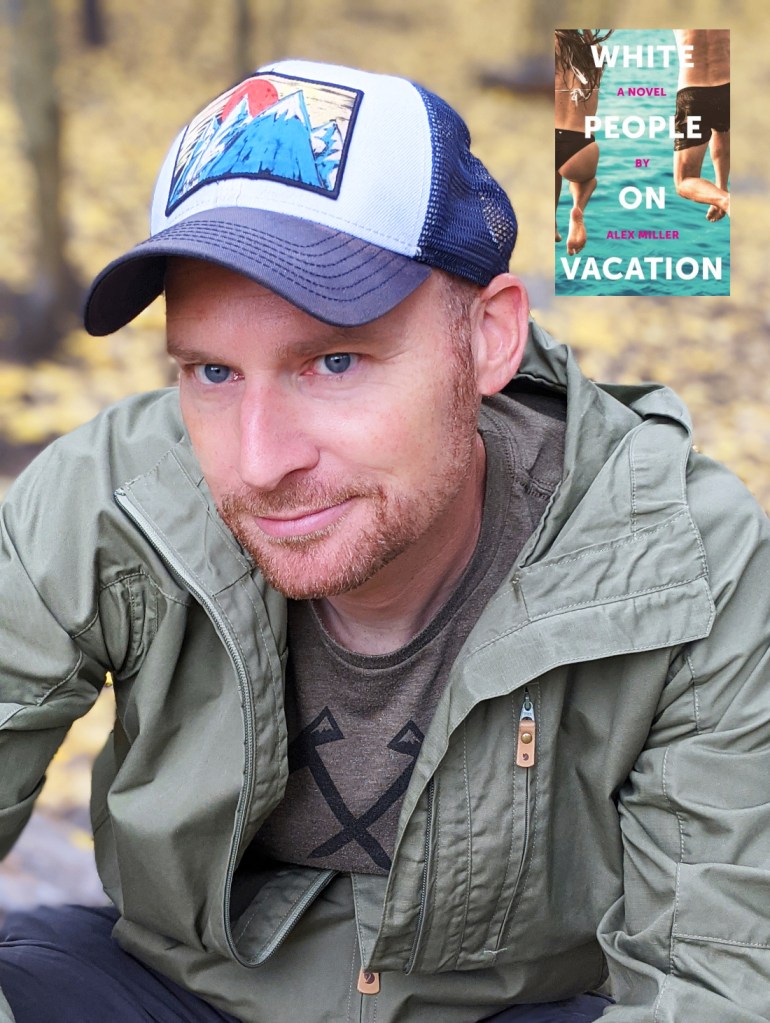
White People on Vacation is the story about the struggle to live a meaningful life in the era of late-stage capitalism. More specifically, it is about a group of college students (white) who take a vacation (cursed) to Hawaii, which is paid for by their parents (loaded). Everybody has a terrible time in this portrait of clueless haoles attempting to leverage their generational wealth and skin color to attain the good life. White People on Vacation is a beach read for socialists, a swan song for human aspiration in the age of climate apocalypse.
Justin Bryant: Let’s start with Nate, your protagonist and our narrator. Nate thinks about the end of the world. Nate wants to be good. Nate has trouble making decisions. How did he become the voice of this novel, and what do you think of him? Is he as bad as he thinks he is? Does he have a chance to be better?
Alex Miller: When I was writing Nate, I had in mind someone who spends way too much time doom scrolling Twitter, someone so thoroughly immersed in the world’s existential problems that it’s taking a psychological toll on him. When Nate thinks about the end of the world, he’s thinking about actual, real-world threats, like nuclear Armageddon and all of the various climate catastrophes that are coming for us, but he’s also thinking about his relationship with his girlfriend Natalie. They’ve been a romantic couple since junior high, but lately they’re making each other miserable, and both of them, in their way, understand they are approaching the end of the relationship. When Nate imagines the end of the world, he doesn’t always see it as a bad thing. Some of his apocalypse fantasies bring him great satisfaction, because as unthinkable as a breakup would be, a part of him understands it’s for the best. He’ll be better off once he’s free.
In terms of Nate’s badness vs. goodness, I don’t consider him bad at all. I mean, he’s human, with all the normal human failings, but there’s nothing particularly terrible about him. He’s not any worse than anybody else. His worst quality is passivity. He sees people doing bad things, and he doesn’t try to stop them. This is a source of guilt for Nate. His whole character arc is one toward greater agency. He gradually develops the ability to tell his toxic friends to fuck off. He’s able, finally, to give up those friendships and move forward with his own life.
Nate’s passivity and helplessness are emblematic of our times. Anyone who is paying attention knows we’re fucked. We all know about climate change, and depending on how far down the rabbit hole we’ve gone, we might know something about fisheries collapsing or ocean acidification. We’ve all felt what Nate is feeling, but the human brain is pretty good at tricking us into getting over it. Our minds focus on day-to-day stuff—working that nine-to-five job, deciding which restaurant to try this weekend, figuring out how to get the kids to fall asleep before midnight. And once we’re caught up in the minutia, we don’t have the bandwidth to care about the big stuff. So we run our air conditioners day and night. We buy a big SUV. We keep on eating meat. Nate is interesting to me as a character because this moderating part of his brain hasn’t kicked in. He faces the big, apocalyptic problems head on, without ignoring them or rationalizing them away. He comes off as a misanthrope, but how could he not? I think of Nate as a sane person living in an insane world.
JB: I see your point about Nate and I agree he’s not really “bad,” but he does vacillate between Avril and Natalie and somewhat leads Avril on. Does that say more about Avril? She’s such an intriguing character, one who comes off at first as a bit of a poseur, but who also seems to have some degree of conviction in her beliefs. What do you think of her?
AM: I think Avril is the most compelling character in the book. And part of what makes her so interesting is what we don’t know about her. She’s flamboyant, always saying and doing interesting things, but the story doesn’t take us deep in her interior. We don’t learn much about her past or what drives her. For all her talk about class war, she never defines it precisely, and readers never find out why it is so important to her. We don’t get the whole story on Avril, just hints of it. On the one hand, that’s one of the novel’s weaknesses, and on the other, I like giving readers space to fill in those blanks for themselves.
Most of the sex scenes in the novel are between Avril and Nate, but the foundation of their relationship is intellectual. They are drawn to each other’s minds and ideas. They both recognize that the system they were born into doesn’t work, and they’re looking for a way out. And they have an ongoing dialogue about what that way out looks like. If global capitalism is making the planet unlivable, should we go to the mountains and organize violent resistance, or is there a way to live within the system while still opposing it?
As a boyfriend, Nate is messy. He’s not an ideal romantic partner. He’s indecisive; he’s dishonest; and he cheats. He spends the whole book ping-ponging between Natalie and Avril and lying about it. But I think Nate’s failings are very human and very common. A lot of people have, like Nate, hooked up with someone new before breaking up with their current romantic partner. And he’s young and definitely doesn’t have his shit together. And he’s beginning to wonder if he still wants a traditional relationship, the kind where two partners enter a lifelong agreement to be monogamous and raise a family. White People on Vacation is a story about Nate struggling to define his own identity within the various systems he feels he is expected to take part in, and traditional relationships are one of these systems. Nate finds himself in a jam, and in trying to get out of it makes a lot of bad decisions.
JB: Natalie and Roger, on the surface, are awful. Yet they are, at least, genuinely and unapologetically themselves, without trying or hoping to be somehow “better.” Roger especially must have been fun to write. Did you have to put limits on yourself for how obnoxious you were going to let him be? What does he represent to you?
AM: I wrote Natalie as a foil for Nate. Her response to the world’s problems is to rationalize them away, as all of us do. In that respect, she’s perfectly normal. But normal in a cartoonish way. With Natalie, there’s no pretense. She wholeheartedly embraces the fantasy of buying a big house and a big fucking car. The similarity in Nate and Natalie’s names was a way of suggesting they are not so different. They are both aware of the world’s big problems; they only differ in how they react to them.
And then there’s Roger. He’s the worst. He gives no fucks. He’s not even trying to give a fuck. I think everyone has to struggle to be a good person. By that I mean we do some work to define good and evil for ourselves, and then we try to live in accordance with our values. In Roger, we have a character who never bothered with this. He is primarily selfish, and it’s his unexamined selfishness that fuels his racist and fascist tendencies.
Roger is too oblivious to realize it, but in the rural U.S. South, he’s living in a safe space, where his shitty ideas don’t raise many eyebrows. It’s only when he travels to Hawaii that it catches up with him.
I always liked the part in Slaughterhouse-Five where the narrator talks about never having written a story with a villain in it. Roger is as close as I’ve ever come to writing a villain. Sometimes he was fun to write, and sometimes he wasn’t. Writing him meant dwelling on a lot of bad shit. But I gave him some funny lines, and there’s always enjoyment in making jokes, even when the jokes are horrible.
A woman who read an early version of the manuscript noticed that only the male characters had any funny lines. So I did a rewrite where I spread around the humor more equitably. I asked myself, when can Natalie be funny? What kind of jokes would Avril make? And the book is a hundred times better for it. It’s a hundred times funnier.
JB: I’m fascinated by the structure of the novel. There are some flashbacks, but in terms of the narrative, we stay with Nate for every waking moment, with no jumps forward in time, not even a ‘later that afternoon.’ Did you know going in that you would tell the story this way? What are some of the challenges of such a compressed timeline?
AM: I did not start writing the book with that idea in mind. At some point in the first draft, I noticed I was doing it, and from then on I tried to keep it up. My thinking wasn’t sophisticated. It was just: hey, I did a thing, so now maybe I’ll keep doing this thing.
I write a lot of short stories and flash fiction, and those short forms lend themselves to narratives that follow a character very closely. I’m accustomed to writing that way, so when I started the novel, I just wrote it in the way that felt natural to me.
It also worked really well with my writing schedule. Whenever I sat down to write, I’d try to knock out a chapter (that’s why the chapters are so short!). I would just pick up from where I left off the night before. I’d write a chapter about everybody driving to Outback Steakhouse. Then a chapter about eating at Outback Steakhouse. Then a chapter about witnessing a minor car crash in the parking lot of Outback Steakhouse. I would always write with a general idea in mind about where the book was going, and I’d try to find little ways to push the story forward with each episode—in terms of the novel’s narrative arc but also the characters and who they were becoming.
I tend to think of playing around with time as a special effect or a tool in my back pocket. Like maybe after Natalie says something viciously bitchy, I’ll hit the reader with a flashback that puts her character into context—like the time in high school when she really, earnestly tried to save a stray cat.
I enjoy reading stories that play around with time. Slaughterhouse-Five is a good example. And recently I read The Swimmers, by Julie Otsuka. I like how she moves the story through time at a steady pace until zeroing in on a character suffering from dementia, and suddenly time in the story just scatters with her memories. We’re here, we’re there, we don’t know where we are. And I like how you played with time in Thunder From a Clear Blue Sky. It even worked as a form of characterization for Geoff, who is so lost in the past. All those cuts from present to past, along with the scraps of letters and radio broadcasts, gave me a sense of how unmoored he was. And then it was nice when, later in the story, his journey takes him to the weird hotel that is literally unstuck in time.
JB: There are many larger themes in the novel, and the one that was most telling to me is that the legacy of colonialism is a kind of colonial tourism, where someone like Roger believes Hawaii exists only for his entertainment, and the people there are living lives that don’t truly matter. You seem to know the islands really well. Was it your intention to highlight this dynamic?
AM: For sure. Poverty and extravagant wealth exist side-by-side in Hawaii in a way that makes it a natural place to set a story about the rot at the heart of capitalism. And I like how you put it, that the tourism industry in Hawaii today is a legacy of colonialism, because it very much is. In the old days, white colonists exploited native Hawaiians and immigrants for labor on plantations. Today the workforce is exploited by the big hotel companies. Tourism is an important industry in Hawaii, and a lot of locals make their living from it, but that’s because there just aren’t enough better options.
The tourism economy creates practical problems in terms of low wage jobs and the environmental impact of millions of visitors to the islands each year, but there’s also a cultural impact. You’ve got the local hotel workers in Hawaii who know they’ll be fired if they aren’t always seen to be groveling to the millionaires in the luxury suite. For restaurant and hospitality workers, there is a lot of pressure to be subservient. I’ve worked in hotels, and I remember those pressures. It’s not a natural way for human beings to relate to each other.
Roger exploits these dynamics. He loves making the service workers grovel. His only interest in Hawaii is in extracting as much as he can from it. And he doesn’t care at all about Hawaii as a real place, separate from his paradise fantasies, or about the people who live there, who he considers inferior. If you read Highlights magazine when you were a kid, you’ll recognize the comic strip Goofus and Gallant, where the character Gallant always does the right thing, and Goofus is just a shithead. Roger is the Goofus of White People on Vacation.
I’ll also add that, despite the problems of tourist economies, I think travel is worthwhile. I don’t get out of the U.S. very much (because plane tickets are expensive!) but even the handful international experiences I’ve had have made a big impact on who I am and how I see the world. You learn a lot about yourself when you find yourself in unfamiliar surroundings, far out of your comfort zone. In those situations, you are not confronting the place so much as you are confronting yourself. And I try to keep in mind that while travel is personally enriching, my presence isn’t necessarily enriching to the people and places I’m visiting. Maybe I need the Maldives, but the Maldives don’t need me. So my advice for tourists is just try to learn a little about the place before you go and be respectful of the people who live there. Speaking as the author of a book called White People on Vacation, my whole approach to traveling boils down to don’t be an asshole.
JB: Finally—where did the idea of White People on Vacation come from? How long did it take you to commit to the project, and what was your road to publication like?
AM: When I started the book, I had been living in Hawaii for about a year, and I loved it, and I wanted to write about it. At first I just had a vague idea about writing a novel about “the environment,” but then I started thinking about some of my fellow white people, guys I’d met who had been on the island for a while and were completely over it. They lived in the most beautiful place on the planet but were completely oblivious to it, just consumed by their own petty nonsense. It didn’t take long for those observations to start seeping into the manuscript, and once I realized I was writing something more expansive than I had planned, I just opened myself up to including whatever was on my mind—rude tourists, the apocalypse, Miley Cyrus, French New Wave movies, social democracy, Outback Steakhouse.
It didn’t take me long at all to commit to it. I just started writing and kept going until I had a rough draft. It took about six months. Then I revised the draft over a period of eight years. For most of that time I was working on other projects, but every once in a while I would pull out WPOV and make revisions.
Obama was president when I wrote the first draft, and I was still revising when Trump was elected, so I went back and updated all the references to politics as well as the main character’s entire attitude toward politics. I also updated the musical references. I removed a mention of Katy Perry because she became less relevant to pop culture.
I just kept revising the book until I was happy with it. I didn’t see any point in pushing it into the world half-baked. Once I had that final draft, I started querying agents. I queried for a year, and no agent offered to represent it. I never even got a request for a partial. Then I saw a tweet from Alan Good, who was looking for manuscripts to publish through Malarkey Books. I’d seen a lot of funny tweets from Alan and Malarkey, and it was those tweets that made me think WPOV might be a good fit there. I sent Alan the manuscript, and a couple months later he offered to publish it. Alan rescued White People on Vacation from the black hole of literary oblivion.
JB: Tell me about your writing habits when you’re working on a novel. Do you try to write at a set time every day, or do you just write when you find the time?
AM: Like most writers, I don’t make a living from writing, so I have to make time to write outside my day job. I write at night, and over the years I’ve become pretty consistent. I’ll probably write on three nights during the workweek, and I’ll try to have one longer writing session on the weekend. On weeknights I might write for just an hour, or if I get in a good groove I’ll keep writing until I go to bed. On my weeknight writing sessions, my goal is always to write 1,000 words. But it’s not something I hold myself to. If all I get are 300, that’s just fine; it’s progress. And if I skip some writing sessions, take a week off, that’s fine too. You can’t beat yourself up over that stuff, because if you do, you’ll start to hate writing, and you’ll stop writing. I’m not the kind of writer who hates to write. I enjoy the act of writing; that’s why I do it so much.
I’m not always writing new stuff. The majority of my writing time is spent editing and revising. And sometimes I use that time to do writing-adjacent stuff, like sending submissions or looking up new lit mags. I am most consistent in my writing when working on a novel, because more than anything else in the world I want to be finished. When I’m getting close, on weekends I’ll do two-a-day writing sessions, where I write in the morning and then again in the evening.
I didn’t always write like this. I always loved to write, but for years and years I didn’t do much writing at all. Then one day I got serious: I made up my mind to stop dicking around and just write a short story and get it published. With that goal in mind, I began to spend a lot of time writing. People sometimes talk about the discipline needed to write, but a better way to think about it is wanting it bad enough. If you want it bad enough, you’ll make time for it.
Something else I’ll add is that I don’t have children, and that allows me some time to write. Of course there are tons and tons of great writers who do have children, but I have no insight into how they do it. It seems impossible.
Justin Bryant is the author of the 2023 novel Thunder from a Clear Blue Sky. He lives in Raleigh, North Carolina.
Check out HFR’s book catalog, publicity list, submission manager, and buy merch from our Spring store. Follow us on Instagram and YouTube. Disclosure: HFR is an affiliate of Bookshop.org and we will earn a commission if you click through and make a purchase. Sales from Bookshop.org help support independent bookstores and small presses.
 Heavy Feather Review