
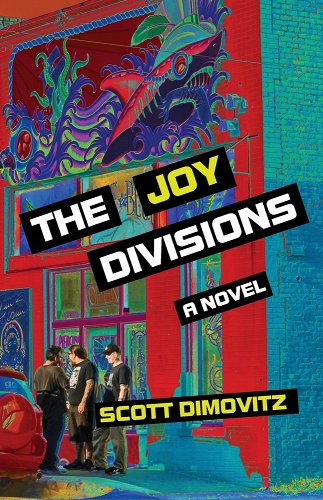
In Scott Dimovitz’s novel The Joy Divisions, Allentown, Pennsylvania, is not merely a geographic location or the novel’s setting. Yes, it is a place, but in Dimovitz’s book, Allentown is a living breathing entity, a character with a life and experiences entirely its own. The Joy Divisions draws on Allentown’s rich history as Pennsylvania’s third most popular city, fusing the city’s legacy as an early industrial hub with its economic denouement, which culminated in the early 90s due to the declining necessity for heavy industry throughout the Rust Belt. However, while Allentown’s early-90s economic decline is one of the novel’s major focuses, The Joy Divisions also captures working class attitudes regarding major Clinton-era post-NAFTA policies, the continued rise of cults in the 90s, and a careful look at a world standing on the brink of massive change.
One cannot read The Joy Divisions and not notice the important role of historic buildings. The author gives a great deal of attention do describing some of the city’s buildings. Some of the novel’s most beautiful and poetic passages emerge as contemplations of structures like the old textile and industrial buildings for which cities like Allentown are famous. The descriptions are also philosophical, describing buildings as “a palimpsest, a layered history of all the aspirations of those who plan, those who create, and those who live.” Accompanying the architectural and philosophical observations are lengthy, thought-provoking historical anecdotes about the building’s relevance to not only Allentown’s existence, but also the lives of Allentown’s inhabitants. One of the most intimate portrayals of this connection arrives when Ed, one of the novel’s main characters, tours the old Phoenix Clothes building with Stan, a shop steward, and his daughter, Joanie, a Penn State student writing her master’s thesis on Lehigh Valley labor history. Stan describes the building to Ed as “‘your history’” and the “very building” in which Ed’s parents met during the mid-60s. Thus, Stan and Joanie’s roles in the novel mirror the roles of the buildings in the novel: Stan represents the personal, working class connections Allentown residents hold to the area’s rapidly disappearing industries, and Joanie—in her academic role—serves as a means of historical preservation, much like the buildings themselves.
The Joy Divisions dares to descend into some fairly questionable territory in its chapters. One of the most taboo places to which its characters travel is into the realms of a cult led by Tod Griffin. Tod’s commune is a place where artists, musicians, and wayward and adrift folks convene, share ideas, and work together toward common goals. One of the novel’s darkest moments occurs when neo-Nazis appear at an art and music gathering in one of the old buildings, and it is revealed that Tod actually invited them. The situation devolves into chaos after attendees learn that the Kool-Aid is spiked with ecstasy. The scene, while gruesome, is necessary not only to the novel, but also to the overall contextual understanding of Pennsylvania at that point in history. While most of Pennsylvania managed to resist white supremacy in the 1990s, some rural areas—such as Potter County—have been historical and contemporary hotbeds of hate.
The state’s ties with white supremacy are also embodied in another character—Richie. Whereas Tod is a subtly terrifying character, Richie is more overtly terrifying. His house is adorned with questionable relics like “an American flag hanging next to a Confederate flag.” Ed perceives Richie as the type of person who becomes “more White-with-a-capital-W” the “blacker and more Hispanic his neighborhood became.” In one scene, Richie commands the family to “‘do a reading from a real American pilgrim’” and passes a copy of William Bradford’s Of Plymouth Plantation for each family member to read a passage. While The Joy Divisions is far from a humorous book, one of the most hilarious, and memorable, scenes is when Ed decides to read a section from “A Horrible Case of Bestiality” just as the family is about to eat a turkey.
Of course, the isolationist views of characters like Richie and Tod are what make The Joy Divisions a novel that could easily be set in any one of the states in the US today. In many ways, that should frighten us, because it shows that little progress has been made in certain areas regarding diversity, equity, and inclusion. Also, it shows that for the working class, foreign political and economic policy—and America’s role as negotiator, mediator, and defender—are controversial. The Joy Divisions is a philosophically heavy examination of Rust Belt America and the populations which shaped it. Much like Zachary C. Solomon’s A Brutal Design, Scott Dimovitz’s debut novel stands as a stark warning to us about the consequences of living in the past, rather than looking toward the future. Nonetheless, each and every page drips with nostalgia as the characters pursue not only a future beyond themselves, but also, perhaps, beyond Allentown.
The Joy Divisions, by Scott Dimovitz. New York, New York: Tailwinds Press, November 2023. 254 pages. $18.00, paper.
Nicole Yurcaba (Нікола Юрцаба) is a Ukrainian American of Hutsul/Lemko origin. A poet and essayist, her poems and reviews have appeared in Appalachian Heritage, Atlanta Review, Seneca Review, New Eastern Europe, and Ukraine’s Euromaidan Press. Nicole holds an MFA in Writing from Lindenwood University, teaches poetry workshops for Southern New Hampshire University, and is the Humanities Coordinator at Blue Ridge Community and Technical College. She also serves as a guest book reviewer for Sage Cigarettes, Tupelo Quarterly, Colorado Review, and Southern Review of Books.
Check out HFR’s book catalog, publicity list, submission manager, and buy merch from our Spring store. Follow us on Instagram and YouTube. Disclosure: HFR is an affiliate of Bookshop.org and we will earn a commission if you click through and make a purchase. Sales from Bookshop.org help support independent bookstores and small presses.
 Heavy Feather Review