
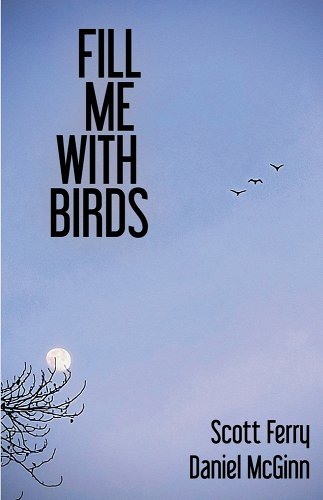
In some ways, Scott Ferry & Daniel McGinn’s Fill Me with Birds sneaks up on you. Ferry’s poems are usually brief, less than a page, with spare lines that eschew such trifles as capitalization and punctuation. McGinn’s work can be longer, but his straightforward, matter-of-fact style lulls you into a false sense of security. Make no mistake, this collection is a revelation. On the surface, this is a dialogue, a conversation between two poets. Sometimes the poems build on each other, and sometimes, they zigzag away to other topics, only to flit back again. The poems cover a wide variety of everyday, accessible topics: family, nature, work, illness, making soup. But within these topics, they tackle the big stuff: God, death, aging, time, fear. It’s a very clever sleight-of-hand. They lure us in with promises of commonality and then, presto—we’re staring into the Deadlights with them, trying to make sense of the universe, and ourselves.
The balance between the everyday and the eldritch is really the crux of the collection. Ferry and McGinn ask us to explore the binary, to stand on the narrow divider between life and death, between heaven and Earth, between past and present. In several poems, Ferry refers to the idea of splitting in half—edamame, a bivalve, a pupa, a “bisected tire,” even our mouths. It evokes thoughts of cellular division, of points and counterpoints, of openings and closings, of the soul escaping its flesh-and-bone confines. When we are free of our bodies, we become free of space and time. The collection opens with “i ask” (Ferry) and “The Six of Swords” (McGinn). Both have images of Charon and the underworld. Ferry’s searing, siren-song of a poem blasts us with holy light. It verges on cosmic horror, as Charon “unzips the blistered seed of his face.” McGinn’s poem speaks from the point of view of Charon himself in a way that is quieter, yet no less haunting. As Charon pilots our souls across the river, he says, “you are almost there / you were always there.” These poems are your only warning, telling you to buckle up; we’re going on a journey to a place where time has no meaning. And it’s thrilling.
The poets engage with the temporal and its lesser twin, memory. In “Buddha in the Deep End,” McGinn says, “I remember my life in the present tense / as if my life hadn’t unspooled like a ball of yarn …” This is the paradox of aging. The older we get, the further away the past gets. Yet, the older we get, the more we find the past intruding on our present. Both poets write about their elderly parents’ struggles with age-related memory loss. Ferry offers this beautiful and painfully accurate description: “half of the mind sometimes goes / into the afterlife already …” But in that sort of memory loss, as McGinn says, the past becomes the present again. We cling to what is familiar. We return to the scenes that we have traced over and over again in our hearts, in our minds, engraved on our psyches.
This paradox of time and memory affects how we see the world, and our place in it. In “The Weight of Dreams,” McGinn describes his elderly father as both Captain Hook and Peter Pan, both old man and child in the same body. Is this what becoming liberated from the strictures of time looks like? Throughout the book, McGinn, who is 70, struggles with his own Captain Hook/Peter Pan dilemma, “Clocks don’t tick any more, but I’m an old man. I can hear it.” In youth, everything is new. Sometimes it’s exciting, and sometimes, it’s frightening, but it’s all novel. Then, just when you get settled in, just when you feel like you’re becoming old hat at this whole life thing, bam. The world shifts. New generations are coming in behind you, erasing the world you knew little by little and replacing it with their own. And then one day, you don’t recognize anything anymore. McGinn closes “The Weight of Dreams” with his father reading the newspaper “… every day from cover / to cover, but he can’t remember a thing he just read.” For his father, everything has become unfamiliar again. No wonder it becomes so difficult to take in any new information. As for Ferry, his time / memory paradox often crops up as the division of soul and body. In “when i am let out of here,” he writes of “an opening an unzipping,” which hearkens back to the Charon image, a suggestion that our corporeal selves are a mask to drop, a suit we can strip off. It also suggests that all our past selves are still in here somewhere, and we can return to earlier versions, “all that is left is the me before any shame.” And what is lack of shame, but innocence—childhood? The Peter Pan persona. In “the face of god,” Ferry tells us God is “a child racing through the rain.” If we are large enough to contain this multiplicity, then God certainly is.
Years, distance, and maturity help us to understand our experiences better. On the flip-side, as we wander the labyrinth of life, we often find ourselves second-guessing our choices, grappling with guilt and regret. But unlike in an actual labyrinth, we can’t double back or retrace our steps. Ferry & McGinn look back at their youthful days of booze, drugs and rock and roll, and reflect on how far they’ve come. Now, they are both family men, both with caregiver jobs (a nurse and a teacher’s aide). Being sober and clear-headed allows them to appreciate beauty—these poems refer often to the beauty of our world, including the titular birds. Hummingbirds, seagulls, turkey vultures and crows all make appearances, as do multiple references to wings. Bird symbolism suggests both the soul and the soul’s journey, leaving our landlocked ways behind to soar up to heaven. They suggest, too, a bird’s eye view of the world, the ability to better grasp the long view, the big picture. It’s a greater understanding borne of experience. Yet, both poets still ask, is this purpose enough—getting clean, going respectable? Or is there more? I suppose once you’ve gotten your life together, you start to wonder what lies beyond this life. Predictability is nice, but it sure can be stifling. In “sometimes a holy man is a damned soul,” Ferry describes the day-to-day as “an engineered grave of lists / and shovels and rat traps …” The mundane kills us, and we are the curators of our own demise. But death itself is mundane; it happens to hundreds of thousands of people every day.
Which brings us to mystery. These poems peel back the layers of existence to get at what we don’t understand, at the things that make us question our reality. There are things like ghosts, Kirlian photography, Jesus’ third eye chakra. We see God in a Jack-in-the-Box drive-through. God is both the miraculous made mundane, and the mundane made miraculous. Again, Ferry & McGinn walk us through everyday situations juxtaposed with the uncanny. We’re all here waiting for God or Jesus or somebody to speak, to explain to us what this all means. But then, something happens, because it always does—school shootings, a parent with Alzheimer’s, testing positive for COVID. Such events, while not uncommon, show us just how precarious this all is. McGinn, who was raised Catholic, refers to Latin as his “first god language.” He describes it as something he memorized phonetically, but didn’t understand. I can’t think of a more perfect metaphor for our relationship with God—we can learn the sounds but not the syntax. In “In the Pines,” McGinn shows us how everything is everything: the sea and the sky, rivers and blood, oceans and the moon, our bodies. We are all water and salt. We are all star specks churning in a molecular stew. In a poem about his CPAP machine, Ferry speaks of being “on a type of life support / waiting to be brought / back to the glory …” This implies that heaven is a place we return to, an ouroboros of existence. The body is the bridge between our pre-life and our afterlife. It’s a tantalizing image, to think of life as just one big masquerade ball for the soul.
For better or for worse, while we live, our souls and our bodies have to coexist. These poems spend a lot of time discussing the body, exploring pain, our senses, mental and physical illness, and getting older. Ferry frequently uses body imagery, drawing upon his healthcare background. He often refers to the body in mechanical terms, “pipes and wires,” “my wet vehicle of pain,” “a coil of codes, “organs spinning with their / clockworks …” Our bodies themselves are great mysteries. We don’t fully understand how they operate, and they are capable of both extraordinary joy and unbelievable agony. We can lose our bodies all at once by dying, or little by little as we age and our health declines. Loss is the heart of fear—we are afraid of losing comfort, and the things and the people we love. Above all, we fear losing ourselves.
Of all the themes in this collection, the thread uniting them all is fear. In a book as spiritual as this one, fear can be good—fear in the sense of awe, like standing in nature or feeling the presence of God. Ferry writes about having to go on medication for anxiety. Both poets speak candidly about their worries and insecurities. But there are more visceral fears. In “The Lockdown,” McGinn describes a mass shooter drill with a group of pre-K special needs children. The children had been in the middle of rehearsing for a Christmas program. In other words, the children were practicing—for the holiday celebrating Christ’s birth, and for dodging death by gun violence, on the same day. (The irony writes itself.) But mainly, it’s a powerful commentary about fear. The kids are too young to understand how afraid they should be. Many of them are not verbal, so it’s also unclear if they will ever understand how death can pop up anywhere, anytime, with a rifle and a grudge. In Ferry’s response, he describes a man in an auto parts store, openly carrying a gun. Ferry talks about being afraid of shooters who, themselves, are so afraid, they can’t even go shopping without packing heat. Both poems reflect on how guns lead to silence—the silence of death, of course, but in lockdowns, we are advised to be quiet to avoid detection. Seeing someone openly carrying a weapon in public—that, too, implies we are to be silent, because to risk offending an armed person is to risk getting shot. Guns are the ultimate tool of anti-communication. People who carry guns often mistake themselves for God, the ultimate ghost-maker.
In the four concluding poems, the poets reflect again on returning to childhood and innocence, on being birds. They hint at ghosts with such lines as “i am a body falling out of a body” (Ferry) and “I can hear you in the leaves” (McGinn). In the former, there is comfort in the notion that we are more than this earthly form, this lifetime. In the latter, there is comfort in the notion that after we’re gone, there are people still listening for us beneath the murmur of rivers and the hum of dragonflies. Poetry and life have the same goals—to ask questions, to gain understanding, and to connect to our fellow humans. What insights we gain can grant us peace. In filling ourselves with birds, we can regain a little bit of heaven. In filling ourselves with poetry like this, maybe we can find our way back to ourselves. Ferry & McGinn are at the top of their game here. They give us poems that are beautifully-wrought, transformative, and profound. They bring us something more important than mere beauty or even comfort—they bring us truth. They give us a shot at grace.
Fill Me with Birds, by Scott Ferry & Daniel McGinn. Holyoke, Massachusetts: Meat for Tea Press, January 2024. 104 pages. $16.95, paper.
Lauren Scharhag (she/her) is an award-winning author of fiction and poetry, and a senior editor at Gleam. Her latest poetry collection, Moonlight and Monsters, is now available from Gnashing Teeth Publishing. Forthcoming are Ain’t These Sorrows Sweet? (Roadside Press) and Screaming Intensifies (Whiskey City Press). She lives in Kansas City, MO. More: linktr.ee/laurenscharhag.
Check out HFR’s book catalog, publicity list, submission manager, and buy merch from our Spring store. Follow us on Instagram, Bluesky, and YouTube. Disclosure: HFR is an affiliate of Bookshop.org and we will earn a commission if you click through and make a purchase. Sales from Bookshop.org help support independent bookstores and small presses.

