
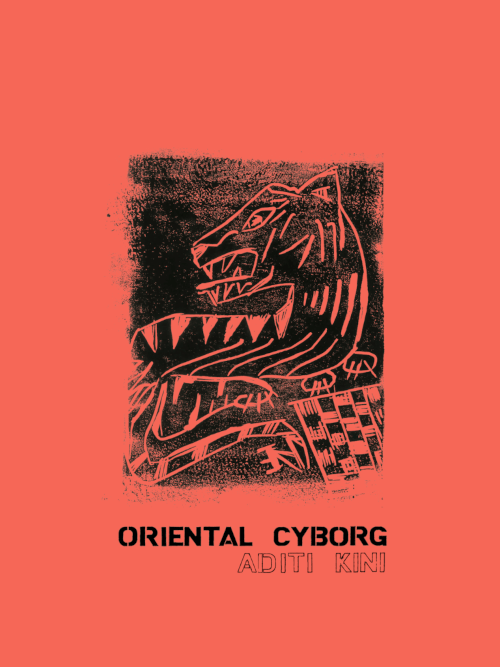
Aditi Kini’s debut chapbook and winner of the 2021 Essay Press Chapbook Prize, Oriental Cyborg, is material but also imaginary—as in, image based, as in, an invention. As in, an invention with material repercussions. Under cyborg operatics the body is an invention for labor and to toll away: specifically a body coded in, and of, the Global South. An inventory is made. And the inventory fares as a layered epistemology. An inventory is also a counting; simultaneous reproduction alongside individualist manifestation of experience.
What does it mean to have a face and an identity in a contemporary neoliberal market? To have face value. “Elon Musk was named Person of the Year 2021 by TIME. Since then, he has bought a social media platform. Now he is the CEO of three companies … A corporation can be a person but a remote worker has no face” writes Kini. The Oriental Cyborg is an invention, a continuation of Western technology and the Western gaze; humanity discordant based on globalists perspectives and colonial tactics. Although Donna J. Haraway writes in “A Cyborg Manifesto” of the cyborg as an “illegitimate offspring,” in Kini’s text the cyborg is treated less as a future transgression, and more in the lineage of Western ontology’s invention of labor. According to Fuchs and Sivignani, “In the Marxist tradition, the word labour has been associated with alienated and exploited work, a historical category, as opposed to work, an anthropological category, quintessential to the human species.” Although not formally spelled-out, Kini’s attention to work vs. labor is sprawled out in the mechanics of their work as a baseline to considering neoliberalism and colonialism.
The Oriental Cyborg is a contemporary version of a technological projection upon the Other as worker. Who gets to labor, from which standpoint? “Pedagogy works in tandem with the economy / The economy is all about demand baby / Babies are learning to code in India” asserts Kini. Pedagogy, too, becomes an invention, inventing the human machine. The cyborg in Kini’s text is a body of labor; a body infused with labor. Of production value. They are a projection of the West’s ideology and image, an image born out of the West’s hunger, desire, insatiable wanderlust for so-called authenticity and adventure. The Western desire to be serviced and served, but untouched by the repercussions fruiting in capitalisms’ hothouse.
Oriental, or the Orient, harks back to Edward Said’s notion of Orientalism; the European invention of the Orient, Oriental identity, and the Other, reflects the shadow desires of the European middle and upper class. The Other became a projection of European fears, and trepidations of self. “Rendered invisible through nation-state documentation or technological intervention, / the Oriental Cyborg is a reminder of the / continued colonization of the body / one that festers, replacing atoms, turning one into metal and machine,” continues Kini.
This colonization of the body is exemplified by Kini while thinking through literal technological inventions. One important example lies in the automaton. Automata are robotics inventions of the 18th century. Mostly their function was rendered to please and entertain.
We are first introduced to the Mechanical Turk, whose traveling body is used to play chess against opponents for a spectating crowd; his left arm is mechanized to move chess pieces or gesture towards the opponent. The Turk, dressed in a turban and robes, was invented and constructed by the German, Wolfgang von Kempelen, for Maria Theresa of Austria’s court. The Turk’s stupendous chess playing was an illusion devised by a man sitting inside the interior of the contraption. The chess master, presumably European, plays a game first invented in India, controlling the body of the Turk, whose image is an invention of the Western imagination.
We are then met with a Tipu’s Tiger, currently displayed at the Victoria and Albert Museum in London, a large automaton of a tiger mawing a British soldier outfitted in a red coat and a black, wide-rimmed hat. An organ is built within the tiger, adjusted by a golden crank outside its wooden body. Rotating this crank enables the soldier’s yelp and the Tiger’s roar. The Tiger, whose sounds and labor are enacted against the British soldier—commissioned by Tipu Sultan, who resisted the British forces, fought four wars, and was finally defeated, “His living big cats—killed”—is powered by French watchmaker technologies, the latest available at the time.
Labor and its invention fine tunes much of this work; this work itself has been compounded by the conditions of labor. Kini’s own situated knowledge “presented in Oriental Cyborg is a product of where I was in my life (in a Zoom University MFA, taking technoscience literature classes, reading of Frankenstein, dreaming of Frankenstein, watching Metropolis and Her and Ex Machina, losing my cousin and thinking about her niece’s English schooling),” they write to me in an e-mail. The book’s form defies genre, inculcated with influences beyond the literary essay, poetics, and theory. It is a single poem, or a fragmented constellation essay. Yet, it is also a dialogue between words and images; art and science; the real and the imaginary.
Kini’s print images, produced by their hands in the print studio, a practice they began while living and studying in San Diego for their MFA, accompany the written text. Letterpressed linocuts of the Turk’s arm, as well as Tipu’s Tiger next to a chess board, on the cover and within the pages, become a textual collaboration representing the labor of the author themselves. Kini’s own labor, although photocopied and reproduced, fills the body of book, as well as the exterior cover.
Oriental Cyborg, by Aditi Kini. Buffalo, New York: Essay Press. $12.00, chapbook.
Born in Kyiv, olga mikolaivna works in the (intersectional/textual) liminal space of photography, word, translation, and installation. She is interested in memory, dream spaces, absences, inheritance (dis)place, and the construction of language. Her work can be found in Cleveland Review of Books, LitHub, mercury firs, and elsewhere. She is getting her MFA in creative writing at UCSD, and her debut chapbook cities as fathers is available through Tilted House.
Check out HFR’s book catalog, publicity list, submission manager, and buy merch from our Spring store. Follow us on Instagram and YouTube. Disclosure: HFR is an affiliate of Bookshop.org and we will earn a commission if you click through and make a purchase. Sales from Bookshop.org help support independent bookstores and small presses.
 Heavy Feather Review