
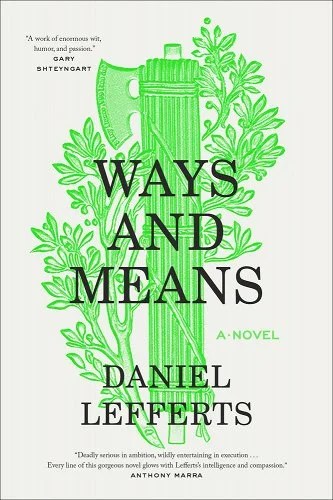
In 2016, Alistair McCabe’s dreams of a fantasy banking job have fizzled. His paramours, an older gay couple named Mark and Elijah, are facing a breakup due to financial and emotional fizzles. America—rife with Donald Trump’s fiery, and at many times nonsensical, rantings—teeters toward a breaking point. Meanwhile, Alistair finds himself running for his life when the shady dealings of an elusive billionaire for whom he works turn on Alistair himself. Ways and Means takes a clinical look at America’s wealthy populations, the effects of abused generational wealth on humanities and society, and the ever-shifting definition of family in the United States.
From its very first pages, Ways and Means focuses on what truly makes American society go ‘round—capitalism. Alistair’s own academic career is a testament to capitalism’s demands and influence on how Americans define and live their lives. Alistair does not, by any means, live a lavish lifestyle, and unlike many of the other characters in the novel, he is not privy to generational wealth, and he serves as a necessary juxtaposition to characters like Mark and Elijah. Alistair is burdened by student debt, and after leaving JP Morgan Chase “in his offerless shame,” he resorts to working for an elusive billionaire. Sadly, Alistair’s self-chosen path bears an ominous resemblance to the one chosen by his father in the name of quick money and the hope of a better future for his family. Thus, Alistair’s murky family circumstances, which influence his present choices in the novel, emerge and establish the theme of generational cycles in the novel.
These cycles become even more relevant for characters like Mark, who, as his trust fund nears zero, panics. Mark received the money—a total of $995,000—from his father. The sum is significant to the novel’s capitalistic themes, because Mark’s father believed his sons should earn their first million themselves. However, rather than earn money to add to the trust fund, Mark and Elijah embark on living a lazy, luxurious weekend that ends only after eight years. Elijah even sacrifices his meager, freelance graphic design work and painting as part of his and Mark’s journey. Thus, by initially portraying Elijah, the novel challenges the “starving artist” trope. Thanks to Mark and his wealth, Elijah is not starving—nor is he an artist. His artistic ambitions dissipate under Mark’s influence, because Mark and Elijah’s carefree, responsibility-free lifestyle does not encourage work, and Elijah’s art becomes a form of work for him.
Jay is another artistic character who also defies the “starving artist” trope. A friend of Elijah’s, Jay is an artist provocateur who thrives on the anger inherent in Trump loyalism. One of the novel’s most disturbing moments is when Jay makes Elijah pose, wearing a “Make America Great Again” hat. Jay’s actions, despite his description of them as “fun,” are malicious and hurtful to Elijah. The scene is particularly eerie as we recognize how Jay’s actions actually serve as a metaphor for Trump’s entire platform, one that thrived—and as Trump bids for candidacy for the 2024 Presidential Election—and thrives on crush-the-vulnerable rhetoric and policies. Later in the novel, Alistair contemplates the media’s role in elevating Trump. Alistair observes that Trump “continued to inundate the country with deranged invective, and the media, fascinated with its indignation, continued to magnify his voice.” Alistair’s observations are superficial, but they are also necessary, as they echo the sentiments of millions of Americans who endured the rhetoric which apparently appealed to the majority of voters in 2016.
Amid the political anecdotes and social commentary regarding wealth’s corruption of the art world, the novel also focuses on the ever-changing definition of family in the United States. This is most apparent in the novel’s portrayal of the relationship between Mark, Elijah, and Alistair. While Mark and Alistair thrive in coupledom, Alistair is an addition to their relationship. He frequently recognizes how he is an “extra” in Mark and Elijah’s domesticity. However, it seems, at certain points, that the couple cannot exist without Alistair’s presence. Because of Alistair’s youth, Alistair becomes the nucleus holding the relationship together. His youth, and the financial, sexual, and emotional opportunities that youthfulness offers, is a fixation for Mark, who eventually recognizes that he is in love with Alistair.
Ways and Means is a truly complex novel. Its character sketches and plotlines densely weave together. However, the novel’s complexity truly serves a function. It mimics the seemingly inescapable scenarios in which each of the characters find themselves, and it mimics the generational ties that those characters are hesitant to break. More so, the structural and linguistic complexity mirrors America’s sociopolitical chaos stirred by a man whose presidential and post-presidential influence continue to stoke white, rural rage and bring America to fascism’s brink. In other words, Ways and Means is a novel for the new and frightening America, where turbo-capitalism and economic privilege reign supreme.
Ways and Means, by Daniel Lefferts. New York, New York: Overlook Press, February 2024. 400 pages. $28.00, hardcover.
Nicole Yurcaba (Нікола Юрцаба) is a Ukrainian American of Hutsul/Lemko origin. A poet and essayist, her poems and reviews have appeared in Appalachian Heritage, Atlanta Review, Seneca Review, New Eastern Europe, and Ukraine’s Euromaidan Press. Nicole holds an MFA in Writing from Lindenwood University, teaches poetry workshops for Southern New Hampshire University, and is the Humanities Coordinator at Blue Ridge Community and Technical College. She also serves as a guest book reviewer for Sage Cigarettes, Tupelo Quarterly, Colorado Review, and Southern Review of Books.
Check out HFR’s book catalog, publicity list, submission manager, and buy merch from our Spring store. Follow us on Instagram and YouTube. Disclosure: HFR is an affiliate of Bookshop.org and we will earn a commission if you click through and make a purchase. Sales from Bookshop.org help support independent bookstores and small presses.
 Heavy Feather Review