
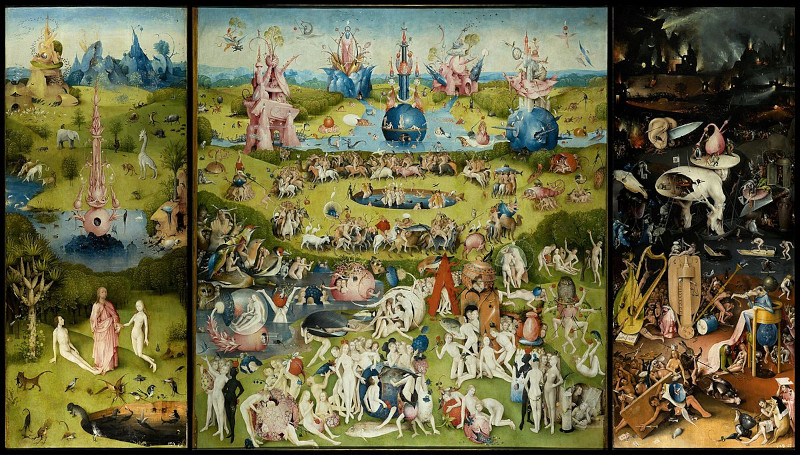
In the garden, the monsters bloom. Stems and vines trendil over and under, through and back, vibrating to the rhythm of a dance that has no rules. There are no plaques here, no little hand-painted signs segregating herbs from flowers from vegetables. Anonymous to others, but we know their names. Martha has a little list. In her cramped hand, ink-smudged crossways, she records. Jimson and nightshade. Lily of the valley and ricinus. Foxglove and dieffenbachia. Lined up like little tin soldiers in the columns she sketched on the flyleaf of my baby book, together we watch their movement. Together we strategize, moving battalions into position according to the seasons and the waxing and waning of the moon. The most seasoned veterans, the deadliest infantry we disguised with giant clumps of collards, with the sprawling and prickly vines of blackberries.
On chilly nights when our breath hangs in the air, or on hot nights, waiting for the sun to set, the sweat dripping down our backs, we enter the lines, baskets in hand. Martha tells me who and where to cut. She hands me her old pair of gloves, smaller for my slim fingers. Not all our monsters want to be touched, she reminds me. I have served as her assistant for several years; I know which plants are friendly, and which are not.
We pick and trim. We gently lay the clippings in our wicker baskets. We stumble back into the house before sunrise, sleep pulling at our eyelids. The next day we hang the monsters to dry. We squeeze others, dark juice gathering in pots that we pour into little glass bottles. Some monsters require distillation. I help Martha drag out her still, and for days steam clouds the downstairs.
I worry the steam will turn away our customers, but Martha knows better. She just fans the clouds in front of their faces as if they were a pesky fly someone let in. She takes them by the hand, and guides them around the still, through the maze of hanging monsters, to the dining table so she can get to the root of their problem. Mostly, these meetings are short. Common issues like an unwanted child, neighbor cats that destroy prized azaleas, or how to induce sickness to avoid jury duty, are our main trade. But occasionally, Martha is closeted away for much longer. On those days, I sit behind the counter, pouring over rows of inventory, straining to catch snippets of the conversation on the other side of the door. Generally, the thick wooden door means I’m not successful. But one day, Martha leads a woman wearing a short wool coat past me into the dining room.
After Martha pours her the courtesy cup of tea, the woman launches into her story. The blood is pressed out of my ear as I strain against the door, hoping to hear something.
“He always says he’s sorry, that he won’t do it again but …” the woman says after moments of silence.
“But he always does, doesn’t he?” Martha asks, teaspoon clinking against the rim of her cup.
“No one believes me. He always has a story rehearsed. And they all buy it, every time. I tried living with my sister.”
The woman is crying now, the wails of a wounded animal that take my breath away. Her fists are pounding out a rhythm on the table. Thump … thump thump … thump thump thump. Martha must have grabbed her hands because the pounding stops. I wait for more; I can hear my heartbeat woosh in my ears. But there are only muffles on the other side of the door.
Later, when I’ve retreated behind the counter, Martha emerges from the dining room, leading the woman. She pates her hand before opening the shop door. “In two weeks, don’t forget,” she tells the woman who nods quickly. She won’t forget. I’ve seen that look of desperation before, though never as intensely as is written on her face. She will be here in two weeks; she’ll probably be early.
Before I can probe for details, Martha is pulling down my baby book and a leather-bound notebook from the top shelf. She holds up a hand when I begin to ask her about the woman. “I need tea, extra-strong,” she says, head already buried in her smudged notes.
She’s assembling the troops. Regiments are directed to the left, the right, and the rear, organized by efficacy, symptoms, and absorption. Companies are shifted to supplement the regiment of tiny red berries or the one with leaves so dark they appear black. She goes down the little list making amendments and creating generals and majors from once humble corporals and sergeants. She is sparing, she is ruthless, but she is also right.
So, I make the tea extra-strong. It’s as black as ink when I pour it into the teacup. The blue willow pattern is faded in places, and the cup’s handle is spindly, so delicate I don’t understand how it’s still intact. I expect Martha to grimace when she tastes the tea, to tell me she didn’t want it that black, but it’s as if she doesn’t even taste it, just bolts it down before I pour her another cup. I sit on my matching stool behind the counter, waiting for enlightenment.
The sun sets and the shadows in the shop lengthen. The cabinets behind us and the jars behind their glass doors become murky, obscured despite the cut-glass lamp hanging overhead. My stomach is rumbling beneath the black apron I wear and I’m thinking about the eggs in the kitchen and a loaf of fresh bread a neighbor brought this morning when Martha finally closes my baby book.
“We have work to do tonight,” she says.
It is a terrible night for this kind of work. The wind howls through the garden, drowning out our voices. We communicate by hand signals. Martha makes cutting motions with her fingers when she wants the shears, I point to plants and she shakes her head “yes” or “no.” The rain begins halfway through, pelting my rain jacket and entering through the gap between the detachable hood and collar. Martha’s wet skirt clings to her legs, revealing every sinew and the depression in her thigh where she had a cancerous mole removed.
But Martha’s military eye never wavers. Even amidst a deluge, she reviews the troops, measuring their growth, checking the size of last year’s blossom against this year’s. She directs me toward a bigger, juicier berry when I opt for the cluster nearest me. Stern, but without malice, she yanks the shears out of my hands when I make to cut a spiky white flower and shoves me toward a shaft of purple foxglove. I am a young recruit, barely a private, but I must learn.
That night, after our little monsters are put to bed in the distiller, the hook that hangs from the ceiling, or in the presser under a heavy weight, we eat. The eggs and the bread make an appearance on the dining table. But there are other guests. Martha produces delicacies. Pineapple and strawberries, both out-of-season. Thinly sliced ham she fries next to the eggs. Small squares of cake covered in thick frosting she calls petit fours. To drink, she mixes wine and fruit in a glass pitcher. She squeezes in a few drops of a plant we distilled weeks ago. “To help us sleep,” she says with a wink.
We eat like gluttons, gorging until our minds are clouded. Our unholy feast is presided over by the little monsters, Mammons, and Molochs in their own right. At some point, the cut-glass lamp dims, and the table slopes down toward me. The remnants of our feast are sliding into my lap, or past me crashing onto the floor. I am covered in egg yolk, and fruit juices coat my hands and make my fingers stick together. Martha steps over the mess that surrounds me and pours me another glass of wine. She holds it up to my mouth and I drink, drink … drink it all down.
The room swims before me as I slide to the floor. My lips touch a fallen strawberry; it is wet with wine. I take it like a nipple between my lips, sucking until the smallest bit of pulp remains. Martha is stroking my head, and humming something that sounds like a march. The cadence rises and falls, and repeats. Martha’s lips are stained with wine too, but she sits upright, without the slightest sway. With one hand, she lifts my arm, with the other hand she holds something shiny and pointed at the end.
Martha is standing over me when I wake up the next morning. I’m still on the floor, my arm wrapped around the leg of the dining table. My head throbs and the crook of my arm is tender to the touch. A purple bruise spreads from the cluster of blue veins opposite my elbow. There is a little red dot in the middle of this royal contusion, an X marking the spot of something I only remember in snatches. Martha telling me not to move … the dregs of my wineglass running down my shirt … the sound of suction.
“Can you stand?” Martha asks, offering her arm.
I struggle to my feet, grabbing Martha’s arm when the room spins. My eyes travel up and down the length of her tanned skin, searching for a comparative bruise or little red dot. Her engagement map is a clean slate. No battles, troop deployment, or lines of entrenchment.
“I need to show you something,” she says, steering me toward the shelves of jars.
When I am seated on a stool at the counter, Martha retrieves a key from her pocket. She opens the largest drawer in the cabinet where we store packets of dried herbs and flower petals. A second later, she pulls a secret drawer out of the darkness.
Martha lays the drawer in front of me and gestures for me to examine it. I see tiny bottles, envelopes, and plastic bags in the shallow interior. A label accompanies each container, but I don’t recognize the markings.
“My own system,” Martha explains.
She arranges the items into rows on the countertop. I wait for her to explain, flicking the peeling labels with the forefinger of the arm that bares the evolving bruise.
At last, Martha lifts the last object out, a minuscule vial with a viscous red substance clinging to the interior. Martha swirls the contents and holds the vial up to the light. Whatever she sees seems to satisfy her because she nods and lays the vial alongside a packet of dirt.
“Most, but not all of the remedies we make, come from the garden.”
I touch my arm, unaware of myself until Martha nods and reaches out to touch the bruise. She is gentle, her fingers barely brush the darkened flesh. The hairs on my arm stand up like they did last night in the garden during the rain. Martha smiles and removes her fingers.
She begins a roll call of sorts.
First menses … meconium … corpse hairs … goofer dust … dying breath … mosquito saliva. This list is exhaustive, and Martha pauses after each ingredient to gauge my reaction.
“And of course, this,” Martha concludes, holding a tiny vial above the rest. “Some think it’s the most important of all.”
“And you?”
“It depends on the donor. But come on, ask the question you really want to ask.”
“Why mine instead of—”
“Mine?” Martha looks at me sideways, anticipating my reaction. “The donor can’t be willing, not as powerful that way.”
Of course not. The grotesque collection sitting between us is a collection of violations, their dark energy pulsing until I feel a throbbing in my fingertips which I know isn’t from all the wine I drank. My head is buzzing; I can’t hear Martha as her lips move. She seems to understand and refills the drawer and closes the cabinet.
The room comes into sharp focus. My stomach feels uncertain, and I massage it with my left hand. I want to lash out at Martha, to take the vial and smash it against the wall, tell her to find another victim. But something in Martha’s expression stops me. Is it a plea for patience? Martha has always conducted everything in our day-to-day lives; a request, even one barely communicated, is an aberration.
“Wait and see,” Martha says, again touching my arm.
So, I wait. While the other monsters spread their beastly leaves and open their noxious petals. During sunny days that scorch while we flood the garden with water, and cloudy days when the thunder rolls and rattles the cabinet containing all our jars. As the remedy matures, I keep a keen eye on Martha, ready to dodge any further attempts.
The day finally comes. The woman arrives and Martha flips the closed sign to open, locking the door behind her. The woman is sporting matching black eyes when she removes her sunglasses. Martha presses an opaque jar into her hands and in return receives a bulging envelope.
“All of it. Remember?” Martha says.
The woman nods. She winces as she dons her sunglasses, the metal frames grazing her bruised eyes. Her hands tremble as she pockets the jar, and Martha must open the shop door for her.
A week later, Martha is reading the newspaper while I weigh some dried oleander. She spreads the obituary section in front of me and points to a short paragraph about the sudden, accidental death of a man who lived on the other side of town.
“Want to go to the funeral?” She asks, a smile forming at the edge of her lips.
I do.
Jordan Dilley lives and writes in Idaho. She has an MA in literature from the University of Utah. Her work has appeared in the Vassar Review, Heavy Feather Review, Anti-Heroin Chic, and Loch Raven Review, as well as other publications. Her 2022 short fiction piece “Lani in the River” was nominated by JMWW for a Pushcart Prize.
Image: wikipedia.org
Check out HFR’s book catalog, publicity list, submission manager, and buy merch from our Spring store. Follow us on Instagram and YouTube. Disclosure: HFR is an affiliate of Bookshop.org and we will earn a commission if you click through and make a purchase. Sales from Bookshop.org help support independent bookstores and small presses.
 Heavy Feather Review