
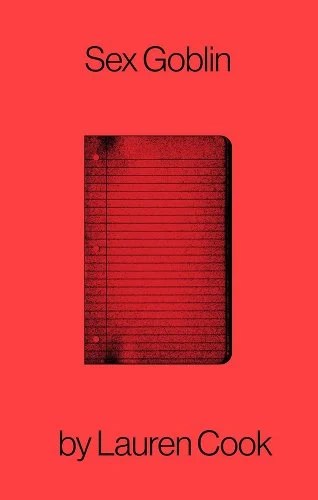
Oftentimes, Sex Goblin feels like a lustrous alternative to the doomscroll. Non-narrative vignettes—which all utilize an “I” that assumes different lives and situations in each “story”—are transitioned between with short lines that read both like brilliant tweets (“We don’t have to ride or die we can just chill”) and like aphorisms (“The human brain didn’t evolve to perceive truth / It evolved to survive the most effectively / They are not the same thing”). These shifts are sudden but successful, in part because they share a carefully developed voice that’s dryly funny, matter-of-factly reflective, and full of exacting yet expansive detail. In this sense, Lauren Cook has created a cohesive anti-cohesion. Sex Goblin perhaps—at face value—mimics the randomness of information and stories you imbibe while scrolling through social media, but Cook harnesses that experience by examining each seemingly unlinked vignette and prophetic, tweet-like moment until a through-line of irrevocable, unavoidable humanity arises.
The result is a book that’s polyvocal, poly-corporeal, and full of moving, quiet optimism that shines through the mud of self-loathing, fear, shame, and the burning desire for an impossible emotional remove that might anesthetize us from the inevitable suffering of being alive. As Cook puts it: “If you were a bad person why would God reincarnate you as a bug? To be a human is ultimately the most an animal can possibly suffer on this planet. Humans spend their entire lives trying to have what bugs have. You have a forty-dollar co-pay for mindfulness training so maybe one day your mind can come close to the lack of existential back-and-forth an insect has.” And as he puts it on another page (wherein you can easily place yourself in the role of “lover”): “There’s something I want my lover to understand … I know I make fun of everything. So, I think you get scared I’m going to make fun of you. But I’d never really make fun of you. If I thought you were stupid and annoying, we wouldn’t be here.” Even amid wry observations of the existential nonsensicalness of being reincarnated as a bug for punishment, Cook wants you to understand that, if you say or think something dumb, and he makes a sharp takedown of it, it’s not without an undercurrent of love.
A handful of the vignettes tell stories of outcasts, including a boy named Peter who fails to fit in on his first day of school and an unnamed narrator whose beloved family dog becomes permanently attached to her chest in a car accident. Cook’s ability to work through narratives that are sometimes grounded and sometimes bizarre—but always notably original—makes the vignettes exciting. Where will a graphic description of a dog’s bones infused into a girl’s body lead us? What will happen when Peter wears the fur suit that he made out of roadkill to school?
These are some of the moments in which Sex Goblin beautifully narrates the experience of being queer. Having a dog-chest becomes a metaphor for the plague of the body’s publicity when your corporeal existence is interpreted as an oddity, something to stare at or fear. Putting on the fur suit—wearing a piece of clothing you truly love, displaying the self you’re most radiant as—bears the risk of ridicule. And these characters, in their vignettes, do get ostracized and ridiculed. But Cook places them there, on the page, unerased.
Then there’s a fabulous moment toward the end of the book in which a privileged, macho frat-recruit is getting hazed. The upperclassmen make the recruits have anal sex with one another. The narrator and his top slowly and quietly begin to feel a warmth for the act of sex and for each other. The frat boys notice and jeer at them. The narrator thinks “I bet they had never seen real gay sex at their hazing before. Actually, there is no way that is true. These faggots love being gay too. It is all a lie.” Yes, the necessity of fearing and stamping out queerness, as well as the horror and shame around desiring and having sex, is indeed a lie, one that, in Sex Goblin, Lauren Cook moves within and outside of to reveal a dazzling tenderness. This book moves beyond and between binaries and boundaries, de-prestiging an “I” by making it at once everyone and no one, much like the ever-accumulating “I” of the internet, and arrives at a characteristically blunt yet vulnerable question after 178 pages: “Not to be overly short but maybe you can relate?”
Sex Goblin, by Lauren Cook. Brooklyn, New York: Nightboat Books, May 2024. 184 pages. $16.95, paper.
Oli Peters is an MFA candidate at the University of Notre Dame. She is based in the Midwest.
Check out HFR’s book catalog, publicity list, submission manager, and buy merch from our Spring store. Follow us on Instagram and YouTube. Disclosure: HFR is an affiliate of Bookshop.org and we will earn a commission if you click through and make a purchase. Sales from Bookshop.org help support independent bookstores and small presses.
 Heavy Feather Review