
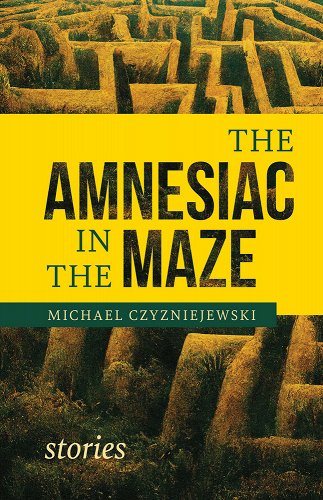
According to T.S. Eliot, we supposedly read “many books because we can’t know enough people.” Having experienced (and enjoyed) Michael Czyzniejewski’s stories over the years, I’ve always believed Czyzniejewski agrees with Eliot. After reading his most recent collection, The Amnesiac in the Maze, I no longer need to believe; I know. I think Czyzniejewski would add to the Eliot, however, that it’s not enough to be acquainted with folks, we must care about them, no matter who they are. Unsurprisingly, then, The Amnesiac in the Maze contains a vast array of characters, including hypochondriacs, daredevils, glass eaters, ventriloquists, atheists, bigamists, inventors, time travelers, vegetarians, vegans, and, yes, even murders, pyromaniacs, cannibals, sex offenders—and many, many more, including ones who aren’t even from this planet. Now, what has always amazed me about Czyzniejewski’s work is that no matter who he happens to be writing about, he can make you empathize with them, though you might not condone what said characters are doing or have done. It is in this book, though, that Czyzniejewski puts forth why we must empathize with everyone.
Of course, some characters are easier to empathize with than others. In “The Time Traveler Laments,” the protagonist accidentally eliminates pineapple from all of history, leaving her (and only her) with a permanent, unquenchable yearning. Why “only her?” Because no one else has ever heard of or experienced pineapple thanks to the “A Sound of Thunder”-like accident in the story. Here we are left to ponder all of those things that have vanished from our lives forever, or fear the vanishings to come, while perhaps dwelling on our feelings of guilt that might not be comprehensible by others. And yet, though others might not understand the specifics, certainly they can understand the nebulous guilt. Now, whereas the time traveler is at least a little culpable for her predicament, “The Manic Pixie Dreamgirl Stops Dyeing Her Hair” focuses on someone who was prescribed her role and now she’s sick of it: “For once, she wants to meet somebody who’s just as interesting as she is. She’s tired of pulling meek loners and aspiring sociopaths out of their shells.” This exploration of literary types and labels we stick on people, which pervades The Amnesiac in the Maze, shows that too often we’d prefer to strip the humanity away from others and replace it with a simple, understandable simulation. By giving us these characters’ inner lives, along with their wants and dreams, Czyzniejewski proves everyone is more complicated than we tend to think, an important statement because we always claim to understand that, while embracing general types at the first opportunity. “The Cuckold Seeks an Explanation,” then, lays out for us that the good guys and the bad guys in a broken relationship might not be who we think they are, but it does so by questioning the very idea of goods guys and bad guys in the first place. And whereas these stories, and others, rarely go where we expect, they all reach for a humanity that might help bring us all together.
And when I say all, I do mean all. In stories like, “The Hypochondriac’s Husband Has Munchausen’s” and “The Hemophiliac Engages the Glass Eater,” the characters’ conditions or situations are so specific, in a lesser writer’s hands, we might end up gawking like we would at a sideshow. Czyzniejewski, however, always dives to the root of what’s going on, showing us no matter how strange we may initially find certain people, their motives are ultimately comprehensible if we’re willing to jettison our preconceived notions: “Life wasn’t always like this, for the hypochondriac or her husband. For years the couple lived the life of a normal couple.” What happened? The hypochondriac gained an intense fear of death after being sneezed on by a corpse (one of the many ways, as it turns out, that corpses can surprise us), while the husband likely developed Munchausen’s to feel what his wife thought she was feeling. Again, this setup could be used as the beginning of a joke, but Czyzniejewski brings the characters to life, exploring ideas of mortality, anxiety, and dedication. A similar impulse appears in “The Hemophiliac Engages the Glass Eater.” Here, the couple plans to pledge their love for each other by doing that which they should not do (cutting himself and actually eating glass, respectively). Whereas neither of these actions is actually necessary, once the challenge is set, the two know they must prove their devotion to the other. Many of the characters in Czyzniejewski’s stories go to great lengths to connect with each other, which ends up making them seem “normal,” no matter how bizarre, or at least statistically unlikely their situations might be.
It is less easy to empathize with the protagonist of “The Killer Always Returns to the Scene of the Crime” because, well, he’s a murderer. Not a hitman, or assassin, or rogue cop/private detective/ex-soldier who hunts villainous cretins. Nor is he Dexter or the later version of Hannibal Lecter (who, at times, we’re encouraged to root for … confusingly, in my opinion). No, he’s a straight up murderer. After he’s invited to the middle of nowhere to hang out with his mountainous co-worker, the narrator tells us, “What’s tempting about Tiny’s offer is, I think I’d like to kill Tiny. It’s what I do on the side. A few people a year, eight altogether so far.” Only very early in the story, the protagonist realizes that Tiny might not be the one in danger. Tiny, as is already obvious, is enormous. And he’s really into violence. His trailer is absolutely covered in the skins of dead animals, some nearly as big as him. The reason he lives in a trailer on his vast property is because he accidentally set his old house on fire. Before that, he found a gargantuan machine gun that used to belong to his grandfather; he uses it to blow holes in the six junker cars scattered on his land. Yes, when the story begins, we’re leery of the narrator. As it continues, though, I felt more and more afraid for the protagonist. Shouldn’t I, I don’t know, not care? Shouldn’t I revel in the possible destruction of this murderous main character?
No, says Czyzniejewski. And nowhere is that more apparent than in “The Daredevil Discovers His Doppelgänger.” In this story, Danger Dan is like Evel Knievel if Knievel were a better person. Honestly, although not a saint, Dan hasn’t really done anything bad in his life. He rides motorcycles, does his tricks and jumps, hooks up with any willing ladies in town, jumps back in his bus, and does it all again when he reaches the next stop. Except, at the beginning of “The Daredevil Discovers His Doppelgänger,” Danger Dan finds out that in this burg, there’s someone who looks exactly like him, someone the entire town reviles: a pedophile. Thanks to this resemblance, Dan’s bus gets ransacked and he gets hauled in to the police station. Luckily for him, the sheriff is a fan and realizes the bizarre coincidence. Things get better for Dan, until he comes face to face with his twin. But what should Dan do? And by extension, what should we as readers do? Should we cheer for the demise of the killer from “The Killer Always Returns to the Scene of the Crime” and the pedophile from “The Daredevil Discovers His Doppelgänger?” If we don’t cheer for their respective demises, does that mean we condone their behavior? No and no. First, Czyzniejewski shows throughout The Amnesiac in the Maze that we should always empathize, that we should always look for the humanity in others and in ourselves, or risk losing it. Second, while empathizing, we should also hope those who need help can get the help they need, we should also hope that when someone does something terrible, they should be confronted by a dispassionate justice system, not a potential lynch mob like the one Danger Dan has to deal with.
In “Everything and Nothing,” Jorge Luis Borges puts forth the idea that Shakespeare was everyone and no one because, having been so many different characters, there’s no essential identity to Shakespeare himself. In The Amnesiac in the Maze, and especially in the title story, Czyzniejewski shows that he is similar. After all, the main character in “The Amnesiac” has no long term memory, no name, no identity. Each person he meets in the maze is someone he’s never met before, and he therefore must go about understanding them. I argue that’s how Czyzniejewski approaches his characters. And I think, in his plea for empathy, along with agreeing with Eliot, that Czyzniejewski in this excellent collection also agrees with the Kurt Vonnegut of God Bless You, Mr. Rosewater: “There’s only one rule that I know of, babies—God damn it, you’ve got to be kind.”
The Amnesiac in the Maze, by Michael Czyzniejewski. Pittsburgh, Pennsylvania: Braddock Avenue Books, May 2023. 194 pages. $18.95, paper.
Andrew Farkas is the author of Are You Now or Have You Ever Been?, The Great Indoorsman: Essays, The Big Red Herring, Sunsphere, and Self-Titled Debut. He is a fiction editor for Always Crashing and Associate Professor of Creative Writing at Washburn University.
Check out HFR’s book catalog, publicity list, submission manager, and buy merch from our Spring store. Follow us on Instagram and YouTube. Disclosure: HFR is an affiliate of Bookshop.org and we will earn a commission if you click through and make a purchase. Sales from Bookshop.org help support independent bookstores and small presses.
 Heavy Feather Review