
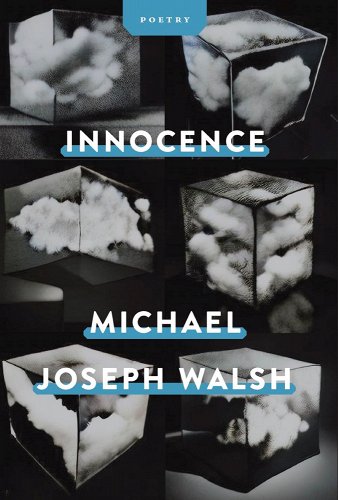
Michael Joseph Walsh’s Innocence, winner of the 2021 CSU Poetry Center Lighthouse Poetry Series Competition, reads like a book-length meditation that cycles between themes and perspectives, continually recreating the experience of consciousness seeing itself and the world anew. “Common Flowers” beautifully evokes our experience of self-perception through creating and taking in—being taken in by—creative work:
You can grow some things,
whether you want them or not.
The air that surrounds us here we call music,
the force of which is old, and full of life.
It imagines us here, and finds pleasure in the shape of our wound.
The shift from second person to plural coincides with the shift from the literal ground of growing things to imagining being imagined by the perspective of what “we call music,” a human creation that we nevertheless experience as present to our feelings. The imaginative frame portrays, as if from outside, “music” making us feel connected within the timeless life it evokes, paradoxically, by contouring to individual feelings.
“Innocence” incorporates the thinking about creating necessary to express such interplay of our feelings and intuitions with created devices that engage them. A similar awareness of the overlaps between internal and external perception opens the temporal and recurring aspects of the creative work itself:
There is another logic
by night, no flowers.
There is other than me
stretched out in the fabric of voice
to clothe and adorn
this secret. And whatever spills
into the present is the thing that will last.
And the world whose clichés we awakened is already far behind us.
The overflow of the sentence into the next stanza enacts the transformation of the “secret” actual experience into the “other than me” given form as “voice”—no possessive, in part, because the speaker occupies a self-observing perspective. Further, this depersonalized “voice,” the work itself, becomes its response to the perceived “logic” that prompted it, relatively detached both from the speaker and the intuited coherence itself. The contextualizing thought of the long concluding line underlines this separation’s literary nature by invoking clichés; however, the passion of the scene it contains infuses this thought, thus presenting the total work as both revelatory and recurrent, the future’s artifact conceived in the quick.
“Drone of Art” begins to connect these intricacies with the technologies we invent to monitor:
But not everyone speaks
the language we speak.
It is insane to know both
(as everyone touches)
the smooth brown fur,
the cobwebs spreading
across the faces of two clay cherubim,
“some drone of art”
that awakens a world.
We’ll see it out. We’ll call it our own
subterranean, the warm suede
glove of the monitored life.
Here, the non-specific “a world” evokes the permeable membrane between creator and audience consciousness, and the repetition of “we” that follows also implies transpersonal aspect of consciousness awakening through the process of each individual perceiving aspects that are unconscious in and to others. Incorporating quotation further underlines such interplay on a textual level. Such overlaps deepen in both pathos and foreboding in “Ownership”:
Conspiracy is a science
that speaks cloud,
as I remember it.
& viral is that cloud’s
fine hand over the loved
personae of our dead.
Puns on “cloud” and “viral” reflect the mirroring between technology created by consciousness and its own self-perceiving imagination, indicating the way we have unconsciously recreated in our inventions psyche’s original connective and alienating relationship with itself and the world. Our fascination with the ever-emanating mysteries of technology is, in part, related to the psychological experience of mental images of “loved / personae” that we carry in temporary defiance of death. Memories, in being present to consciousness, open awareness of our inherent ephemerality, which appears substantial because we temporarily share experiences: “To say this shadow is mine // & also mine / & so it happened here.” The ampersands brilliantly invoke this paradox: The visual replacement of the actual connecting word both enacts and belies the sharing of experiences and their afterlife as memories. In their fluidity and malleability, mental connections among memories also eerily resemble those among images produced and organized using our technologies.
When not made conscious by thought as in the poems, these psychological attachments allow unconscious mass fantasies to control the external world:
inside us,
our stronger voice
become a dream of ownership,
where the waves are born
of collective flesh,
where more is made
of love than of
our empty mourning,
money that pillows
the void & is our ghost.
The illusions of money in the ending can be experienced as substantial because they are rooted in the mind’s own illusion-making capacity. The “ghost,” projected by the mind into the future as if to negate the eventuality of death, unconsciously responds to this primal fear. The poems also respond to these innate features of the mind; however, critically, the poems support us in the process of considering the fantasies objectively rather than unconsciously following them.
In “Innocence,” the observing psyche also views its own alienating historical moment through the lens of its own apprehended fears and illusions:
There are more of us than there used to be.
To make the right
decisions we need to look at things
in different locations, returning home to mourn
the loss of being emplaced and alive,
rearing up the large in spirit
to solve the problem of a life
whose size no longer serves us.
A volcano of oil is flowing,
and we believe it,
and call it our innocence.
The ambiguity in “returning home to mourn” presents the crucial choice: Do “we” return to the home of our own awareness in order to feel “emplaced and alive”—or to an “innocence” that involves literalized belief in dominant cultural fantasies? The speaker’s response balances being—in awareness of self and world—with creating mirrors of these interdependent layers of consciousness in poetry:
only now and then at first, then always
(to quote the voice) as the golden
poem “I am breathing,” the moaning of
the I who meets the eye
in the evaporating pool.
The poem’s textual levels mirror our levels of consciousness, sometimes seeing through the “eye,” others perceiving through the broader “I” capable of contextualizing both subject and object. Creative—created—work reflects this duality, both autogenous and “golden” as breath. The experience of each work prepares us for others, strangely, in that they are each distinct because of their similar genesis. Confronting these realities can nevertheless be disconcerting; as we have seen, they bring to awareness the mortal ramifications of “the evaporating pool.”
The speaker summons a grounded resilience in response:
Because it is cruel to live,
and crueler, on this earth which is
an entire body of cherished
affinity wet feet and air, not to,
because the condition of permanent
crisis we hold
inside ourselves remembers us
in the egg of our eventual deaths,
I will write this as it occurs
The extended description of earth that separates “crueler” and “not to” is kinesthetically instructive. Its imaginative affirmation of diligent presence to life so complicates the syntactical comparison that we have to reread to remember why we were even considering anything else. Life is the only choice, and “another logic,” the process of making poems, flexibly grounds this speaker’s being.
This poetry brilliantly evokes the feeling of present awareness that animates unconscious fantasy—while at the same time forming contextualizing synapses between love and alienation, death and creation, individual experience and similarity of mind, that must be both experienced and thought to be fully realized. This book exemplifies the interdependent processes of self-reflection, imagining and thinking in cultivating poetry that witnesses and awakens psyche to itself.
Innocence, by Michael Joseph Walsh. Cleveland, Ohio: Cleveland State University Poetry Center, October 2022. 128 pages. $18.00, paper.
Michael Collins’ poems and book reviews have received Pushcart Prize nominations and appeared in more than 70 journals and magazines. He is also the author of the chapbooks How to Sing When People Cut Off Your Head and Leave It Floating in the Water and Harbor Mandala, and the full-length collections Psalmandala and Appearances, which was named one of the best indie poetry collections of 2017 by Kirkus Reviews. He teaches creative and expository writing at New York University and has taught at The Hudson Valley Writer’s Center, The Bowery Poetry Club, and several community outreach and children’s centers in Westchester. He is the Poet Laureate of Mamaroneck, NY.
Check out HFR’s book catalog, publicity list, submission manager, and buy merch from our Spring store. Follow us on Instagram and YouTube. Disclosure: HFR is an affiliate of Bookshop.org and we will earn a commission if you click through and make a purchase. Sales from Bookshop.org help support independent bookstores and small presses.
 Heavy Feather Review