
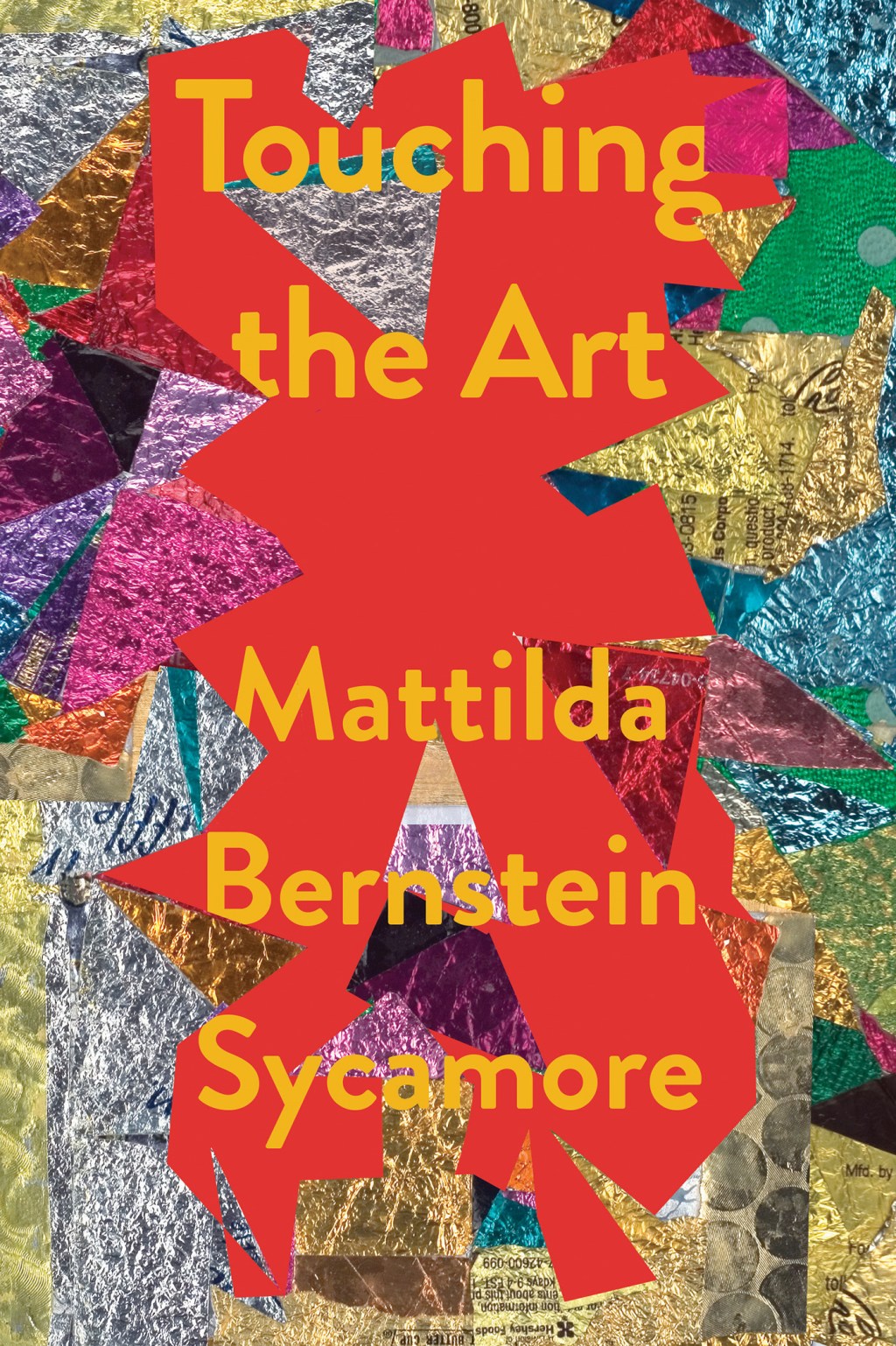
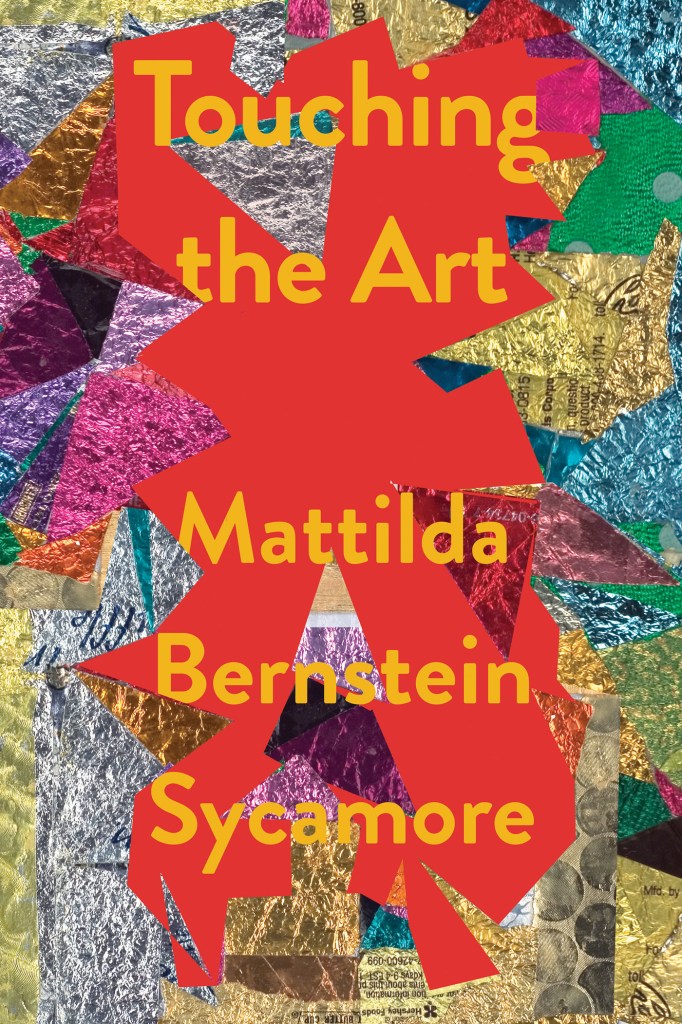
In Touching the Art, Mattilda Bernstein Sycamore examines her complex relationship with her grandmother, an abstract artist from Baltimore, and the ways in which she impacted her own ideas about what it meant to be an artist; in doing so, she examines the legacy of racism in Baltimore, her own coming out as a queer artist, and her attempt to discover the relationship of Gladys’ work to the movements of midcentury modernism and Abstract Expressionism. Sycamore moves from the present to the past in her examination of documents, letters, videos, art catalogues, her own encounters with Gladys’ art, and interviews with her friends and students.
Sycamore also remembers her fraught relationship with her parents, her father’s sexual abuse, and her family’s attempts to silence Sycamore when she confronts them about the abuse. Touching the Art is about the realization of one’s place in the world; it is a book about difficult but necessary choices, defiance of middle-class morality, and finding one’s own artistic voice. Sycamore confronts the older generation and their world in all its complexity. In this way, she can secure her own identity as a queer writer while re-orienting the past so that she can see it clearly, more vividly. But then there are always blind spots. It is in the gaps between language and reality that a kind of truth can be found. “Touching the art” involves a fight against racism and injustice as well as the liberation of finding your own voice as an artist. But the journey is never easy. Sycamore writes: “Art is never just art, it is a history of feeling, a gap between sensations, a safety valve, an escape hatch, a sudden shift in the body, a clipboard full of flowers, a welcome mat flipped over and back, over and back, welcome.”
And, later in the book, “art is never just.”
The book opens with Sycamore’s memories of rebelling against the status quo of knowledge. Gladys always believed in the importance of education fostering the ability to “think” but Sycamore “dropped out of the elite college I’d spent my life working towards because I realized this wasn’t where I would learn what I needed …” As soon as she “came into my own as a writer, as soon as my work became noticeably queer, sexually and politically saturated, she [Gladys] called it vulgar. “Why are you wasting your talent, she would ask me, over and over, until it became a refrain.” Sycamore moves to San Francisco to discover her sexual and literary identity but feels that Gladys, who never visited her there, was “threatened by my life, what she might find if she came to me instead of just seeing me when I visited her.”
The subtly erotic photos that Gladys took of Sycamore when she was nineteen or twenty seemed to delight her. And Gladys appeared proud of her at that time. Sycamore felt they collaborated: “In this photo my green hair melds into the blue-green of one of Gladys’s Emotional Squares paintings, and the blue in the painting brings out the blue in my eyes. Between person and painting, between person and person. Or I’m dancing for the camera in several shots, and one of them is just a blur of green and blue and gray and Gladys’s thumb in the frame, here we are together.”
Didn’t Gladys know Sycamore was queer then? When she comes out before moving to San Francisco, it is this very “queerness that was ugly” to Gladys. She goes so far as to say Sycamore is simply being provocative, that she is trying to shock the family, but Sycamore is “trying to let them in,” to let them experience her world.
When Sycamore confronts her father about sexually abusing her as a child, Gladys concludes a letter to her: “We all want to get on with our lives.” But what she really meant was that Sycamore’s truth was “getting in the way. When she said lives she meant lies. The family wanted to get on with their lies.” But despite Sycamore’s anger and frustration with Gladys and her family she realizes that when she was a child “Gladys told me creativity meant everything. I believed this myth, and it saved me.” Her complex relationship with Gladys leads her to research her life, and in doing so to attempt to understand the world Gladys inhabited. She begins by interviewing her friends.
While talking to Gladys’ childhood friend, Helen, Sycamore discovers that Gladys was very proud of her, and bragged about her, but never told her about it. Helen tells Sycamore that she and Gladys talked about homosexuality. Sycamore brings up the gay artist Keith Martin, Gladys’ close friend, and Helen tells her that Gladys never admitted he was different, never discussed his homosexuality. Sycamore writes: “Even though she mentions homosexuality directly, and how it affected Keith Martin’s lover, she’s still offended that her grandchild is searching for a queer legacy.” Sycamore realizes that there is more to the story and meditates on Gladys’ relationship with Keith:
I’m thinking again, about the role of gay men in Gladys’s life. Starting with Hobson Pittman [Gladys’ teacher]. And then Keith Martin. How did they enrich her thinking? And how did her relationships with them influence her feelings about me, both as a child, when she supported everything about me that set me apart as queer, and as an adult, when she supported me less and less.
Sycamore discovers that Keith, who exhibited his art in one man shows in Paris, London, and New York in the 1940s, supported Gladys as she navigated the New York art world. Sycamore meditates on the sexual identities of both Gladys and Bill, Sycamore’s father. Keith Martin gave some “ballet sketches” to Bill, which he kept, and Sycamore writes: “what a hilarious queeny gesture.”
Gladys’ neighbors give Sycamore a thirty-page autobiography that Gladys started in a sketchbook, found after her death by the new owners of her house. Of this hand-written autobiography, Sycamore writes: “Gladys thinks all the boys are in love with Helen, but it sounds like she and Helen are in love. ‘I thought of her then and think of her now as a daffodil.’”
Sycamore’s mother remarks in conversation with her: “At times there some unhealthy things going on between Gladys and Bill, like they were boyfriend and girlfriend.” Sycamore discovers sexual overtones underneath the veneer of middle-class respectability. And she reads between the lines: gender is not stable but fluid.
After divorcing her first husband, Abe Oliver, Gladys married Ed, a schoolteacher and after that, her life “would remain moored to middle-class stability. She would not live the countercultural life of Elaine de Kooning, Lee Krasner, or other women who became part of the New York School, but also she did not have to compete with a man for her autonomy.”
In the prologue to Cathy Curtis’ biography of Grace Hartigan, Restless Ambition, Curtis writes: “I discovered that Grace had entered adulthood with no goals except to escape her family.” It is well-known that the New York art world of the 50s was a man’s world. Among the exceptions, Grace Hartigan was ambitious, fearless, and judgmental, and when she moved to Baltimore from New York in the 1960s, and ended up teaching at the Maryland Institute College of Art, she was ruthless in her criticism of her students’ artwork. Gladys, who had taught for many years, including at the Maryland Institute, was known to be more generous with her criticism, and to encourage her students. A student of hers, Janet Mishner told Sycamore: “I had absolutely no idea how to make an abstract painting, Janet says, and Gladys would say just have fun … She showed me how to build composition with color.” But according to Bobby Donovan, who wrote the catalogue copy for one of Gladys’ exhibits (copy which Gladys rejected), Gladys was not a risk-taker: “Gladys turned her back on the professional art establishment, and after that she didn’t pursue a professional career, and you can’t expect the world to come to you.”
But according to Sycamore’s research, Gladys was a part of the contemporary art world as early as the 1950s, and received an excellent review by Parker Tyler in ArtNews (1957) for her one man show at the Duveen-Graham Gallery in New York; Tyler writes:
Gladys Goldstein, in her first New York one-man show, has an ingeniously modish way of giving atmospheres the density of abstract Cubism, used decoratively rather than structurally to denote objects. The complex paint-patterning, whether of Chinatown or the desert, tends to flow rapidly to the picture plane like things bobbing to the surface of water. With expertly modulated palette and palette-knife, Miss Goldstein creates an impression of appealing virtuosity.
About her one man show and gallery representation in New York, Keith Martin writes to Albert Duveen that he is “very pleased you decided in favor of Gladys Goldstein. I feel the work is outstanding in these parts. She, too, is very happy with the arrangement.”
Sycamore realizes the importance of art: “Unlike these famous men, Gladys did not gain national prominence, she did not influence generations of artists around the world, her work is not widely acclaimed, and she barely exists now in official memory, even in Baltimore. But, ‘there are things I can do that I don’t think anyone else can.’ Isn’t this the goal of every artist?”
However, writing about Gladys leads Sycamore to consider the larger world of which her grandmother was a part and the gentrification and racism that occurred over the years. White neighborhoods in Baltimore would become largely Black as a result of “white flight,” which was based on the racist fear of Blacks in the neighborhood:
Perhaps, Rouse [a land developer] felt similarly about Black residents in Cross Keys – his new development never instituted a formal quota but made sure only to allow a small number of carefully vetted Black residents across the Falls Road in the White-and-Christian-only Roland Park would not be too offended. Was this the kind of integration Gladys believed in?
Where Sycamore arrives at the many differences between her life and Gladys’, I think about how teenagers often keep journals, think about love, and about their feelings, and are inclined to write and read poetry. This is the idealism of those years. Often, these same people go to college, to study business or computer programming, and forget about that idealistic world in the pursuit of profit, as they marry and have children. This is the script. And it’s so ingrained in one’s mind that few can fight it. If you step out of this structure, you face persecution, abuse, poverty; and the world becomes dangerous and your life precarious. Gladys sought to shield Sycamore from a dangerous world, as often parents or grandparents do in an attempt make you conform, having forgotten the idealism of their own youth. Gladys was firm with her son, Bill, Sycamore’s father, who initially wanted to be a writer, and told him to pursue a different course if he didn’t want to live a life of poverty. It’s a common tale. But Sycamore rejects this path and in doing so, his father’s expectations of her as well: “I had to outdo him on his own terms. I needed to go to college, to get married and live in the suburbs with someone I hated, buy a bigger house and get a better job, and then I would win.”
Later, Sycamore finds a book, The 2015 Baltimore Uprising: A Teen Epistolary, which contains tweets about the murder of Freddie Gray by cops. This relentless police brutality is part of the racist legacy of Baltimore. One of the tweets says: “Everything they destroying can be replaced Stores, houses, cars, etc but once you take someone’s Life they gone forever.” The importance of property over human life. Another tweet: “40 years of peaceful protesting got us absolutely nothing, no recognition. As soon as we riot, every news channel and celebrity got opinions.” How to wake up the zombies? Art is never just art. While exploring her grandmother’s art, Sycamore found that behind the curtain of middle-class respectability there was a world of violence, racism, gentrification, sexual repression, urban blight. Indeed, art is never just. Reading Touching the Art, one believes again in the vision of a life that can be transformed through art. But you have to keep your eyes wide open.
Near the end of the book, Sycamore writes: “I want a history of everything that was never recorded, and all the records that have been lost. I want a history of everything left unsaid. Everything that never happened, but should have happened.” Touching the Art is just such a book. In her research, Sycamore is able to re-create a complex world, using documents, letters, videos, and other sources to imagine possibilities of communication between artists, to examine the sexual codes and to crack them, and in doing so to illuminate her own identity as a queer artist and activist.
Touching the Art, by Mattilda Bernstein Sycamore. New York, New York: Soft Skull, November 2023. 304 pages. $27.00, paper.
Peter Valente is a writer, translator, and filmmaker. He is the author of twelve full length books. His most recent books are a collection of essays on Werner Schroeter, A Credible Utopia (Punctum, 2022), and his translation of Nerval, The Illuminated (Wakefield, 2022). Forthcoming is his translation of Antonin Artaud, The True Story of Jesus-Christ (Infinity Land Press, 2022), a collection of essays on Artaud, Obliteration of the World: A Guide to the Occult Belief System of Antonin Artaud (Infinity Land Press, 2022), and his translation of Nicolas pages by Guillaume Dustan (Semiotext(e), 2023).
Check out HFR’s book catalog, publicity list, submission manager, and buy merch from our Spring store. Follow us on Instagram and YouTube. Disclosure: HFR is an affiliate of Bookshop.org and we will earn a commission if you click through and make a purchase. Sales from Bookshop.org help support independent bookstores and small presses.
 Heavy Feather Review