
If you were to put the Internet on paper, what would it look like? Perhaps this is a redundant question in 2023. The Internet has not been a separate mode of being since at least the early 2000s: it has long permeated everything we think and do. Media theorists like Nathan Jurgenson, Matthew Fuller, and Stephanie Bailey have each argued that there is no longer a distinction between “online” and “offline.” It seems only natural, then, to regard the Internet as a mainstream lens for interpretation, rather than as a novelty or niche. Perhaps this is also why the Post-Internet trend of the early 2010s did not survive as an enduring genre within the visual arts. The aesthetic characteristics of Post-Internet were not particularly remarkable or inventive, nor did they arise from a traceable political urgency. It was all about the thrill of seeing a meme-format work on a museum wall. It was a fun thrill while it lasted. But a thrill of little consequence, nonetheless.
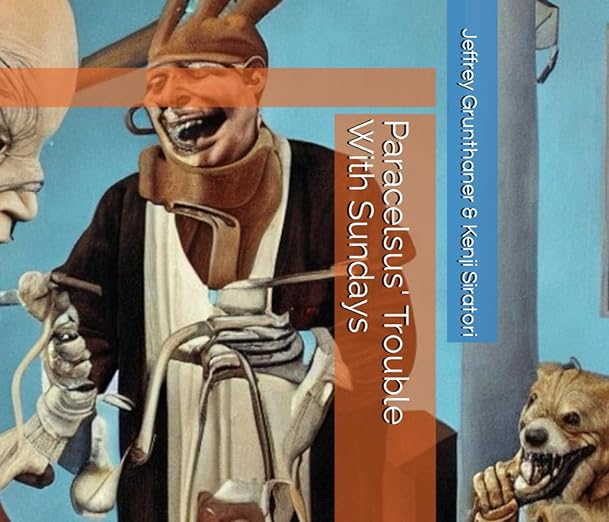
In Paracelsus’ Trouble with Sundays, Jeffrey Grunthaner explores the impact of the Internet as a narrative tool. Here, Grunthaner foregoes the Post-Internet obsession with aesthetics, and seems to ask: how does the Internet influence the way that we process information, or tell stories? The book is a collection of screenshots, images, and original artworks by Kenji Siratori, interspersed with bits of text that appear to be copied from various physical books. The collection spans about ninety pages, but besides those from the copied texts found within, they aren’t numbered. Upon my first read, I found myself flipping through the book and briefly pausing at the pages that caught my interest, only to then move on, looking for a new object of intrigue. The book had the same effect on me as my various social media feeds, in that way. If Grunthaner set out to capture the online experience and transpose it to a physical object, he succeeded. Paracelsus’ Trouble with Sundays perfectly demonstrates the state that Amanda Lagerkvist calls “digital thrownness”: that is, the state of “stumbling, hurting, and navigating within the limits and interruptions of digital existence, in search for meaning and security.” But then what about the book’s title? What does a Renaissance doctor have to do with all of this?
Paracelsus was a German physician who lived between 1493 and 1541. In the west, he is known as the “father of toxicology,” and he developed such a vast number of treatments and treatises that his name became synonymous with early modern medical practice: Paracelsianism. During the Renaissance, Paracelsus reintroduced opium to western Europe as a potent painkiller, and he is attributed with the maxim “the dose makes the poison”—now one of the basic principles of toxicology. Does Grunthaner reference Paracelsus to invoke Derrida’s notion of pharmakon, that posits the art of writing as both a remedy and a poison? I find a possible key in the second part of the book’s title. When I google “trouble with Sundays,” the top result is a blog post by a pastor from Brandon, Florida. In this post, the pastor in question complains about social media’s influence on his weekly sermons, and particularly, on his congregation. The people in his community, he writes, no longer come to Sunday service with an open mind, ready to worship and receive the word of God; but are instilled with “the discussions, vitriol [and] hatred” they gleaned from their respective timelines. “Can’t we save a single hour a week for Christian love and kindness?” the pastor asks, in a rant-like paragraph that suggests at least mild desperation. But in writing this blog post, the pastor effectively proves to have been seduced by the same force that his congregants fell for: the accessible allure of online discourse. And why wouldn’t he be, given that “the offline” has become as big a mythical state as “cyberspace” was in the 1990s?
I’m not sure whether Grunthaner composed Paracelsus’ Trouble with Sundays as a criticism or an endorsement of online narrative culture. But if it’s true that Derrida’s concept of pharmakon—consciously or subconsciously—informed the collection, a binary assessment of the kind hardly matters. The Internet does not “sedate” us. Rather, it sharpens our gaze on the present. Paracelsus’ Trouble with Sundays simulates the online reading experience through what is perhaps the last remaining “offline” medium: the book. In doing so, Grunthaner invites us to think about the spaces we associate with deep reading, and by extension, solitude and contemplation; and to open these spaces up to the contemporary mode of online gazing. How well does printed text lend itself to scrolling and sharing, or memeification and reproduction? While reading Paracelsus’ Trouble with Sundays, it is difficult to not feel incessantly thrown, in Heidegger’s original sense of the term. In this way, I’m tempted to read Grunthaner’s work as an ode to the physical book: as possibly the last medium in our culture that is still tangibly altered by the digital mode.
Paracelsus’ Trouble with Sundays, by Jeffrey Grunthaner & Kenji Siratori. November 2023. 86 pages. $20.00, paper.
Nadia de Vries is a poet and art critic. Her collections include Know Thy Audience (2023), I Failed to Swoon (2021), and Dark Hour (2018). She holds a PhD in Cultural Analysis from the University of Amsterdam.
Check out HFR’s book catalog, publicity list, submission manager, and buy merch from our Spring store. Follow us on Instagram, Bluesky, and YouTube. Disclosure: HFR is an affiliate of Bookshop.org and we will earn a commission if you click through and make a purchase. Sales from Bookshop.org help support independent bookstores and small presses.

