
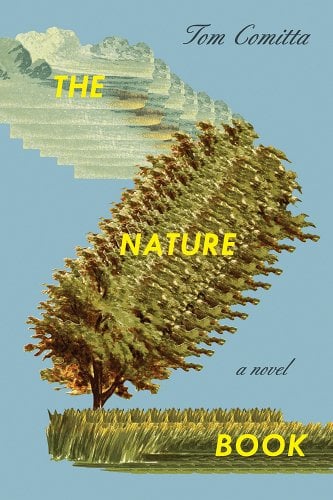
Some will be familiar with the style of experimental writing found between these covers. “This novel contains no words of my own,” the author ominously portends in the book’s short, explanatory preface. “I have gathered nature descriptions from over three hundred novels and arranged them into a single book.” The aesthetic of collage, or, more precisely, mass-appropriation, is at least as old as Moby-Dick. In an essay published on Lit Hub in 2020, while The Nature Book was well underway (it began in 2017, appearing online in excerpts), Comitta referenced Herman Melville’s deft use of appropriated material: copying whole sentences or even paragraphs from various sources; such as encyclopedias, dictionaries, Paradise Lost by Milton, and the works of Charles Darwin, to name a few. The Nature Book’s afterword is even more transparent, including a list of sources copied from. Many are fiction classics and often bestsellers; with Moby-Dick, not coincidentally, among them. The technique now has a vastly different effect overall, and a rather numbing, desultory one, at that. When you are collaging material that was entirely intended to be literature—one genre, literary fiction, specifically—in the first place. What’s missing is that palpable, subtle curatorial grace, with the nuance of broader shifting(s) of language from one distinct context into another. For risk-averse publishers anyway, this redundancy may guarantee a book will have at least some audience built-in … if you liked that old novel, you’ll love this … à la Amazon shopping recommendations, or intellectual-property-based comic book franchise films.
Every chapter in this book’s four sections is about three pages long, just as—without much exception—every paragraph is roughly eight-to-sixteen lines long:
From the long sloping field, bright little birds hovered like insects over the tree. Then birds of prey, winging from the sea, rising from the marshlands, swooped with a flurry of white wings, hovered over the wild plants of field and hill. Other aquatic birds had congregated downhill at the pond yonder—another pond just where you see the rise in the ground. These birds bent their beaks to the pond and began to drink greedily for only a moment, but in that brief instant they noticed things they had never consciously noticed before: The water was colder than anywhere else on the island. The water seemed to have icy light.
It renders each piece’s prosody, its evocation, not only laughable (silly humans with their pathetic fallacies!) but uncommunicative and colorless, as a virtually identical brick in the overall spectacle/concept of this book. The Nature Book may be undeniable as a feat of organization, but the reading experience feels overly-sterilized, like we’re walking into a cavernous, monolithic art super-gallery vacuum, outside time, social relations, aesthetics, and maybe even ethics—certainly outside plagiarism laws—as if each paragraph is mounted and framed up on an otherwise-blank wall, presented as a curiosity in itself to command our attention as all-of-one-piece. But our eyes get no peripheral relief like they do when looking at a work on a wall … because this is a novel, it’s an obstreperous traffic jam of all these paragraphs in place, a herd frozen mid-march across the Alps of the book object.
Footnotes occasionally offer salvation as they pop up bafflingly, sometimes to overwhelm what they’re supposed to be subordinated to, like some mischievous chorus, as in one chapter regarding a pastoral landscape: with a wide-shot of “… the dry grass in a Prairie of desperate Immensity … The sun had baked the land into a dry and dusty mass, with little cracks running through it … The parched fields frowned.” before the footnote below launches into a dramatic monologue all about weather more abstractly, perhaps a metaphor for the abyss of the blank page itself, a kind of feral Samuel Beckett voice resonating from nowhere:
*There, in the continental trough, is the hardest weather in the world. In winter there are blizzards, which come bearing hail and sleet and snow and ice. Hot tornadic winds, heavy clouds, torrential rains arise in the spring, and in summer the prairie is an anvil’s edge. Loneliness is there as an aspect of the land. Loneliness and silence and memory. Yes, all things in the plain are isolate; there is no confusion of objects in the eye, but one hill or one tree. To look upon that landscape is to lose the sense of proportion. Your imagination comes to life, and this, you think, is where Creation was begun.
The human voice always creeps in, with its lingering narcissism, making everything refer back to itself, even without any visible human characters or speech in quotations to anchor it. This is evidence of our constant projection onto nature, surely, how we are always ventriloquizing innocent plants, animals, and minerals, to make further avatars of our loneliness, hubris, etcetera. However, that much certainly isn’t Comitta’s fault. The author’s plausible deniability here is uniquely airtight, given how this novel was composed. Borrowed, familiar colloquialisms spin odd turns of phrase, minute inflections crop up throughout, with quick impulses towards profanity that we will recognize occasionally … how often we “damn” the same mountains, creeks, and winds around us that we might at other times praise. Various other footnotes manifest as well fertile bits of more concrete poetry, fragments of old thyme rhyming verse, onomatopoetic flourishes (the song of the bullfrogs: “Krik! Krek!” a charming cameo) or bulleted lists, archaic apostrophes, O Romanticisms, Biblical metaphors … a sort of ongoing call and response with the main act above.
Comitta has said that the nature descriptions are usually the parts of novels that people skip, and in The New Yorker, one critic fesses up that The Nature Book can be “… at times, maddening … disorienting and alienating, which is not surprising. My fear was that I would be bored …” However, they add, we really should stick with the book, as it is “… not there to prioritize a reader’s comfort but to challenge us.” The challenge may be to make it through the book at all, to forgo the pleasure of it, to simply imbibe it like medicine in our age of the ‘Anthropocene.’ Reading becomes an act of penitence, to chasten/chastise, might be more accurate. The Los Angeles Review of Books confirms this novel is an acquired taste: “You can appreciate The Nature Book as an object once you understand how it came to be.” These reviews also tend towards a kind of non-sequitur, benign what-about-ism, rife with personal anecdotes about the reviewer’s experience of climate change on the Upper East Side, childhood memories of times spent at their vacation home, or watching nature documentaries on television. The other shoe that always drops as part of the discussion of The Nature Book is a sort of new pop ecology that is being used as a core marketing strategy vis-à-vis climate change. This recycled novel will make us better people, educate us, make us more enlightened consumers; we won’t even have to actually change our consumer habits at all; never mind, wondering if this is a book that really warrants the use of the paper it was printed on. No, it doesn’t, but at least it doesn’t pretend that it does … and so it is in a way peculiarly more sentient, without actually making a difference to help the problem it identifies, like we could be, also.
It’s an oddly duplicitous song and dance, like the Officer Krupke number from West Side Story on two fronts: the ballad of someone—first the author, then the critic, then us, if we choose—openly admitting to the undesirability of what one is doing and/or what one knows is happening, while not doing anything about it. One is simultaneously claiming that said-awareness of said-issue is enough in itself; a kind of full redemption, overriding any considerations of how to actually confront the acknowledged problem and/or find solutions. Once we’re done with The Nature Book we may feel cleared of our climate crimes. All is forgiven. Thus it would seem that the novel finds its perverse strength in this reveling in a kind of surplus irony, a doubling-down … consumerism equals altruism, your slacktivism is included in the price, sorry, not sorry … to the all the trees, other plants, animals, and things that went in to making it. Still, dutifully like any number of novelists of the past, Comitta is holding up a mirror to a certain decadence in our society that is indeed unpleasant to deal with, yet this book feels more hypocritical if it really claims to be here to teach us, given the book’s choice of subject matter and the material truth of what it is.
The Nature Book was largely inspired by a seven-minute public art video installation that ran in New York City’s Madison Square Park in Spring of 2011. It consisted of pieces of nature scenes from some two-dozen or so feature films, re-rendered via animation techniques including rotoscoping, effectively re-grounding its images into an avant-garde film context, no longer the mainstream context of blockbusters like Jaws or others that it was taking from. Again, it appeared like a palliative spectacle, something to make people feel better about all the non-biodegradable packaging that came with their Shake Shack order, that they were about to throw out as they sat enjoying their lunch in the non-wild outdoors of Manhattan. The Nature Book attempts something similar, but winds up caught in a feedback loop with itself as materialistic literary escapism, offering bizarre luxury in excess, while also posing itself as a new, purely liminal form of writing, perhaps … a kind of MacGuffin literature, a placeholder as in Alfred Hitchcock’s films, a set of blueprints that we never see, an anti-object remaining illegible to the audience, but it helps move the whole plot along, or the system of literary production, in this case, something the main characters (writers, critics) always need to be chasing after. In this way, we may have arrived at a truly new genre: the book that functions as a gamified hagiography of the publishing industry itself, some kind of literary QAnon of the Left, a contest of pattern-recognition in this era of climate crisis where many industries are constantly grasping for new justifications that they should even exist at all, and furthermore grasping for appeals to an ever more fickle, fraught, and undeniably culpable consumer.
The Nature Book, by Tom Comitta. Minneapolis, Minnesota: Coffee House Press, March 2023. 272 pages. $17.95, paper.
Ben Tripp is a writer and performer from Vermont based in Queens, NYC. His writing can be found via Brooklyn Rail, BOMB, Hyperallergic, Guernica, Full-Stop Quarterly, and Gauss PDF. He was a finalist for the National Poetry Series in 2021 and received a City Artists’ Corps grant that same year. He blogs and archives work at benjamintripp.wordpress.com.
Check out HFR’s book catalog, publicity list, submission manager, and buy merch from our Spring store. Follow us on Instagram and YouTube. Disclosure: HFR is an affiliate of Bookshop.org and we will earn a commission if you click through and make a purchase. Sales from Bookshop.org help support independent bookstores and small presses.
 Heavy Feather Review