
Peripatetic
As a nomad, I’m drawn to international stories about displacement. My life drastically changed when my husband and I lost our Parisian home in the winter of 2019 and began traveling around the world. I cannot always identify why my wandering existence is as challenging as it is rewarding, so I seek out authors with similar experiences in the hope they will shine their light. What does it mean to endlessly pack up and leave, and why do we keep doing it?
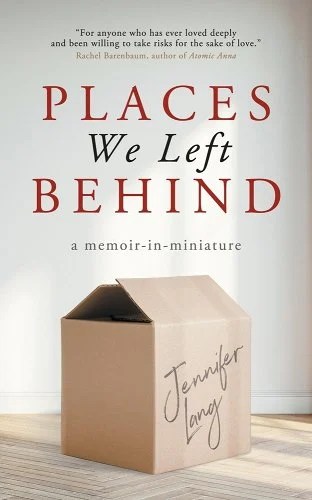
Jennifer Lang, author of the clever memoir Places We Left Behind, pines for elsewhere as a youth and ends up peripatetic. Like me, she yearns for change and adventures, but unlike me, her decisions on moving from one place to the next are complicated by career opportunities, her husband’s conflicting interests, issues of safety, and what might be best for the kids.
What Love Does
In 1987, Lang leaves her native California behind and uproots to Paris for her first job after college. Two years later, she falls in love with Philippe while on holiday in Israel. He fits every box on her imaginary list: French, Jewish, Smart, Single, and Sexy with a guarded smile. They tour Jerusalem’s sights together, roam the Arab souk, gorge on sesame pretzels and falafel, and wish for no more violence at the wailing wall. When it comes to religion and cultural practices, Philippe is more traditional than she is, yet not necessarily more than acceptable. Considering whether they should move in together, she makes a list of pros and cons that fails to do its job.
“When the negatives outweigh the positives,” Lang writes, “I tear out the sheet and toss it.”
She’s already in too deep.
Like Dried Glue
At the start of their life together, Philippe asks her a weighty question: “Do you think you could do Shabbat more like me?”
There are 39 prohibitions for observant Jewish people. On the Day of Rest, they are not supposed to bake, write, drive, use electricity, or spend money—to name a few. Lang negotiates with her partner and seems willing to adapt to his lifestyle, yet also observes, “Where he feels comfortable, I’m ill-at-ease.” And later, when she capitulates and promises to respect his rules as best as she can, she adds, “Some phantom weight slides from his shoulders onto mine.”
Urged on by parents from both sides, they get married and embark on a conjugal journey that is powered by love yet hampered by divided desires and the even heavier burden of a world at war.
Lang, who has artfully chosen an untraditional way to convey her story, incorporates diagrams, erasures, and poems into her memoir. She writes:
Stuck
Weeks before our nuptials,
1019 miles east,
Saddam Hussein invades
Kuwait and threatens to
attack Israel, and I want to
scream
—at the nonstop news
headlines, the irrational Iraqi
president,
my foolhardy decision to
abandon my plans and stay in
this unstable region—
but sound sticks to the sides
of my throat like dried glue.
Marriage Is Not a Meditation
How will they make it work with their differing convictions, in a country that sends gas masks as wedding presents and gets bombarded by Scud missiles that force the newlyweds to hide in shelters each time the shrill sirens ring?
“No one around us is hurt,” Lang writes. “On the surface, we’re untouched. But inside, in my kishkes, everything throbs.”
Despite the pervasive feeling of danger, Lang starts a family with her husband, and a son is born around the time when Israeli Prime Minister Yitzhak Rabin shakes hands with PLO leader Yasser Arafat in an attempt to create peace.
The years that follow are full of incentives for the growing family to move house between continents. Parents in France and California need care. Job offers appear too good to pass up. Lang wishes to resettle in the US, whereas her husband claims he can only root in Israel:
As our one-year-in-America agreement slides into two then three then more, elephants take cover under every rug in every room, turning the where-to-live and how-much-Judaism-to-live-by conversations taboo. We break down. Lose our bearings. Come unhinged. Wrestle, with each other, with ourselves.
Lang finds stability in practicing yoga, as a student and later as a teacher, helping others make transitions in life. But marriage is not a meditation and the deeper issues won’t resolve themselves with dedicated attention. “No matter where we reside, one of us will always rue the loss of the place we left behind.”
Brevity
The book’s subtitle is “a memoir-in-miniature,” preparing us accurately for the sharp chapters and succinct style Lang delivers. The fragmented narrative is powerful, reflecting the fragmented nature of the author’s life. Her experimental forms often enrich the content, such as the boxed paragraph about couples’ counseling, communicating how hemmed in the author feels, how only hope escapes the confinement. At other times, however, the compactness of her writing makes her conflicts seem too factual, as though she relinquishes felt experience and complex emotions for the sake of brevity on the page. Then again, the brevity enticed me to read this book twice and discover more meaning between the lines.
Whose wishes carry more weight?
The painful thread running through Lang’s moving memoir is the question of sacrifice. What should we give up for the person we love? Can you ask your wife to relocate to a country where she feels unsafe? Ask your husband to live where he feels dead? Whose wishes carry more weight? How do we stop feeding resentments?
Lang describes the commitment she feels toward her husband, the unquestioned love, and how she struggles with the compromises her marriage demands. And the opposing interests in their family are not limited to the adults. When they all live in New York, the oldest son wants to enlist in the Israeli army, and they debate whether they should move back to Israel as a family for him. But if they do, the daughters will also be drafted. How can they judge the family’s greater good? Must there always be sacrifice?
In the dimness
Places We Left Behind is a fascinating memoir about the selves we have deserted. “When did I lose my voice and become so passive in our relationship?” Lang wonders early on.
Many people invested in intimate relationships have probably asked themselves something similar. I surely did. It’s not uncommon, especially not for women, to ignore our needs and get lost in the lives of others, lose track of who we are in our effort to accommodate the ones we love. But self-desertion often leads to dissatisfaction and regret, or worse: depression. We feel bad for what we’ve sacrificed and cannot even blame the ones for whom we denied ourselves: Nobody forced us to give up our plans. We abandoned them all on our own.
“In the dimness, I think about how far I’ve derailed from my dreams,” Lang writes, “how long ago I lost my inner compass, and how desperate I am to find my way back.”
Lang makes a strong case for accepting compromises in the name of love and an equally strong case for protecting the habits and values that ground us. Read this compelling memoir to find out how her inner journey continues and whether she retrieves what she left behind.
Places We Left Behind, by Jennifer Lang. Athens, Greece: Vine Leaves Press, September 2023. 156 pages. $14.99, paper.
Claire Polders grew up in the Netherlands and now roams the world. She’s the author of four novels in Dutch, co-author of one novel for younger readers (A Whale in Paris, Simon & Schuster), and many short stories and essays. Recurrent themes in her writing are identity, feminism, social justice, and death. She’s working on her first memoir, a speculative novel, and a short prose collection. Learn more about her travels, book recommendations, and projects on clairepolders.com.
Check out HFR’s book catalog, publicity list, submission manager, and buy merch from our Spring store. Follow us on Instagram and YouTube. Disclosure: HFR is an affiliate of Bookshop.org and we will earn a commission if you click through and make a purchase. Sales from Bookshop.org help support independent bookstores and small presses.
 Heavy Feather Review