
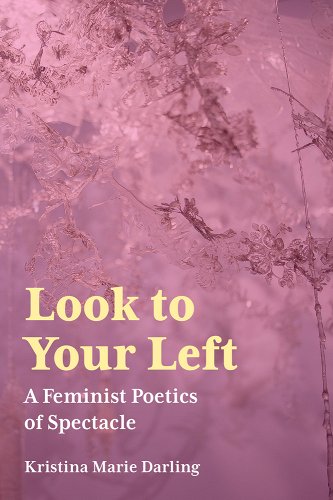
Prolific author and champion of experiment Kristina Marie Darling reveals a thriving culture of feminist poetics in this recent collection of critical essays, as well as using the lyric essay to expose the dark side of sexism in academic circles.
In a spare 140 pages, this collection has many characteristics of a conventional academic text. It cites nearly one hundred sources in about twenty essays. Such a bibliography serves as a fine introduction and map of contemporary female poets who are shaking up language, choosing to work in forms that do not cohere to an expected version, whose feminist message is sometimes overt and sometimes as subtle as breaking with form itself. Darling is a wonderful guide, purposeful and well-read. In her introduction she writes:
As the language unfolds before the reader, they are involved and implicated in a revision of what is and what has always been an unequal share of power on the stage of textual authorship and readerly interpretation.
Darling then reveals the dark side of contemporary literary communities as she experienced them herself, in an afterword that left my heart pounding with rage and recognition. It refocuses the urgency of the messages in the texts she analyzes before. While we can celebrate the working poets who have birthed these brave texts, we must also acknowledge the trials and traumas of simply being female in traditional spaces both textual and personal. In her introduction she states, “The style of the writing is part of this work’s performance.”
The first essay is a brief and accessible take on Barbie Chang. Victoria Chang’s fascinating book commands us to redirect our gaze by using interesting line breaks and taking on many layers of marginalization: to be a poet, to be female, and to be Asian. “The author’s deft stylistic maneuvers complicate and question the form narrative and artistic tradition from which the work arises,” Darling writes. Illustrated with those deft quotes, we come to understand that Chang in her fourth book of poems has freed herself to fully play in the language in service of a larger mission of social justice.
Darling builds a book with flow by referencing texts and ideas from previous essays in the collection. Repetition allows us a chance to absorb and apply these larger concepts. The effect is a book in the shape of a widening spiral. In her analysis of Virgina Konchan’s The End of Spectacle, we find a poet who “subtly and skillfully” uses fairy tales and icons to relieve female speakers of the burden of desirability: refreshing concept in a culture where the pressure on women to appear desirable is so accepted that to even consider the opposite is a radical idea. I imagine the rich discussion this essay could spark in class room setting.
Essays that explore the wildest forms are fascinating. Darling is well read and understands this landscape well. Gertrude Stein is a starting point many of us are familiar with and Darling is wise to invoke her: “…we glimpse the specter of a film reel in her unyielding repetitions” she writes of Stein when introducing Julie Carr’s REAL LIFE: An Installation, a book which “frames language as ‘a performance’ rather than that ‘familiar narrative of striving’… she breathes life into a Modernist inheritance that has been obfuscated by our culture’s predilection for clear narrative.” Isn’t that an exciting prospect? In “The Poetics of Ephemera” Darling explores the work of poets who are using white space to “loosen” the narrative grip. It is thrilling to consider these possibilities, as these poets’ works might not be easily on our radar as subscribers to “Poem-a-Day.”
Works by Chris Camponioni, Carla Harryman, and even Ilya Kaminski’s Deaf Republic receive Darling’s careful attention, all in essays that are only three or so tantalizing pages. By including Kaminski, a male writer who explores the marginalizations of being a refugee and of bring deaf, she helps broaden the landscape of the discussion of contemporary poetics beyond women. This gathering of poets, as in her previous book of criticism In the Room of Persistent Sorry (C&R Press, 2019), feels like the creation of a community in conversation within a book. Her essays in that book are uplifting celebrations centered on complex questions, and feature groupings of works which each correspond to an overarching theme. But Look to Your Left goes further by using sequencing so skillfully, and the inclusion of experimental first-person essays in the afterword.
Any woman in contemporary poetic circles will recognize the injustices that Darling has documented here in such wild style:
An empty cup, a crumpled paper, my mind already gone from the room. The conversation treading the same paragraph over and over as though it were a body of water. Needless to say, I could not speak.
So she begins “Textual Violence & the Workshop: Responding to Difficult Poetry by Women.” Here I found my heart pounding with rage and recognition. Those who dare to experiment within even experimental spaces are so often silenced, often by sheer exhaustion:
“No matter what landscape, building or campus, I remained deeply disturbed by one thing: the difficult text was almost always spoken about as if it were a female body, and as though the primarily male readers in the room were entitled to “access” it.
These three brief and poetic essays are radical and groundbreaking. Darling exposes the sexism and harassment she experienced as endemic to the systems we occupy, still. While in interviews she has discussed the violent ways her work was dismissed and her career undermined by men who demanded sexual attention, here she is able to respond in kind, in writing, in her own version, just specific enough for an audience to relate to, leaving plot lines off camera and letting the imagery do the work.
At one point she considers herself a “republic of one” at the “feminist utopia” she imagined at the academy. She compiles lists of shocking comments that were written on her poems in workshop, documenting the ways they were physically defaced, whether consciously or unconsciously referencing the body. She speaks to all of us silenced when our work defied expectations, when it was threatening for being excellent and when it was threatening for just breaking with norms, whether it was good or not. When I read the litanies of abuse that adorned the margins of her work, it felt familiar. While I promptly destroyed my own works along with the belittling comments (by male classmates who liked to write about murder), Darling has the courage and presence of mind to preserve the damning evidence, and return it to us for our own healing, to correct the course going forward, so we are not so prone to erase ourselves. Darling is a Fulbright Scholar, editor of Tupelo Quarterly and founder of Penelope Consulting among many other accomplishments. This biographical evidence of her hard-won successes after such traumas is personally inspiring and hopeful.
So this leaves the question of how to speak of another’s work, the task I am engaged in right now. Reviews can open up an audience to be receptive and they can close an audience down with a thoughtless word, Darling reminds us in Look to Your Left. Darling’s writing invites us to explore wild experimental texts by women, for the satisfaction of upending the patriarchal nature of language, and also for the sheer joy and daring of it.
Look to Your Left: A Feminist Poetics of Spectacle, by Kristina Marie Darling. Akron, Ohio: The University of Akron Press, September 2022. 140 pages. $30.00, paper.
Karin Falcone Krieger’s recent writing and visual art have been published in The Decadent Review, Tupelo Quarterly, Tofu Ink, Viewless Wings, Hunger Mountain, The Literary Review, and in the anthology, “A physical book which compiles conceptual books” (Partial Press, 2022). In 2022 she was awarded a Multi-Disciplinary Artist Residency at Bethany Arts Community. She served as an adjunct English instructor for 20 years and earned an MFA from The Jack Kerouac School of Disembodied Poetics at Naropa. She can be found writing poems for strangers at fairs and festivals on her antique typewriters. These and other projects can be seen at karinfalconekrieger.com.
Check out HFR’s book catalog, publicity list, submission manager, and buy merch from our Spring store. Follow us on Instagram and YouTube. Disclosure: HFR is an affiliate of Bookshop.org and we will earn a commission if you click through and make a purchase. Sales from Bookshop.org help support independent bookstores and small presses.
 Heavy Feather Review