
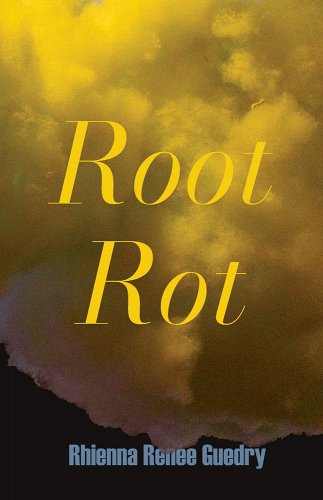
Root Rot, Rhienna Renée Guedry’s debut chapbook, piqued my curiosity for several reasons.
For as long as I remember, I’ve loved nature and the environment. I also enjoy examining the darker side of life and the psyche, and how we cope when processing experiences like loss and grief.
Furthermore, the poems were written on or inspired by the states of Oregon, Florida, and Lousiana. I’ve resided in Florida for the past several years where I’ve seen upclose some of the stressors and devastation due to climate and other changes. While I lived through Hurricane Ian, it isn’t easy to find the right words to convey the calamity and anxiety associated with catastrophic weather events. As these events become deadlier and more frequent, works like Root Rot speak to my soul in the sense of being truthful when facing impending doom.
The collection opens in a blaze of glory with “Mt. Tabor” that’s described as an “Induction to extinction— / that described you, too.” We immediately get the sense of the theme of loss that runs through this collection, along with the possibility of finding strength in “what flourishes after.”
The next few poems explore the wet, humid, and sullen conditions of living in the South. In “The Swamp is a Third-Gendered Thing,” the swamplands take on the persona of “a shapeshifter from sci-fi.” A water motif is explored through lines like:
land as uncertain as floodwaters inside a house where
water ain’t supposed to be
and
kneel down on what is land
today but tomorrow may be water
Living in low-lying land is anxiety-inducing for me, because of that uncertainty regarding housing when you live in a state that could be considered an entire flood zone. The second line sounds like a hymn, where we’re reminded of nature’s power and that we’re at its mercy instead of the other way around (and that having a sense of reverence for nature probably isn’t a bad idea).
Other poems explore coming to terms with loss from a childhood perspective. In “The Name of Streets,” we learn about what it’s like to be “Raised in the same house for twelve / years and two floods,” only to move on “five times in five years to another swamp” in another state. Or to move onto streets “where flowers used to grow.” This captures the nomadic sense of trying to find a home when you’re trying to seek refuge from the elements.
“Mildew” is a poem where we get a sense of “Understanding at twelve what rots, / what sags, what fades,” and how mildew is “a texture [that] reminds us that there is water under us all.” In “Smoke Water,” we learn how the simple action of leaving out bowls of water for birds and squirrels helps create purpose by subsiding worry. The author also recalls how “a small boat made its way through my childhood home / during its second flood.” Childhood ends when these hard facts of life have to be reckoned with, when your education doesn’t just come from books but from real life traumas.
With regard to PTSD following a hurricane or natural disaster, two of my personal favorites from this collection are “It Gets You Through” and “Disaster Planning.” The mildew motif once again makes an appearance in the former poem, where it’s stained “the walls of every / home we’ve said grace in” and is a cycle that repeats in the next year as “earnest / as seeds in the ground.” The latter prose poem is a stream-of-consciousness piece that takes place during a dinnertime conversation. In a hypothetical earthquake, the author and her loved ones hold onto the legs of a table to center on a sense of calm and love, which keeps them going “long enough for the shaking to stop.”
As a nod to the title of the collection, one more overarching theme we find is of death, rot, and departure.
We observe the preservation and burial of a hummingbird in “Some Bones are Blessings,” where the bones are “just a stain” within weeks. In “Untitled Garden Poem,” we learn how the best plants are weeds because of their instinct:
it doesn’t need us
it doesn’t need our attention
to survive
The author reveals that rot “never troubled” her in “Compartments,” while in poems ilke “Corrosion” and “I’m Back at Urgent Care in Overalls Again,” we learn how a sense of possession or permanence can be found amidst constant home repairs, and how it feels “good / to want something” amidst a familiar trauma and a “too-long silence.”
The collection ends with land acknowledgements and the author’s bio, where we learn that their “favorite geographic locations all have something to do with their proximity to water.” I get it—I love living close to bodies of water, too! Unfortunately, love is sometimes irrevocably intertwined with death, and a subtext in Root Rot is about our mortality as it relates to a time of unprecedented climate-driven disasters. There’s beauty and anguish in things ending, being upended, and scraping whatever you have left if you come out of it alive.
A reader would do well to take their time with reading this collection, to let the gravity of the words and complex concepts take root in their mind.
Root Rot, by Rhienna Renée Guedry. San Diego, California: Cooper Dillon Books, March 2023. 48 pages. $9.00, paper.
Jess Chua’s debut chapbook about heartbreak, let it rip, was published in 2023 (Bottlecap Press). A Musepaper.org essay prize winner, her poems, flash fiction, and reviews have appeared in or are forthcoming in 34th Parallel Magazine, Mystery Tribune, and Whale Road Review. Her website is jesschua.com.
Check out HFR’s book catalog, publicity list, submission manager, and buy merch from our Spring store. Follow us on Instagram and YouTube. Disclosure: HFR is an affiliate of Bookshop.org and we will earn a commission if you click through and make a purchase. Sales from Bookshop.org help support independent bookstores and small presses.
 Heavy Feather Review