
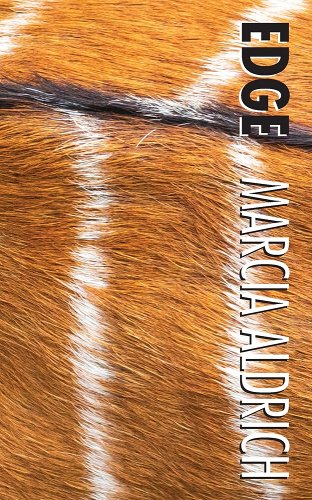
I’m reading Marcia Aldrich’s essay collection, Edge, when I get a text from a friend who is worried that he’s found bones belonging to a deer he knows. Edge is largely, though not exclusively, a book about deer, and I receive my friend’s message at the same moment I’m reading an essay in which Aldrich wonders if a roadkill deer is familiar to her. She writes:
Do I know the deer? Know is too strong a word, for it implies a human intimacy and familiarity, an explicit relationship that I can’t claim. Still, deer come through my yard regularly, and this deer may well have visited a hundred times, stood below my window while I slept, munched my hostas while I watched. When its eyes were alive, our eyes may have met.
With meditations such as this one, Edge draws us into a world defined by vulnerability. Deer, a prey species, evolved to flee wolves but have no compensatory behavior for roads and hunters. We build infrastructure on top of deer habitat while acting as if they are the intrusive species. Aldrich observes that, “This suburban environment has created what deer biologists call edge, that is, crop field juxtaposed with meadow and woods, natural preserves, and enriched residential yards.” “Edge” environments provide deer with food, water, and safety from natural predators. As their numbers grow, more deer end up dead in the road. This is a problem because deer collisions injure motorists and damage vehicles. Motorists also dislike hitting large animals.
The solution is often to kill the “excess” deer, a decision Aldrich addresses in two essays—“Edge” and “Deer Confidential.” In “Edge,” she explains, “Determining a good size for the deer population in a town like ours is not settled by figuring out how many deer the land can support. A decision also depends on what people feel about their interactions with deer.”
Like deer, we startle at perceived threats, though often the cracking sticks that send us into fight or flight are social or emotional hazards. Anxiety, trauma, self-doubt … we fear words, exclusion, humiliation as much as we fear murderers or bears. In “Deer Confidential,” Aldrich augments her narrative with strike-throughs to represent repressed or unresolved thoughts: “I can think of nothing but deer.” We accompany the writer through a “landscape of obsession” as she chronicles the appearances and disappearances of lame doe with fawns. The expanded hunt Meridian Township voted for in “Edge” provides the tense backdrop in “Deer Confidential.” The repeated line “The hunters are in tree stands, shooting down” reminds us of ever-present threats. As Aldrich ponders that “Perhaps because my mother is dead, I am writing about deer,” the hunters remain in their stands, shooting down. When she asks, “Why aren’t people strangled by doubt? I am,” the hunters wait. Deer must contend with unseen hunters, just as the writer contends with unknown social perceptions—“I am probably a minor writer; I am a deer, a minor animal.”
During a passage titled “Winter (1),” Aldrich admits, “The deer is a vision of my own vulnerability.” Reflecting on the lame doe, she writes, “I don’t know why I follow her. She is in pain, yet she is on the move all day. She anchors these fawns. Who do I anchor? I am not lame. I am not hungry. I am not hunted. Am I?” In these lines, we confront vulnerability to all the thoughts and fears that devour happiness as we live.
Three other short essays accompany the longer pieces about deer. The first, “A Chair Inhabits a Dream” recounts childhood trauma, providing a foundation for examinations of vulnerability in adulthood. “My Father’s Shoes” crystalizes a moment of adult vulnerability when Aldrich notices her husband, Richard, wearing shoes that belonged to her recently deceased father. Following Richard through an orchard, she felt that “I no longer knew exactly who I was: was I a daughter following the footsteps of my father or a wife following my husband?”
The final essay, “The Undoing (The Great Michigan Ice Storm)” subjects humans and deer to the same existential threat: our environment. Aldrich describes a storm in which freezing rain encases on all things, human-made and natural, in ice. “The weight breaks whole trees, snaps them like tinder” as Aldrich chronicles her venture out into the frozen landscape. She soon discovers a deer carcass, “recently enough killed that the blood still mixes in the snow and ice: mess of fur, bare leg bones, and fleshless rib cage.” Inside, human and deer—red flesh and tan bone—look surprisingly alike.
Face to face with death, the lines that begin “The Undoing” come back to haunt us:
12/21, 10:42 p.m.: the power goes out— Indeed, we often wait in vulnerable positions. A tyrant threatens nuclear war; we perk our ears, go back to grazing. Scientists bombard us with climate data while politicians approve oil drilling. We startle, but we can’t run from the changes we cause in ubiquitous atmosphere of the planet itself. Mining corporations, like vultures, descend on land Native Americans have used for millennia, bulldozers feeding on the innards of the earth itself. They leave dead mountains, no afterthought or care, like the deer carcasses Marcia Aldrich passes on Michigan roadsides. Her essays in Edge remind us that, like the deer, we live on the edge, vulnerable. Edge, by Marcia Aldrich. Tucson, Arizona: New Michigan Press, February 2022. 56 pages. $9.00, paper. You can find Eric Aldrich’s writing in BorderLore, Terrain.org, and HAD. His YouTube channel is @lofioutdoors. More at ericaldrich.net. Check out HFR’s book catalog, publicity list, submission manager, and buy merch from our Spring store. Follow us on Instagram and YouTube. Disclosure: HFR is an affiliate of Bookshop.org and we will earn a commission if you click through and make a purchase. Sales from Bookshop.org help support independent bookstores and small presses.
Comes on, goes out, comes on,
Goes out for good.
We wait.
 Heavy Feather Review