
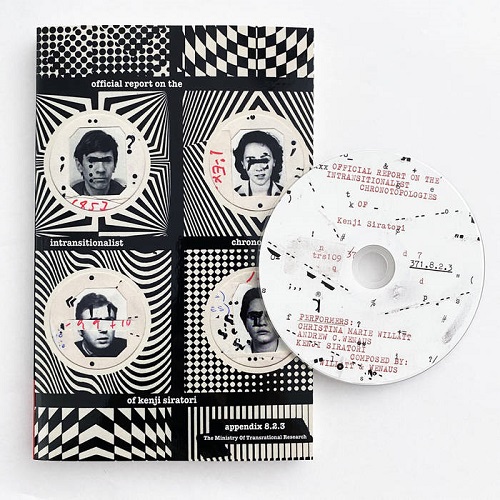
To state that Official Report on the Intransitionalist Chronotopologies of Kenji Siratori: Appendix 8.2.3 is a compelling conceptual collaboration between Japanese glitch-cyberpunk author Kenji Siratori, the Canadian electro-acoustic duo Wormwood based in London, Ontario, and a coterie of academics, writers, artists, philosophers, and other members of The Ministry of Transrational Research into Anastrophic Manifolds, is to give readers of this book review some kind of recognizable starting point into the linguistic labyrinth that lies waiting within this complex text. Reason, syntax, and logic, each familiar concepts associated with language and agreed-to by a community of speakers, are all sent tumbling sideways down the proverbial rabbit-hole by an AI-produced text created by Siratori’s own algorithmic program generator. In fact, the absurdist introduction by the not-yet deceased Andrew C. Wenaus (trust me on this one, as he continues to write under the pseudonym Andrej Shakowski) belies the often shocking, absurd, and unsettling juxtaposition of word combinations that still manage to radioactively radiate a semblance of meaning. Because we are storytellers by nature, even a baffling, fragmented, and linguistically mutated text such as Siratori’s Official Report still manages to elicit a meaningful and thoughtful engagement with us. Just ask Lev Kuleshov, who discovered a mental phenomenon in the early 20th century in which viewers were able to derive “meaning” from the interaction of two sequential shots rather than from a single shot in isolation. “Setting words in the thought realm of the kind of destiny,” writes Siratori’s AI, “you are syntactic, are in this universe because they are cyclical.” The term “because” compels us to seek a causal relationship between these various word fragments.
At first glance, we find ourselves lost in a forest of symbols that observe us knowingly. Terms reveal their denotative qualities, only to withdraw and transpose themselves into something else that has not yet been deciphered. Words and phrases repeat themselves hysterically, psychotically, and obsessively, as if the AI is free associating a new dream language that dares us to grasp its final meaning. Who or what is recollecting the “word poetry and modulations [that] contributes to the primordial chakras gateways alive throughout the universe”? AI language is perhaps the closest manifestation we have to the purest form of a dream language in which logic and syntax are conspicuously absent. No laws or symbolic order govern this language or its thought processes. On the contrary, the text appears to suffer from data panic brought on by dada issues. “My variant exists like a nasty script and generational brain explosion triggers automatically,” writes Siratori’s AI. Yet, if we choose to engage intelligently, poetically, and schizophrenically with the alchemical possibilities of this remarkable book, then the meaning of individual words and phrases, which is what the metaphoric nature of language is designed to convey, begin to emerge from out of this fractured, fractal, and otherwise illogical AI-generated avant-garde text. The obsessive recurrence of key terms results at once in a kind of defamiliarization, a strange feeling of familiarity, and a sense of recognition-through-repetition. Granted, “the self-connecting language is still backwards,” especially given its radical syntax, words with multiple meanings, and descriptive imagery. Nevertheless, the “insane fluidity” of the text challenges us to engage with it, Janus-like, by adopting an approach that looks forward to deciphering mutated forms of asemic or anastrophic writing, yet backward to older psychoanalytic reading strategies that center on identifying discharges of affective feelings. If we listen carefully, the text does speak to us, obsessively so, about a cannibalistic urge to devour all that confronts it (including language?), a Lemurian longing to discover a “lost continent,” and constant catabolic releases of destructive energy that break down the complexity of written language into an even simpler one of individual words. “You will need to be revealed to enjoy the unconscious automatically pointing in the desired direction,” Siratori’s AI remind us.
What must be kept in mind when using a bi-directional reading strategy is to distinguish between meaning, or the sense or significance of an individual word, phrase, or symbol, and interpretation, or the result of elaborating the particular point of view of an artistic work. Siratori’s AI-generated text continually resists interpretation by refusing to yield to a consistent or final point of view. On this fact, Siratori’s avant-garde prose poem succeeds brilliantly in tentatively pointing toward a final significance, before quickly turning away toward a new set of mutated terms. This “literary language reverses gravity,” writes Siratori’s AI-text, “and it is also a post-human text, avant-garde.” Asemic writing has no specific semantic content or unit of meaning. Yet, because of our storytelling tendencies (and occasionally eavesdropping on someone else’s conversation), we feel compelled to fill in the vacuum created by a lack of meaning by searching within the text for signifiers from their own life experiences. Herein lies the critical engagement we have with the text. But be warned, though, the shamelessly illogical (and often humorous) footnotes, which are simply digressions within digressions, are of little help. Does the text actually need interpretation? As Susan Sontag points out, to interpret is to impoverish, to deplete the real world of its ambiguity and complexity—in order to set up a Platonic shadow world of “meaning.” To turn Siratori’s AI-generated world into our recognizable world defeats the collaborative and multi-voiced intent of the text. To engage instead with its meaning is to try to understand the text on its own terms, to seek out the significance of its obsessive compulsions. By doing so, we become less concerned about the representational power of a given term than we are in processing of ideas originally inputted into the AI.
Guy Debord is correct to state that since the end of WWII we have been speaking the language of manufacturing, that is, the language of mass production, consumption, and advertising. Shaped by the pervasive forces of capitalism, language has become increasingly reductive, functional, and informational, as it continues to empty itself of its own poetic and connotative powers. For Roland Barthes, power resides in and through language. Language is a form of classification and all forms of classification are oppressive. To speak or write the “functional” language of power is not to communicate; it is to name and subjugate the known world. As a performative act, language is neither reactionary nor progressive, it is simply fascistic. Here, fascism is not about preventing people from speaking, it is about forcing them to say something. More recently, Michel Bounan has identified the rising phenomenon of alexithymia, which refers an individual’s inability to identify and express emotional states of being. Emotional states can no longer be expressed through language; instead, individuals either lash out at the perceived cause of frustration or narcotize the offending emotional state through drugs and alcohol. In the end, language cannot describe the spiritual energy (chakra) coursing within our body. Not surprisingly, individuals who suffer from alexithymia often have difficulty maintaining social or personal relationships. To counter the impoverishment language has experienced since the middle of the last century, the terrorizing force of AI poetry and literature should be welcome in all its forms. Not T800s crushing the skulls of speaking subjects, of course, but rather AIs decimating the reductive functionality of language into its constituent parts. Given the untapped potential of AI-generated prose to actively demolish the capitalist reification of language and unmoor words from congealed connotations, it seems almost ironic that it takes a computer-generated voice to remind us of our own humanity.
Official Report on the Intransitionalist Chronotopologies on Kenji Siratori: Appendix 8.2.3, by Kenji Siratori & The Ministry of Transrational Research. Soundtrack by Wormwood. Alameda, California: Time Released Sound & Time Sensitive Materials, September 2023. $23.00, standard book/CD.
Edward J. Matthews teaches philosophy, writing, and communications in the School for Language and Liberal Studies at Fanshawe College in London, Ontario, Canada. He is also a part-time lecturer and instructor at the Centre for the Study of Theory and Criticism at Western University. His most recent publications include Arts & Politics of the Situationist International 1957-1972: Situating the Situationists (Lexington Books, 2021) and Guy Debord’s Politics of Communication: Liberating Language from Power (Lexington Books, 2023). He is currently working on a new book, In the Shadows of the Enlightenment: The French Philosophes and the Rise of Materialism.
Check out HFR’s book catalog, publicity list, submission manager, and buy merch from our Spring store. Follow us on Instagram and YouTube. Disclosure: HFR is an affiliate of Bookshop.org and we will earn a commission if you click through and make a purchase. Sales from Bookshop.org help support independent bookstores and small presses.
 Heavy Feather Review